


AI Boom Reshapes US Markets with Rising Financial Risks
Hyperscaler bonds, shadow borrowing and private credit now fund the AI build-out. A dated look at supervisors' warnings from late 2025 to October 2026.
The artificial intelligence build-out in the United States shifted from an equity story to a funding story in late 2025. When this article first ran on November 28, 2025, the largest technology companies were issuing long-dated investment grade bonds, signing multi-year leases and drawing in private credit to finance data centers, GPUs and cloud platforms, while AI-driven deals added leverage across the capital stack.
Supervisors noticed. The International Monetary Fund's October 14, 2025 Global Financial Stability Report warned that equity valuations were stretched and that concentration in a handful of AI-related firms was at historical highs. Three weeks later, the Federal Reserve's November 7, 2025 Financial Stability Report listed a turn in AI sentiment among the risks most frequently cited by its market contacts. This update keeps the original analysis, uses primary-source figures and adds a dated section on what has happened since, through October 30, 2026. It is news analysis, not investment advice.
Key takeaways
- AI capital expenditure is moving from operating cash flows to debt. The Bank for International Settlements (BIS) reports that hyperscaler gross bond issuance topped $100 billion in 2025, mostly at maturities above five years.
- Central banks and the IMF are warning that AI risks are stacking across equity, credit and private markets, so a reversal in AI expectations could travel through several channels at once.
- Enterprises and investors need disciplined AI funding decisions, stress testing and scenario planning rather than assuming cheap credit and exponential demand will persist indefinitely.
How the AI boom is reshaping US credit markets
The AI race has become a capital-intensive infrastructure project. Hyperscalers and large technology firms are borrowing at scale to fund data centers, fiber, power and specialized chips, rather than relying solely on retained earnings. In January 2026, BIS economists described the shift in a bulletin titled Financing the AI boom: from cash flows to debt, arguing that the size of planned investment will require firms to move from operating cash flows to borrowing, with private credit playing a rapidly increasing role.
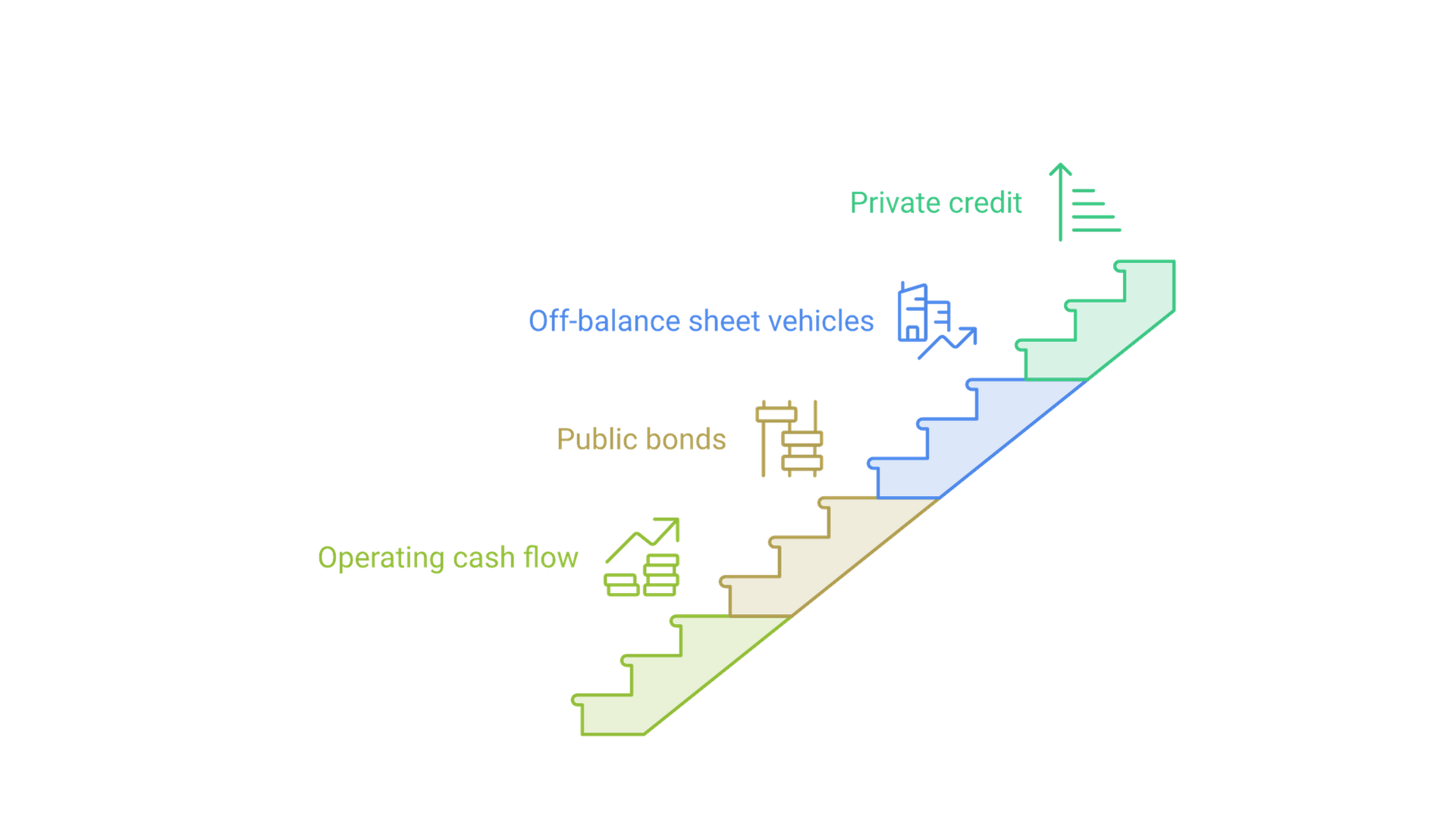
The funding mix now has four layers: internal cash, public bonds, off-balance sheet vehicles that lease capacity back to the hyperscaler, and private credit. Each layer has different investors, disclosure standards and refinancing risk.
Investment grade debt issuance at record levels
For fixed-income investors, the shift is visible in the issuance data. According to Box A of the BIS Quarterly Review published March 16, 2026, hyperscalers' gross bond issuance increased markedly and topped $100 billion in 2025, with most of it carrying maturities longer than five years. Long tenors match the life of data center shells, but they also lock in demand assumptions for a decade or more.
Crucially, these are not distressed issuers. The large platforms carry strong ratings and robust cash flows, which kept spreads relatively tight through most of 2025. The early signs of friction came at the margin: the BIS Quarterly Review of December 2025 noted that recent technology bond issues for data centers were not received favorably, with spreads ticking higher, while private credit deal-making cooled amid concerns about lending standards.
The risk is subtler than default. The same theme, AI, drives equity valuations, capex decisions and bond supply at once, so risks converge and stack. For CIOs and CFOs, AI investment is not just a technology strategy; it changes the firm's position in credit markets and its refinancing calendar.
What the Fed and the IMF said in late 2025
The IMF's October 2025 Global Financial Stability Report, titled "Shifting Ground beneath the Calm," estimated that US equities were overvalued by about 10 percentage points relative to its fair-value model. It added that concentration risk in the S&P 500 was at a historic high: the IT sector accounted for 35 percent of the index, similar to the dot-com bubble, with the Magnificent 7 alone at 33 percent.
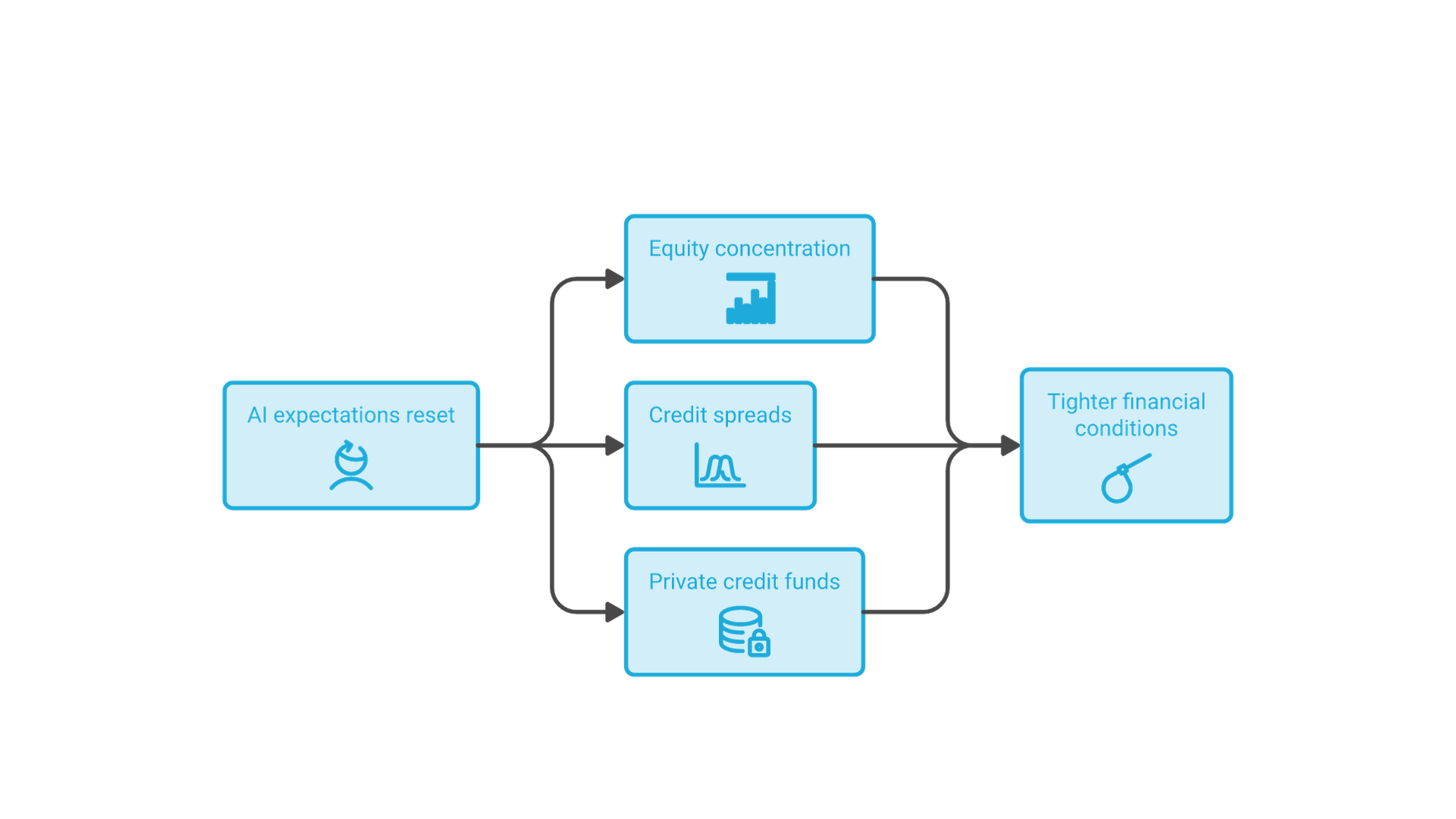
The Federal Reserve's November 2025 Financial Stability Report found asset valuations elevated and reported that concerns about AI were frequently cited in its survey of market contacts. Participants warned that a turn in sentiment toward AI, which had been viewed as a main driver of equity gains, could lead to large losses in private and public markets and, if declines were large enough, a further slowdown in the labor market and tighter financial conditions.
M&A, leverage and the new AI capital stack
Debt issuance is only one part of the picture. The other is a wave of acquisitions, strategic stakes and supply agreements built on one narrative: secure AI capabilities now, integrate later. AI is driving horizontal consolidation, such as buying AI start-ups and cloud-adjacent services, and vertical integration into energy, data center real estate, networking and chip design. Access to accelerators is a strategic constraint in its own right, as our analysis of how NVIDIA defends its AI chip edge explains.
From balance-sheet cash to bond-funded AI expansion
A few years ago, Big Tech was defined by enormous net cash. Today the same companies issue multi-tranche bonds to accelerate AI infrastructure. The result is a capital stack that looks different from the pre-AI era: less reliance on internal cash, more long-term fixed-rate debt, and more contingent obligations tied to data center leases, chip supply contracts and power-purchase agreements.
For boards, this raises governance questions. AI is a series of overlapping bets in models, infrastructure and product integration rather than one project with an obvious payback. GPUs depreciate on a much shorter cycle than buildings or grid connections, so funding long-lived debt against short-lived hardware creates a mismatch that deserves explicit review.
Private credit and asset-backed AI financing
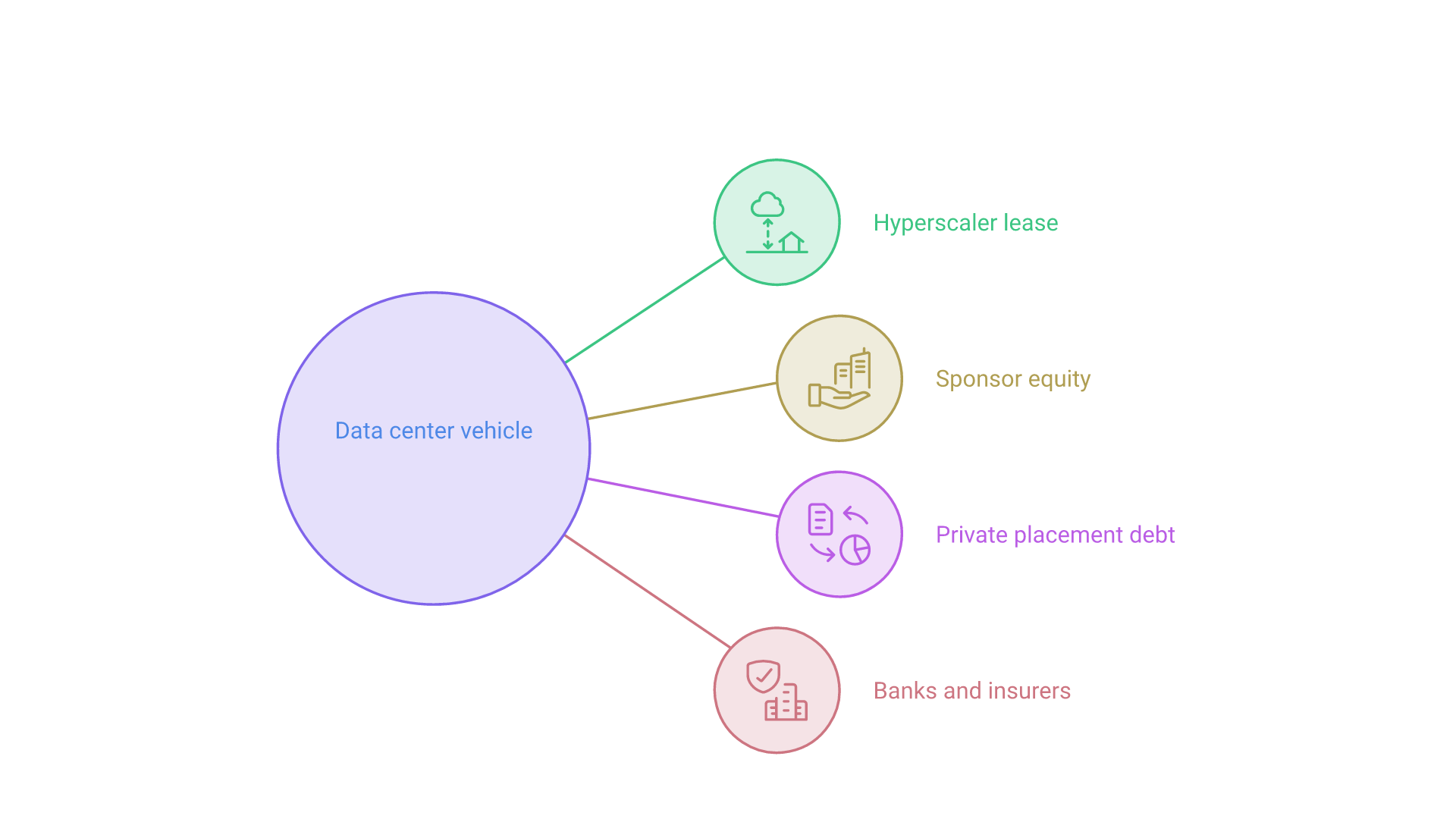
The bond market is only part of the story. The March 2026 BIS box describes a common structure: a dedicated joint venture or special purpose vehicle acquires or develops data center assets, raises equity from a sponsor consortium and debt through private placements, while the hyperscaler holds a minority stake and commits to long-term leases or capacity offtake. Upfront capital expenditure becomes multi-year operating cost, and most of the debt stays off the hyperscaler's balance sheet. The BIS authors call this "shadow borrowing."
The advantage is speed and flexibility. The downside is opacity. Banks provide funding lines to these vehicles, while private credit funds and insurers are key investors, which the BIS warns could create new channels for shocks through refinancing pressure or the activation of guarantees. It also makes aggregate leverage harder for regulators and investors to see.
Enterprises that consume AI services inherit this indirectly: cloud dependencies carry exposure to providers' capital structures. Capacity pricing, contract terms and the choice between cloud, colocation and on-premises inference belong in the same conversation, which our guide to AI inference infrastructure considerations covers from the workload side.
Are we building an AI-driven debt bubble
Comparisons with the dot-com era are inevitable. Earlier capex booms in telecoms and shale energy ended in write-downs when debt-fueled investment outpaced sustainable economics.
In late 2025, supervisors stopped short of calling the AI cycle a bubble. They described valuations as stretched and warned that a repricing of AI expectations could trigger broader corrections, a framing that has held through 2026.
Comparisons with past capex cycles
There are important differences from earlier episodes:
- Today's leading AI firms are profitable, diversified and systemically important in ways early dot-com companies were not.
- AI infrastructure such as power, chips and data centers has tangible residual value, even if specific applications fail.
Yet the risk patterns rhyme with history:
- Investment is front-loaded and highly correlated around a single theme.
- Capex decisions rest on aggressive adoption and pricing assumptions.
- Debt investors accept relatively thin spreads for complex and evolving risks.
The more useful question is not whether AI is a bubble, but where losses would concentrate if expectations fell sharply.
Where the real systemic risks may sit
Supervisors have highlighted several specific risk channels:
- Concentration in a small number of large issuers and equities, so stress in one or two names could reverberate across passive equity and bond indices.
- Large, sustained issuance waves that could affect Treasury and investment grade market liquidity.
- Private credit and structured vehicles that may transmit stress outside traditional bank balance sheets, into less transparent corners of the system.
- Circular financing, in which AI firms invest in each other and buy each other's products, so revenue and funding depend on the same expectations.
Solid earnings and liquid markets have so far cushioned these risks, which makes now, not a future crisis, the time to interrogate assumptions.
What has happened since: November 2025 to October 2026
The supervisory record since the original article shows the AI financing concern moving from a footnote to a headline risk:
- January 7, 2026: BIS Bulletin 120 argues that AI investment will shift financing from operating cash flows to debt and that the boom's durability depends on AI firms meeting high earnings expectations.
- March 16, 2026: The BIS Quarterly Review reports hyperscaler bond issuance above $100 billion in 2025 and documents off-balance sheet "shadow borrowing" through data center vehicles.
- April 14, 2026: The IMF's April 2026 Global Financial Stability Report focuses on the war in the Middle East and amplification risks.
- May 8, 2026: The Fed's May 2026 Financial Stability Report says equity valuations remained high; geopolitical risks and an oil shock top its survey, while AI-related risks, especially equity valuations, and private credit receive greater focus.
- October 13, 2026: The IMF's October 2026 report names an AI-related asset correction among three risks that could trigger market turmoil.
- October 27, 2026: BIS Bulletin 140 finds that a rising share of AI capex is financed with long-term debt and complex off-balance sheet arrangements.
The October 2026 IMF analysis is the most specific so far. In a blog accompanying the report, IMF staff wrote that faltering AI investment and profitability could challenge optimistic expectations, that hyperscalers are borrowing more and investors have been using leverage to buy AI stocks, and that a review of 14 financing deals between AI firms since 2023 found about $300 billion of equity and $650 billion of debt, exchanged for roughly $1.4 trillion of future revenue commitments. The report itself warns that corrections could be amplified by rising leverage and concentrated exposures.
The BIS adds a partial reassurance. Bulletin 140 found that on AI-financing news days in 2026, spillovers to US Treasury and investment grade bond markets were small and short-lived, but that sustained issuance at the current pace could change this. The Fed's May 2026 survey also noted that private credit faced increasing pressure from investor redemptions. The original warning has not been resolved; it has become more precise.
What this means for enterprises, CFOs and boards
For corporate leaders, the AI funding wave directly affects capital structure choices, the cost of capital and the risk profile of strategic plans, even at companies that never issue an AI bond.
Rethinking AI investment under tighter financial discipline
A common early-stage stance has been that everyone must spend on AI to stay competitive. That may be directionally true, but it is not sufficient for capital allocation. Boards should insist on AI investment frameworks that:
- distinguish between core, adjacent and speculative AI projects;
- quantify expected financial and non-financial returns under multiple scenarios;
- factor in the cost and flexibility of funding sources such as cash, equity, bonds and private credit;
- build in review points or stop-loss mechanisms rather than treating AI capex as irreversible.
Those review points work best inside an existing control structure, and an enterprise AI governance framework gives boards a place to record ownership, risk tiers and evaluation criteria. Organizations that lack internal experience in sequencing these programs can use technology strategy consulting to connect the AI roadmap to budgets, vendor choices and measurable outcomes.
Implications for financial institutions and investors
Banks, insurers and asset managers face a dual exposure:
- direct holdings of AI-linked corporate bonds, loans and private credit;
- indirect exposure through indices, ETFs and structured products tied to technology and credit markets.
Risk teams should stress-test portfolios against slower AI adoption, eroding pricing power or higher capital costs, looking beyond headline ratings to:
- issuer-level reliance on AI-related revenue and on lease commitments to a few tenants;
- concentration in specific names or sectors across credit portfolios;
- liquidity resilience if spreads widen or fund redemptions rise.
For lenders to AI infrastructure, understanding workloads, utilization and hardware obsolescence is becoming as important as traditional project finance metrics.
Strategic playbook for enterprises in the AI debt era
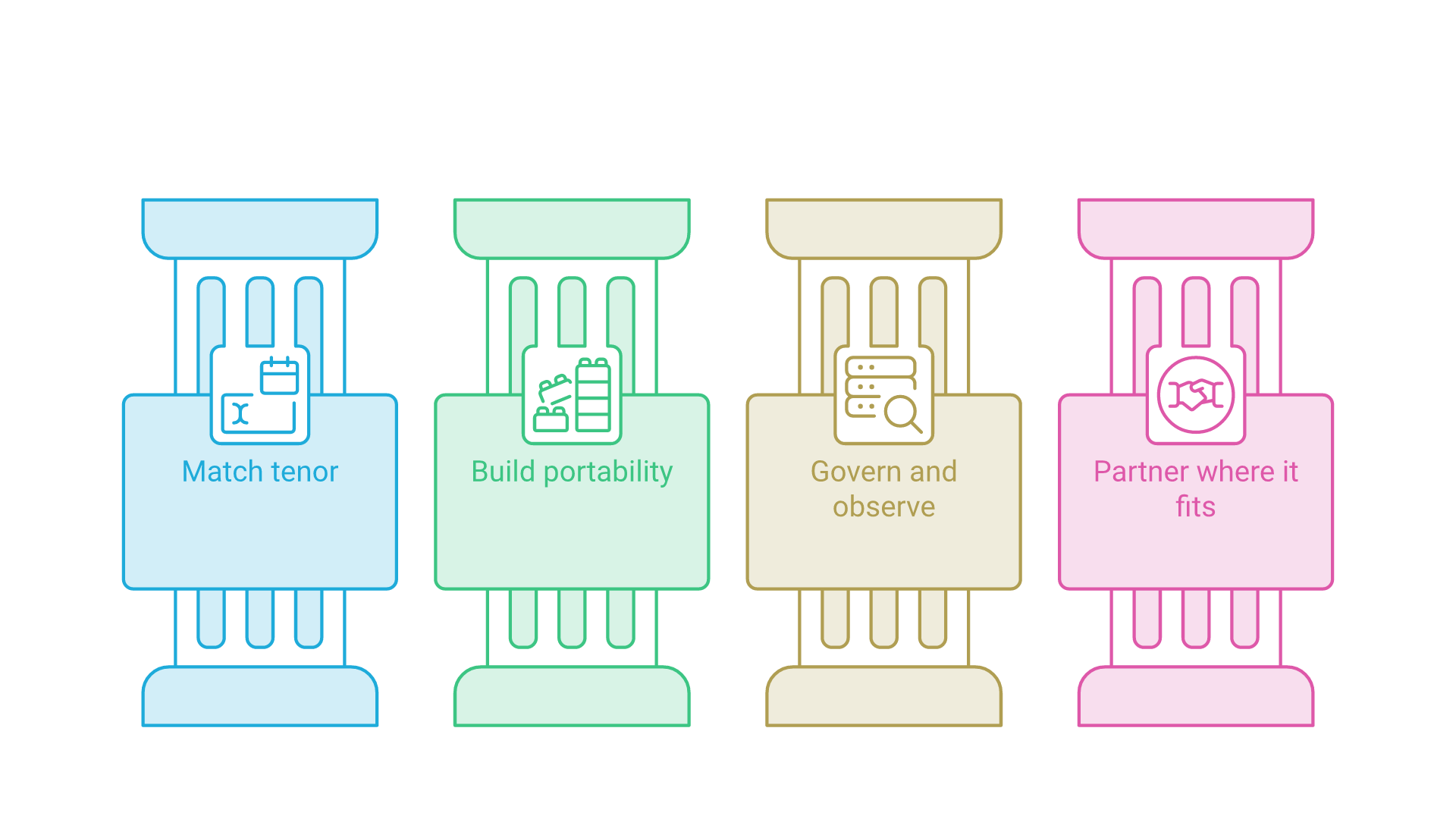
The AI debt wave is not inherently negative. Long-term, fixed-rate funding of productive infrastructure can be a rational response to a technology shift; the challenge is execution and risk management. A practical playbook has four moves.
Align the AI roadmap with capital strategy. Treat AI initiatives as part of the corporate plan, not a side project. Match funding tenor to asset life, and avoid stacking short-term funding on long-term bets.
Build optionality into infrastructure choices. Favor architectures that allow workload portability and modular upgrades over monolithic commitments. Designing for portability from the start, as in AI-first architecture, reduces the risk of being locked into stranded capacity if economics or regulation change.
Strengthen governance and observability. Hold AI initiatives to the same governance, risk review and post-investment evaluation as other major capex, and track utilization and unit costs after launch.
Consider partnership models. Not every enterprise needs to own full-stack AI infrastructure. Cloud, managed services or joint ventures can reduce balance-sheet intensity, provided contracts cover capacity, pricing and exit terms.
Frequently Asked Questions
Is the AI boom a financial bubble?
Supervisors have not called it one. The IMF, the Fed and the BIS describe valuations as stretched and warn that a repricing of AI expectations could cause a correction amplified by leverage and concentration.
How are tech companies financing AI data centers?
Through a mix of operating cash flow, long-dated investment grade bonds, off-balance sheet vehicles that lease capacity back to hyperscalers, and private credit. The BIS calls the off-balance sheet part "shadow borrowing."
What did the Fed say about AI in its Financial Stability Report?
In November 2025 the Fed's market contacts frequently cited a turn in AI sentiment as a risk. In May 2026, AI-related risks, especially equity valuations, were in focus alongside geopolitics, an oil shock and private credit.
Why does private credit matter for AI risk?
Private credit is less transparent than public bonds and is increasingly used to fund AI firms and data center vehicles. Stress there could spread through banks, insurers and funds that are harder for supervisors to monitor.
Could an AI correction affect companies that do not build AI?
Yes. A correction could tighten financial conditions, change cloud pricing and capacity, and affect vendors' capital structures, so AI consumers face indirect exposure.
Conclusion
The AI boom is no longer only an innovation story; it is a funding story reshaping US credit markets and corporate balance sheets. Hyperscaler bond issuance passed $100 billion in 2025, off-balance sheet vehicles and private credit are carrying a growing share of the build-out, and by October 2026 the IMF ranked an AI-related asset correction among the main risks to global markets.
For enterprises and investors, the message is not to retreat from AI, but to raise the quality of decisions about how it is financed, governed and scaled. Disciplined capital allocation is what makes an AI strategy resilient if the thesis unfolds more slowly than headlines suggest.
If your organization is reassessing its AI roadmap, infrastructure commitments or vendor strategy in light of these dynamics, talk to Cognativ about your AI plans.