

AI in Fintech: Use Cases, US Rules and How to Start in 2026
How fintechs use AI for fraud, credit and identity checks, which US obligations each use triggers after the 2026 changes, and how to launch a first model.
Fraud scoring, credit underwriting, identity checks and support assistants now make or shape decisions inside lending apps, payment platforms and neobanks, often faster than any human reviewer could. That is what AI in fintech looks like in production.
Each of those decisions sits under a US rule that existed long before machine learning arrived, and several of those rules changed in 2025 and 2026. This guide covers the use cases, then maps each one to the obligation it triggers today and shows how a fintech can start without rebuilding later.
What AI in Fintech Means in Practice
AI in fintech means using statistical and machine learning models, and more recently large language models, to decide or recommend actions on money, credit and identity.
Two families of technique do most of the work. Predictive models, such as gradient-boosted trees and neural networks, take structured inputs like transaction history, device signals and repayment records and return a score: the probability that a payment is fraudulent, that a borrower will default or that an account belongs to a synthetic identity. Language models read and write unstructured text, which suits customer messages, document review and case summaries for analysts.
The practical difference from older rule engines is how logic is maintained. A rule engine holds conditions a person wrote and can explain line by line. A trained model learns its weights from data and can drift as customer behavior changes, so it needs monitoring, retraining and a way to explain individual outcomes. That last requirement is the point where regulation applies, because a lender, a payment company and a bank partner each have to show why a specific customer got a specific result.
Five Fintech Use Cases Where AI Already Makes Decisions
The use cases below appear in almost every fintech roadmap. Each is described by the decision the model makes, since that decision determines which rules apply and how much review it needs.
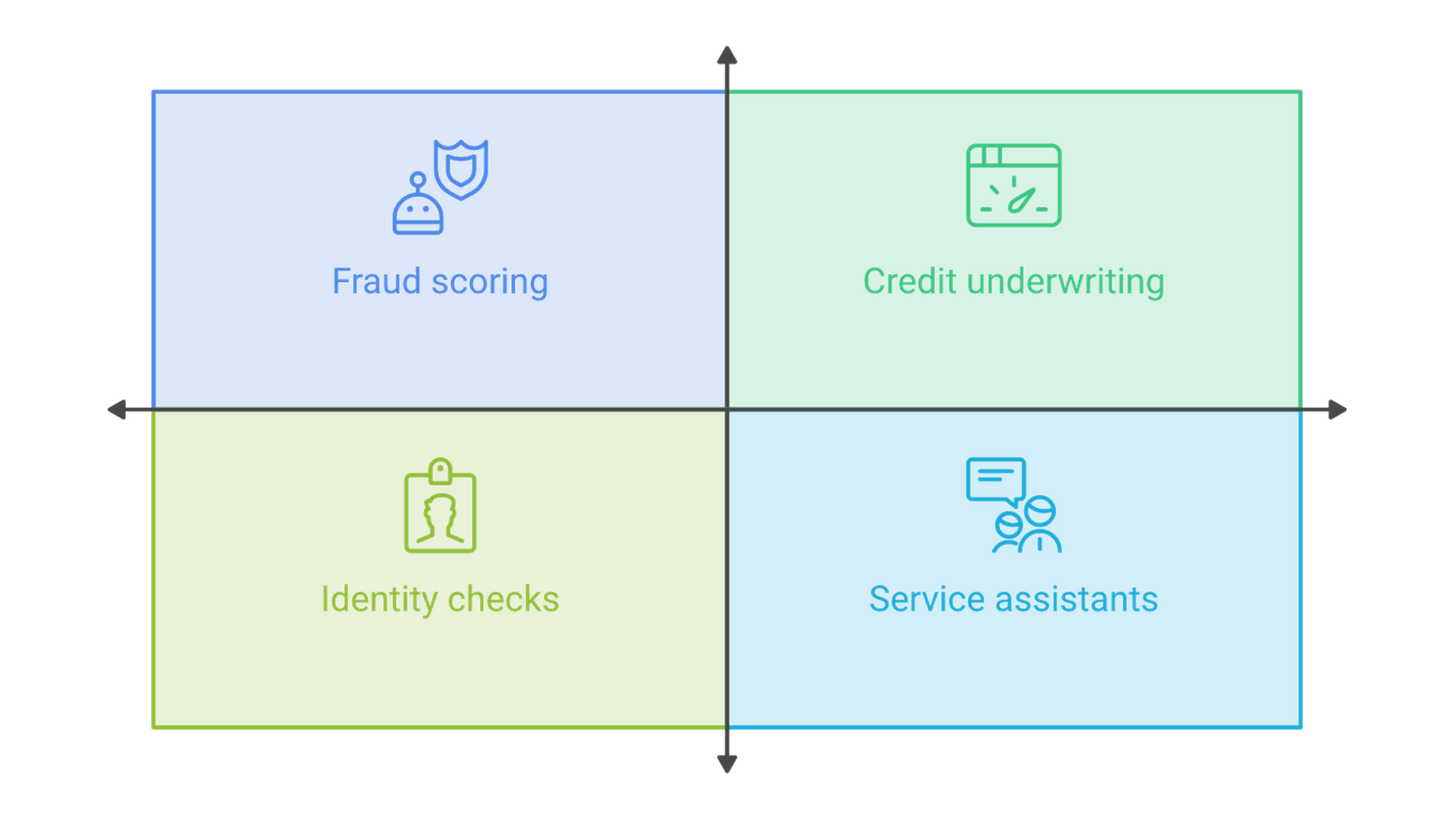
Fraud detection and transaction monitoring
Fraud models score each payment, login or account change in real time and decide whether to approve, challenge or block it. The stakes are large: the Federal Trade Commission said in June 2026 that people reported losing about $16 billion to fraud in 2025, with imposter scams behind nearly one in three fraud reports. The hard part is the trade-off between false declines that frustrate good customers and missed fraud that costs money. For the payment side of this problem, our guide to how AI improves fraud detection and risk in payments goes deeper into real-time payment risk scoring and fraud models.
Credit underwriting and pricing
Underwriting models estimate default risk and set approval, credit line and price. They can use more variables than a traditional scorecard, which is also why they are the most regulated AI use in fintech: every denial or worse offer generates a legal duty to explain it.
KYC, AML and identity verification
Onboarding models compare documents, selfies and data sources to verify identity, while monitoring models flag unusual activity for anti-money laundering review. They speed up good customers and prioritize alerts, but the institution, not the model, remains responsible for deciding whether to file a suspicious activity report.
Customer service assistants
Language-model assistants answer balance, dispute and payment questions, draft replies for agents and route complex cases. Their risk is wrong or incomplete answers about fees, disputes or rights, which turns a support tool into a consumer protection issue.
Personalization and collections
Recommendation and propensity models choose which offer, reminder or repayment plan a customer sees. These look harmless, yet the same fairness and disclosure questions apply when they steer who gets which credit offer.
Which US Rule Each Fintech AI Use Case Triggers
The US has no single AI law for financial services. Obligations come from consumer credit, data security, anti-money laundering and bank supervision rules that apply to the decision.
The table maps the five use cases to the main federal obligation each one touches. It is a starting point for counsel and compliance, not legal advice, and state laws can add more.
| Use case | Main US obligation | What it asks of the AI system |
|---|---|---|
| Credit underwriting | ECOA and Regulation B (CFPB) | Specific principal reasons for every adverse action; no discrimination on protected bases |
| Fraud and AML monitoring | Bank Secrecy Act; FinCEN customer due diligence rule | Ongoing monitoring and suspicious activity reporting by covered institutions |
| Identity verification | FinCEN customer due diligence rule | Identify and verify customers and beneficial owners |
| Any model at a bank partner | Interagency model risk and third-party guidance | Validation, monitoring, governance and vendor oversight |
| Any model using customer data | FTC Safeguards Rule (nonbank financial institutions) | Written security program, encryption, access controls, breach reporting |
Two points shape how a fintech reads this table. First, many fintechs deliver accounts or loans through a partner bank, so they inherit the bank's supervisory expectations by contract even when they are not banks. Second, the rules care about outcomes: a model that cannot produce reasons, logs or validation evidence will struggle to meet these obligations or pass a partner bank's review, however accurate it is. Teams that build regulated products in this sector can see how Cognativ approaches software and AI work for fintech companies.
AI Credit Decisions Still Need Specific Adverse Action Reasons
Regulation B sets the most precise rule for AI credit decisions: a written notice with specific reasons whenever a creditor denies an application or offers worse terms.
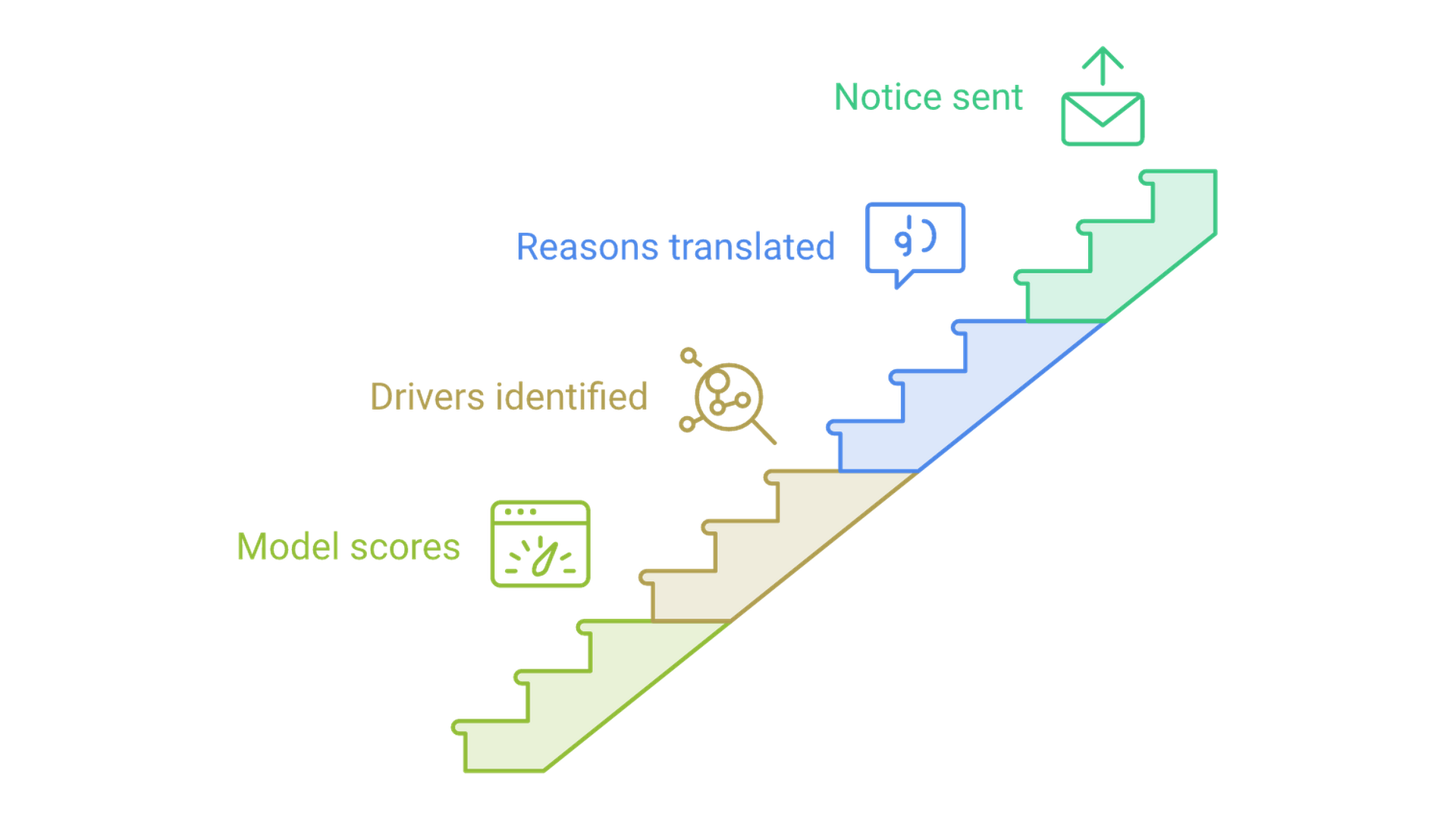
Under the CFPB's text of Regulation B section 1002.9, a creditor notifies the applicant of adverse action within 30 days after receiving a completed application, and the statement of reasons "must be specific and indicate the principal reason(s) for the adverse action." The same section says it is not enough to state that the applicant failed internal standards or did not reach a qualifying score. The official commentary notes that listing more than four reasons is rarely helpful to the applicant.
For a machine learning model, that means the reasons have to come from the model's actual drivers for that applicant, translated into plain language, and they have to be reproducible if an examiner or the applicant asks. Generic reason codes copied from a legacy scorecard do not meet the test when a different model made the decision.
Two 2025 and 2026 changes matter here. The CFPB's withdrawn guidance page lists Circular 2022-03, on adverse action notices for decisions based on complex algorithms, and Circular 2023-03, on sample forms, as withdrawn on May 12, 2025. Withdrawing a circular does not change section 1002.9 itself. Separately, the CFPB's Regulation B page describes an April 22, 2026 final rule that removed the effects test and stated that ECOA does not recognize disparate-impact liability, and it lists the regulation as most recently amended July 21, 2026. ECOA's ban on discrimination against applicants on protected bases remains, so a fintech still needs to test whether its features act as proxies for those bases.
The 2026 Model Risk Guidance Leaves Generative AI Out
For fifteen years SR 11-7 was the reference for validating bank models. In April 2026 the Federal Reserve, OCC and FDIC replaced it with risk-based guidance.
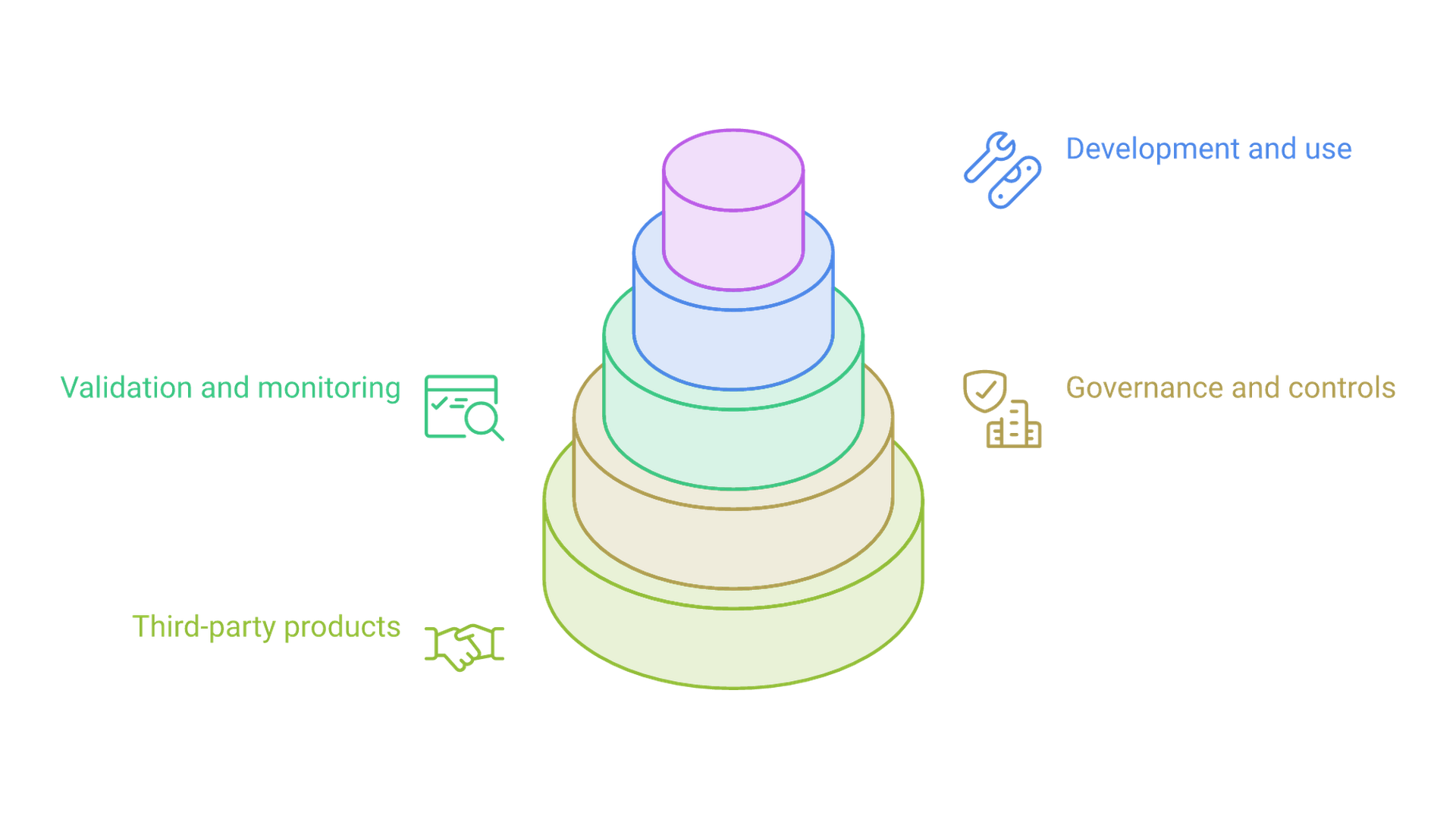
The Federal Reserve's SR 26-2, dated April 17, 2026, supersedes SR 11-7 and SR 21-8, the 2021 statement on models used for Bank Secrecy Act compliance. The OCC's Bulletin 2026-13 covers model development and use, validation and monitoring, governance and controls, and third-party products. It says the guidance is most relevant to banking organizations with more than $30 billion in total assets and does not set enforceable standards. It also rescinds the OCC's 1997 examination guidance on credit scoring models.
Scope is the detail that matters most for fintechs. The OCC bulletin says generative AI and agentic AI models are "novel and rapidly evolving" and leaves them out of the guidance, and the agencies plan a future request for information on banks' use of AI. Credit, fraud and AML models still fall under the guidance; an LLM assistant or an agent that acts on accounts currently does not have a dedicated federal model risk standard.
That gap does not mean no controls. A bank partner will still ask how the assistant is tested, what it can access and who can switch it off, and the answer has to exist before launch. Building that answer is the work of an AI governance program for models and agents, which assigns owners, human review points and evidence to each system.
Bank Partners, Vendors and the Data a Fintech Model Touches
Most fintech AI runs on someone else's infrastructure, data or license. Federal guidance and the FTC both place responsibility on the firm that uses the model, not on the vendor that built it.
The interagency guidance on third-party relationships, issued as Federal Reserve SR 23-4 in June 2023, sets risk management principles for each stage of a relationship, from planning and due diligence to termination. It mentions fintech partnerships with novel structures and asks banks to understand how each arrangement works. In practice a partner bank will review a fintech's models, data flows and subcontractors, including any AI vendor behind them.
Nonbank fintechs outside another regulator's jurisdiction under the Gramm-Leach-Bliley Act fall under the FTC Safeguards Rule. The FTC's guide lists a written information security program, a designated qualified individual, encryption of customer information, multi-factor authentication and an incident response plan. Since May 2024, a breach involving the unencrypted information of at least 500 consumers must be reported to the FTC no later than 30 days after discovery. Training data, prompts and model logs that contain customer information sit inside that program.
Identity and monitoring models add the FinCEN customer due diligence rule for covered institutions such as banks and broker-dealers: identify and verify customers, identify beneficial owners of legal entities, understand the relationship and monitor it on a risk basis.
How a Fintech Starts an AI Program Without Rework
Start with one bounded decision with clear data, a known rule and evidence built in from the first sprint, so partner reviews go smoothly. Scale comes later.
Start with an inventory of every decision your product makes about money, credit or identity, and mark which ones a model already touches, including vendor tools. Then pick one decision where the data is yours, the outcome is measurable and the rule is clear, such as alert triage for fraud analysts rather than fully automated credit denials.
Before training, write down the obligation that decision carries from the table above and what evidence it needs: reason codes for credit, audit logs for AML, access controls for any customer data. Design the model so it produces that evidence, test it on holdout data and for proxy effects, and agree on a human review point and a rollback switch.
After launch, monitor drift, false positives and complaints, and keep a model record with version, data sources, owner and validation results. The same structure scales to the next use case, which is the point of an enterprise AI governance framework that scales across teams rather than a one-off approval per model.
FAQs About AI in Fintech
These answers cover questions that come up alongside AI in fintech but sit outside the sections above. They summarize public regulator pages and are not legal advice for any specific product.
Is AI regulated in US financial services?
Yes, through the laws that already govern credit, data security, anti-money laundering and consumer protection, which apply to AI decisions as they do to any other. Treasury's December 2024 report recommended that firms review AI use cases for compliance with existing laws before deployment.
What is the difference between AI and machine learning in fintech?
Machine learning is the part of AI that learns patterns from data, and it powers most fraud and credit models. AI also includes language models that read and write text, which fintechs mainly use for support, document review and analyst summaries.
Do nonbank fintechs have to follow bank model risk guidance?
The interagency guidance is addressed to banking organizations. A nonbank fintech usually meets it indirectly, because a partner bank applies its own model risk and third-party expectations to the fintech's models through due diligence and contract terms.
Can a fintech use a third-party AI model for credit decisions?
Yes, but the creditor remains responsible for the adverse action reasons and fair lending results. The vendor has to provide enough access to drivers, documentation and testing for the creditor to explain each decision and validate the model.
Where AI in Fintech Stands at the End of 2026
Adoption is broad and the rules are shifting at the same time. Fintechs that tie every model to the obligation it triggers can move quickly while regulators decide how to treat generative AI.
The Bank of England and FCA survey published on October 26, 2026 found that 86% of the 196 responding firms used AI, up from 75% in 2024 (the regulators caution that the two samples differ), and generative AI accounted for 56% of reported AI systems. In the United States, regulators in 2026 replaced SR 11-7, amended Regulation B and said a request for information on model risk management, including banks' use of AI, will follow. The direction is lighter federal prescription and more reliance on each firm's own evidence.
For a fintech, that makes documentation the asset that travels: reason codes, validation results, access logs and owners per model. If you are scoping an AI use case for a lending, payments or identity product and want to map it to its obligations before building, talk with Cognativ about your fintech AI plan.