

AI in the Travel Industry: B2C and B2B Uses, Rules and Risks in 2026
How airlines, hotels, booking platforms and corporate travel programs use AI, which refund and pricing rules apply after 2026 changes, and where projects fail.
AI in the travel industry now runs on two tracks. On the consumer side, assistants plan trips and, since 2026, complete some bookings inside a chat window. On the business side, airlines, hotels, travel management companies and corporate travel programs use models to set prices, forecast spend and rebook travelers when a schedule falls apart.
This guide keeps the split between B2C and B2B, then spends its time on the part that decides whether a travel AI project holds up in production: the refund rules, pricing disclosure laws and liability for wrong answers that each use case touches, and how to build around them.
What AI in the Travel Industry Covers Today
Three kinds of AI do most of the work in travel: predictive models that score and forecast, language models that read and write, and agents that act on bookings through supplier systems.
Predictive models are the oldest layer. Airlines and hotels have used them for years to forecast demand, set fares and room rates, predict no-shows and flag fraudulent bookings. They take structured data such as booking curves, seat or room inventory and historical cancellations, and return a number a revenue or operations team acts on.
Language models reached customer-facing travel products from 2023 onward. They answer questions about baggage, fare rules and hotel amenities, summarize reviews, draft itineraries and write delay notices. Their strength is unstructured text; their weakness is that they can state a policy confidently and get it wrong.
Agents combine the two with the ability to act. A travel agent in this sense is software that searches live inventory, holds or books a fare, changes a reservation or files a refund request through an API. That ability to change a booking is what separates 2026 travel AI from the chatbots of a few years ago, and it is also what brings consumer protection rules directly into the design.
How Travelers Meet AI: Planning, Booking and Service
Consumer travel AI shows up at three moments: deciding where to go, paying for the trip and getting help when something changes. Booking is the moment that shifted most in 2026.
Trip planning assistants
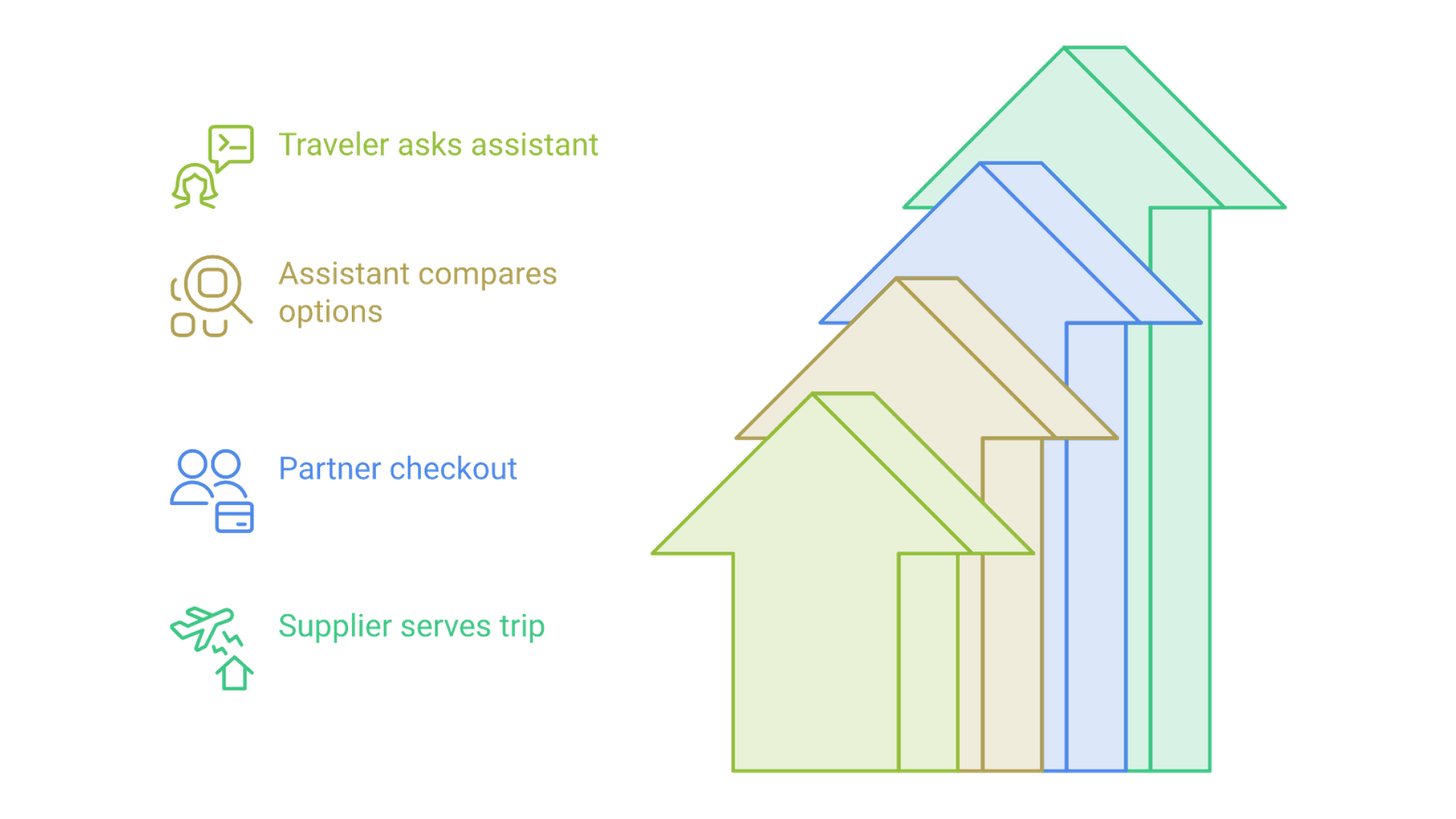
General assistants and travel-specific planners now draft day-by-day itineraries from a short prompt, adjust them when a traveler pushes back and pull in hotel, flight and activity options. For suppliers, the practical effect is that the first comparison a traveler sees may be assembled by an assistant rather than by a search results page, so accurate, structured product data matters more than ad copy.
Booking inside the conversation
Two launches in 2026 moved booking into the chat itself. On May 6, 2026, Mindtrip launched Mindtrip Flights, with live flight inventory and booking from Sabre and in-chat checkout through PayPal, according to Skift. On August 27, 2026, Google began rolling out hotel booking in AI Mode in Search in the US, in English, with partners including Booking.com, Expedia, Hilton, IHG, Marriott and Wyndham. Payment runs through Google Pay, and Google states that the hotel or booking platform stays the merchant of record and handles customer service.
Flights are a step behind on Google. The same announcement added Google Flights price tracking to AI Mode, but tickets are still bought on the airline's or a booking site's own pages. Early agent demand is also modest in adjacent bookings: our analysis of how few rides AI agents actually booked on Uber shows why suppliers should prepare for agent bookings without forecasting a sudden volume shift.
Customer service chatbots
Service bots handle the high-volume questions: baggage allowances, check-in times, seat changes and loyalty balances. The design question is which answers a bot may give on its own. Anything that changes money, eligibility or a reservation needs a source of truth behind it.
How Travel Companies and Corporate Programs Use AI
On the B2B side, AI is less visible and older. It prices inventory, plans operations and, newer still, gives corporate travel managers forecasting and rebooking tools they say they want.
Revenue management and dynamic pricing
Fares and room rates have moved with demand for decades. Machine learning extends that practice by updating prices more often and from more signals: booking pace, competitor rates, events and cancellations. The distinction that matters legally in 2026 is between prices that change with market conditions and prices that change with the individual shopper's personal data, which the pricing section below covers.
Corporate travel management
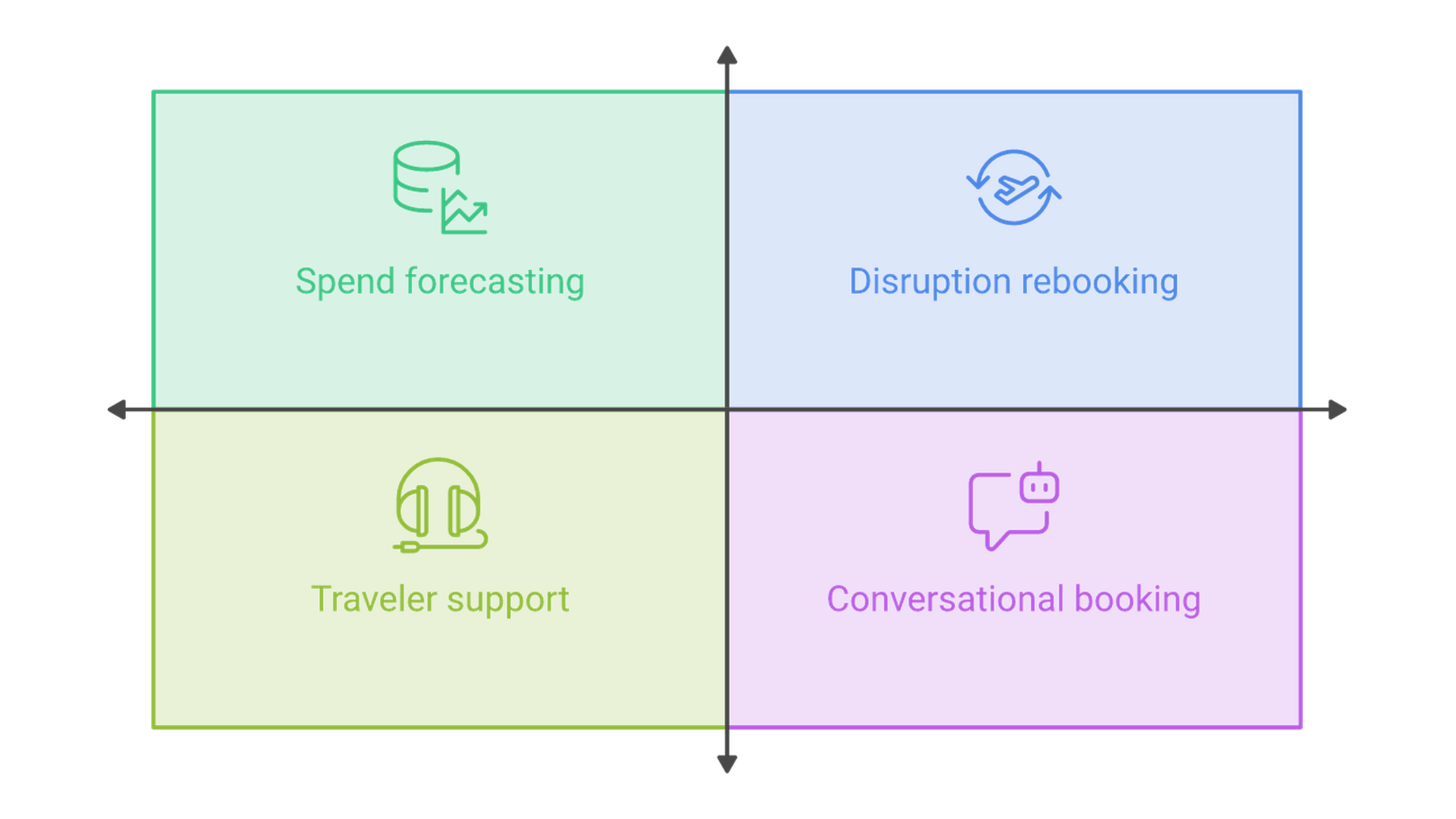
Corporate travel buyers are interested in AI but have seen little of it so far. In a GBTA survey of 269 travel buyers in North America and Europe, conducted March 10 to 23, 2026 and released May 19, 2026, 58% said AI had little or no impact on their program to date. Interest was high: 92% wanted predictive analytics for travel spend forecasting, 89% automated disruption management and rebooking, 85% AI-powered traveler support and 83% conversational booking.
The same survey shows where the data gap sits. Only 12% of buyers had a consolidated view of their program from a single data source, and 72% named travelers finding cheaper hotels outside managed channels as their top pain point. A forecasting model built on fragmented booking, expense and card data will forecast the fragments. Companies weighing custom software for travel and hospitality operations usually face the data consolidation work before any model work.
Operations and disruption handling
Behind the counter, airlines and hotels apply models to crew and staff scheduling, maintenance planning, irregular operations and guest messaging. Disruption handling deserves its own section, because it is where an automated decision meets a passenger's legal right to a refund.
Disruption Handling Is Where Travel AI Meets Refund Rules
A rebooking agent that offers a new flight is making a decision US rules already govern. Its logic has to follow the refund definitions, including the parts DOT is still revising in 2026.
The Department of Transportation's April 2024 refund rule treats a cancelled or significantly changed flight as a trigger for a refund when the passenger does not accept the alternative. The significant change thresholds include a domestic departure or arrival moved by three or more hours, a different departure or arrival airport and a downgrade in class of service.
The rule is not frozen. In a July 7, 2026 Federal Register notice, DOT extended until July 7, 2027 its decision not to enforce refund requirements for flights that are only renumbered, when the passenger is rebooked on the renumbered flight with no significant change. The notice says DOT is working on a further rulemaking, known as Refund III, that would revise the definition of a cancellation.
For anyone building disruption automation, three design choices follow. The cancellation and significant change logic should live in a rules layer the team can update without retraining a model. Each automated offer should log which rule version it applied. And the agent needs narrow permissions: GBTA found 57% of corporate buyers comfortable with AI changing or canceling a booking, which leaves 43% who did not say they were comfortable. Our guide to AI agent permissions and least privilege covers how to scope that access.
Personalized Pricing Now Carries Disclosure Duties
Dynamic pricing based on demand is long established in travel. Pricing based on a shopper's personal data now has its own state rules in New York, and a stricter bill passed there in 2026.
New York's Algorithmic Pricing Disclosure Act took effect on November 10, 2025. According to the state attorney general's November 5, 2025 consumer alert, businesses that set prices with an algorithm using personal data must show the statement "This price was set by an algorithm using your personal data" near the price, with penalties of up to $1,000 per violation.
A second bill goes further. On June 10, 2026, the attorney general's office said the One Fair Price Act, which would ban charging different prices for the same product based on personal data, had passed both houses of the legislature and was awaiting the governor's action. As of November 19, 2026, the legislature's bill page showed it had not yet been delivered to the governor. Legislators supporting it cited hotel rates and airline tickets as examples of the practice.
The design consequence for travel sellers is a clean separation of inputs. A pricing model that uses inventory, booking pace and dates sits in different legal territory from one that uses a logged-in shopper's history or device. If the One Fair Price Act becomes law as passed, even demand-based prices that change more than once in 24 hours would need a disclosure in New York. Teams should document which features feed each price, keep personal-data features switchable by jurisdiction and review disclosures before a model reaches New York customers.
How to Choose and Build a Travel AI System
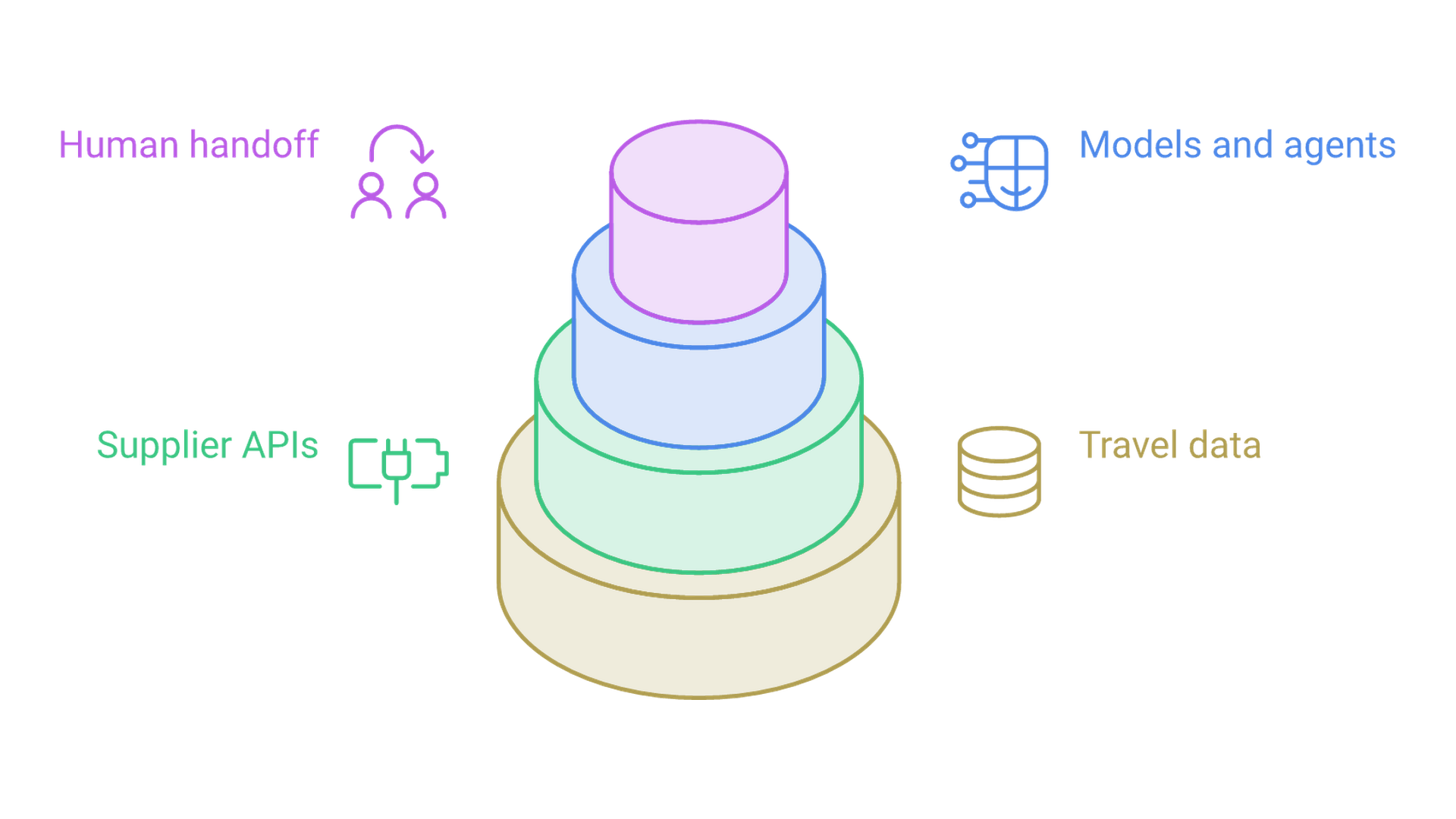
A travel AI project succeeds or fails on its data, its connections to booking systems and its handoff rules. The model choice matters less than most vendor comparisons suggest.
Start with one decision, not a platform. A disruption rebooking assistant, a fare rules answer bot and a spend forecast each need different data and different controls. Pick the one with a clear owner and a measurable outcome, such as handle time, rebooking acceptance or forecast error.
Build the data foundation next. Booking, inventory, loyalty, expense and service records usually sit in separate systems. The model can only be as current as the feed behind it, so live fare rules, seat and room availability and policy documents need a refresh path and an owner.
Connect to supplier systems through their supported APIs, whether a global distribution system, an airline's passenger service system, a hotel property management system or a booking platform. Agents should read freely but write through narrow, logged actions. For customer-facing assistants, chatbot development grounded in your own policies and booking data keeps answers tied to the documents that govern them rather than to a general model's memory.
Finally, set the handoff rules before launch. Decide which requests the system resolves alone, which it drafts for a human and which it routes straight to an agent, and test those boundaries with real fare rules and edge cases. NIST's AI Risk Management Framework, released January 26, 2023 and extended with a generative AI profile on July 26, 2024, gives a common structure for that review; NIST says the framework is being revised.
Mistakes That Undermine AI in Travel
Most travel AI failures trace back to a few repeated decisions: trusting a bot with policy answers, skipping a single traveler identity and removing the human route at the worst moment.
Letting a bot improvise policy
The best-known warning comes from Canada. In Moffatt v. Air Canada, decided on February 14, 2024, the British Columbia Civil Resolution Tribunal found that the airline's website chatbot had wrongly told a customer he could claim a bereavement fare after travel. The tribunal rejected the airline's defense and held that "Air Canada remains responsible for all the information on its website," ordering it to pay C$812.02 in damages, interest and fees. The amount was small, but the reasoning applies to any supplier whose assistant states a fare rule.
Skipping a single traveler identity
A single traveler identity across booking, expense and loyalty systems comes before personalization, not after.
Removing the human route during disruption
Automation saves the most time during mass disruptions, which is also when travelers have the most at stake. A visible path to a person, with the conversation history passed along, keeps an automated first response from becoming a dead end.
Ignoring where personal data flows
Travel data includes passport details, payment cards, loyalty accounts and, for corporate travelers, calendars. Each new assistant or agent is a new path for that data, so access, retention and vendor terms belong in the first design review.
FAQs About AI in the Travel Industry
Travelers and travel businesses ask a handful of recurring questions about AI, from whether it replaces agents to whether its booking tools are safe to use. Short answers follow.
Will AI replace travel agents?
Not for complex or high-value trips so far. AI handles research, comparisons and routine changes well, while human advisors still manage multi-stop itineraries, groups and disruptions that need judgment and supplier relationships.
Are AI travel planners accurate?
They are useful for drafting and comparing, but they can misstate a fare rule, a baggage allowance or a cancellation policy. Before paying, check the price and the policy on the airline's, hotel's or booking platform's own page.
How do hotels use AI?
Hotels use AI for room rate setting, demand and staffing forecasts, review analysis, guest messaging and upsell offers. Larger chains also connect their booking systems to AI assistants so guests can book through them.
Is it safe to share personal data with an AI travel planner?
Share only what a booking needs. Check whether the assistant or the supplier is the merchant of record, read how long conversations are kept and avoid typing passport or card numbers into a general chat outside a checkout flow.
What is agentic AI in travel?
The difference from a chatbot is access. An agent holds permissions to write to booking systems, so the business that deploys it decides what it may change, how much it may spend and what it must log for later review.
Where AI in Travel Stands at the End of 2026
By late 2026, consumer booking inside AI assistants is real but early, corporate programs want AI they mostly do not have yet, and the rules around refunds and pricing are still moving.
For B2C sellers, the near-term task is making inventory, fare rules and policies readable by assistants that may now complete the booking. For B2B teams, it is giving forecasting and rebooking tools reliable inputs to learn from. In both cases, the systems that hold up are the ones built with refund logic and pricing disclosures designed in from the start. If you are planning a travel AI system and want to scope the data, integrations and controls first, talk with the Cognativ team.