

AI in Auditing: How Audit Teams Use It and What the Standards Expect
How external and internal audit teams apply machine learning and language models, which evidence rules govern the output, and how to begin with a single test.
Artificial intelligence now reads general ledgers, matches invoices to contracts and flags odd journal entries in work that used to rest on samples and spreadsheets. External auditors use it to gather and test evidence for an opinion; internal auditors use it to watch controls between reviews.
The tools get most of the attention, but the harder question for an audit team is whether the result will hold up as evidence. This guide covers how AI fits into the audit, where firms use it in 2026 and what the PCAOB, the AICPA and the IIA expect when software does part of the testing.
What AI in Auditing Means for External and Internal Audit
AI in auditing means using machine learning, language models and automation to plan, test and document an audit. It is a different job from reviewing a company's own AI models, which is sold under the same name.
For an external auditor, the goal is reasonable assurance that financial statements are free of material misstatement. AI helps by reading more of the company's data than a person could, ranking risk and pulling facts out of documents. For an internal audit function, the goal is assurance and advice on governance, risk and controls, so AI often runs between formal audits as a monitoring layer.
Three families of technology do most of the work. Machine learning models score transactions and spot patterns that differ from history. Language models and optical character recognition read contracts, invoices, bank statements and board minutes. Rules-based automation moves data, prepares requests and repeats tests on a schedule. The large firms have also added AI agents to their own audit platforms, covered below.
Reviewing a company's own models for bias, reliability and control is a separate assurance task, and the IIA's AI framework, covered below, addresses it. This guide concentrates on AI as a tool inside the audit and touches that review only where the standards do.
How AI Moves the Audit From Samples to Full Populations
Traditional testing picks a sample and projects the result. Analytics and AI can read every transaction, so the audit question shifts from which items to pick to what to do with the ones flagged.
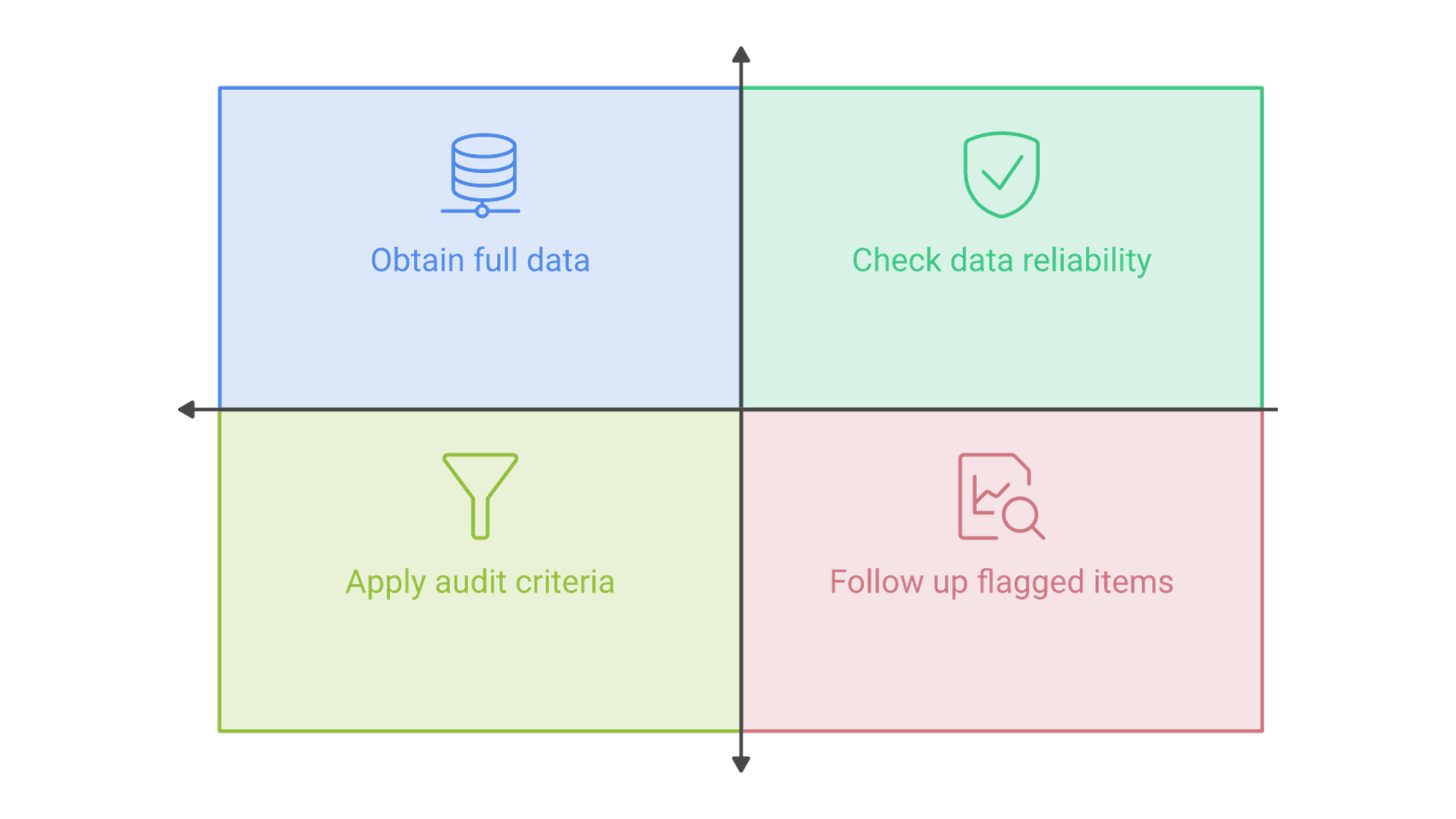
A technology-assisted audit procedure usually follows the same path. The auditor obtains the company's data, often a full general ledger or subledger extract. Before any analysis, the team checks that the extract is complete and has not been altered, because every later conclusion depends on it. The tool then applies the auditor's criteria to the whole population: entries posted at unusual times, round amounts, rarely used accounts, duplicate payments or invoices that do not match a purchase order.
The output is a list of items that need a look, not a conclusion. Each flagged item still needs follow-up: an explanation from management, a supporting document or a further test. A model that flags thousands of items has not done the audit; it has moved the work to the follow-up stage, and the criteria the auditor sets decide whether that list is useful or noise.
The same analysis can serve more than one purpose. A journal entry review can inform the risk assessment and also provide substantive evidence. Standard setters have accepted that idea, with one condition covered below: the auditor has to meet each objective the procedure is meant to serve.
Where Audit Teams Use AI in 2026
AI use in audit has moved from pilots to platform features at the largest firms. The uses below are the ones firms and audit bodies describe most, from journal entry testing to agents.
Journal entry testing and anomaly detection
Journal entry testing is the most common starting point because the data is structured and the fraud risk is well understood. Models compare each entry against patterns for the account, the user and the period, and they rank the ones that look least like the rest. Payment data gets similar treatment: the transaction scoring used for fraud detection in payment flows also applies to unusual disbursements and payments that do not reconcile.
Document review and data extraction
Language models read leases, revenue contracts, loan agreements and bank confirmations, then pull the terms an auditor needs into a structured table. The auditor then traces the extracted values to the ledger. The value is speed on volume; the risk is a misread clause, so extraction is paired with a review step on the items that matter.
Continuous auditing in internal audit
Internal audit teams connect analytics to ERP and data warehouse feeds so that control exceptions surface close to when they happen. An ISACA blog from May 2025 lists continuous assurance among the main uses, with models flagging control deviations in near real time and alerts prompting investigation.
Agents inside audit platforms
The large firms now ship agents inside their audit software. EY announced on April 7, 2026 a multi-agent framework embedded in EY Canvas, a platform EY says processes more than 1.4 trillion lines of journal entry data a year and supports 130,000 assurance professionals; EY expects AI to support all end-to-end audit activities by 2028. Deloitte described agents in its Omnia platform in August 2025 with "full human-in-the-loop" monitoring, and ACCA's AB magazine reported in August 2026 that KPMG has built agents into its Clara platform.
What PCAOB, AICPA and IIA Standards Say About AI-Assisted Audits
None of the three bodies has written an AI-specific auditing standard. Each has, however, updated its rules on evidence and technology, and those rules apply in full when AI does part of the work.
For audits of public companies, the PCAOB adopted amendments to AS 1105, Audit Evidence, and AS 2301, on responses to the risks of material misstatement, on June 12, 2024. The SEC approved them on August 20, 2024, and the PCAOB's filing, published in the Federal Register, sets them for audits of fiscal years beginning on or after December 15, 2025, which makes calendar-year 2026 audits the first under them. The amendments require the auditor to evaluate the reliability of external information the company provides in electronic form, to achieve each objective when one procedure serves several purposes, and to investigate items identified in a test of details to decide whether they indicate misstatements or control deficiencies. A PCAOB Board policy statement of September 18, 2025, as summarized by King & Spalding, says separate testing under paragraph .10A(b) may not be necessary depending on the risk assessment, the importance of the information and the results of other procedures; PCAOB staff examples followed on October 1, 2025. The Center for Audit Quality's September 2025 alert still gives the December 15, 2025 effective date, and no deferral was found.
For private-company audits, the AICPA's SAS No. 142, Audit Evidence, applies to periods ending on or after December 15, 2022. An October 2023 AICPA & CIMA article by Bob Dohrer notes that the standard gives examples of automated tools and techniques, and that analytics over entire populations may meet risk assessment and substantive objectives at once. The same article stresses professional skepticism and warns against assuming external information is more reliable than internal data.
For internal audit, the IIA's Global Internal Audit Standards became effective on January 9, 2025, according to an IIA press release of January 16, 2025. The IIA's Artificial Intelligence Auditing Framework, dated September 13, 2024, gives principles-based guidance for assessing AI governance, risk and controls, and it draws on the Three Lines Model.
| Body | Instrument | Applies from | What it means for AI work |
|---|---|---|---|
| PCAOB | Amendments to AS 1105 and AS 2301 | Fiscal years beginning on or after Dec. 15, 2025 | Test the reliability of company data; investigate identified items, individually or in aggregate |
| AICPA | SAS No. 142, Audit Evidence | Periods ending on or after Dec. 15, 2022 | Automated tools allowed; skepticism and reliability still required |
| IIA | Global Internal Audit Standards | Jan. 9, 2025 | Baseline for internal audit work, AI-assisted or not |
| IIA | AI Auditing Framework | Published Sept. 13, 2024 | Guidance for auditing the organization's own AI |
Pressure for more specific guidance continues. Bloomberg Government reported on August 12, 2026 that audit firms, including PwC and Baker Tilly, and investor groups urged the PCAOB to prioritize staff guidance on applying existing standards to AI-driven audit methods.
Audit Evidence and Documentation When AI Does the Testing
A reviewer or inspector must be able to see what the tool did, on which data and with which settings. If the file cannot show that, the output cannot carry the weight of audit evidence.
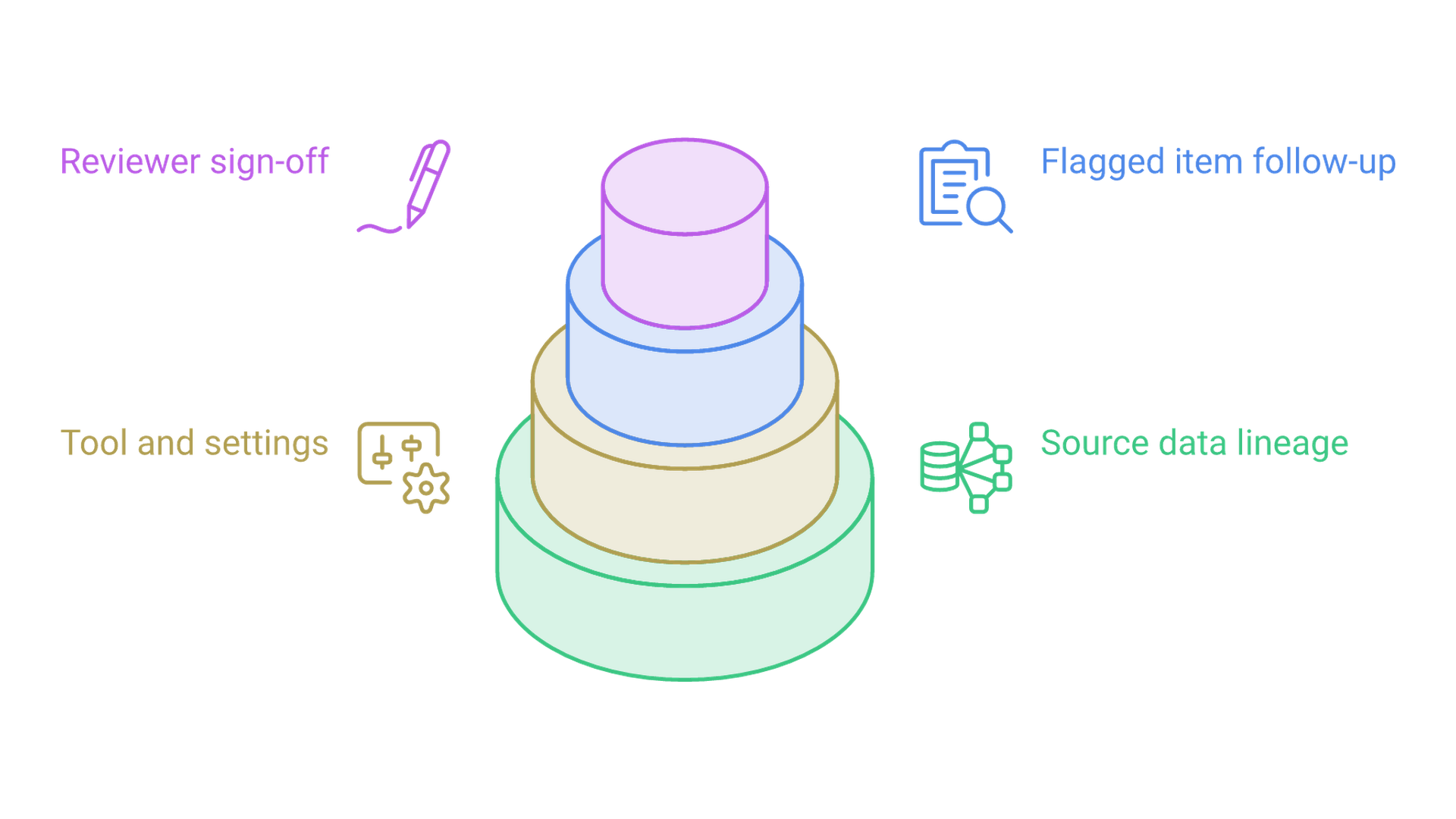
Documentation for an AI-assisted procedure is best built in layers. The first layer is the source data: where the extract came from, how completeness and integrity were checked and, for company-provided external information, how its reliability was evaluated. Clean lineage starts upstream, which is why data governance practices such as owned data definitions, access controls and logged changes make an audited company's data easier to rely on.
The second layer is the tool itself: which model or analytic ran, which version, the thresholds and criteria the auditor set and why those criteria fit the risk. The third layer is the follow-up on flagged items: what was investigated, what evidence closed each item and how the auditor concluded on any items not individually examined. The fourth layer is review: who checked the work, what they challenged and how disagreements were resolved.
Generative output needs extra care. A summary or an extracted value from a language model is a lead, not evidence, until someone traces it to the underlying document. Keeping the prompt, the source file and the traced result together in the workpaper lets a reviewer repeat the check.
Risks and Mistakes With AI Audit Tools
The failures that hurt audits are rarely about the model alone. They come from trusting outputs that nobody traced, from weak data and from tools whose logic the team cannot defend.
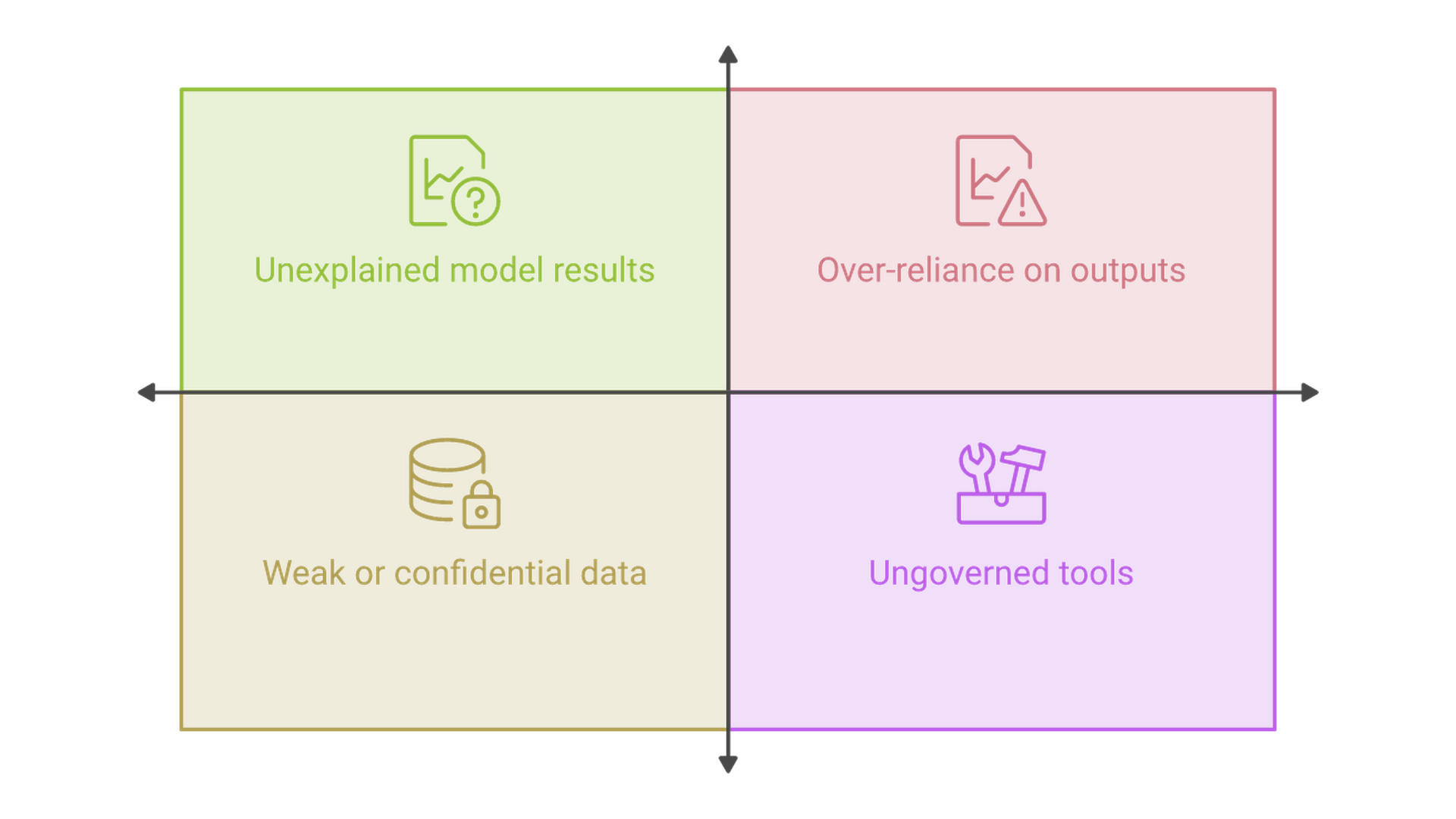
Over-reliance. A clean exception report is not proof that nothing is wrong. Criteria that are too loose bury real issues in noise; criteria that are too tight miss them. The auditor's skepticism applies to the tool's results just as it does to management's assertions.
Explainability. If no one can say why a model ranked an entry as high risk, the team cannot defend why it tested some items and not others. Simpler, transparent methods often beat a stronger model that nobody on the engagement can explain to a reviewer.
Data quality and confidentiality. Incomplete extracts, mapping errors between systems and late adjustments distort every result built on them. Client data also carries confidentiality duties, so teams need clear rules on which tools may receive it and where it is stored.
Ungoverned tools. Spreadsheets of prompts and personal tool accounts spread faster than policy. A firm or internal audit function benefits from the same controls it would expect from an audited company, and an enterprise AI governance framework gives a structure for approving tools, assigning owners and monitoring their use.
How to Start Using AI in an Audit Function
A practical way to begin is one test with complete data and an agreed follow-up path: prove the evidence trail on it, then widen the scope to more accounts, documents and controls.
Start with an inventory of repeatable tests, such as journal entry analysis, three-way matching of purchase orders, receipts and invoices, or user access reviews. Choose one where the data is available in full and the expected exceptions are understood. Agree in writing on the criteria, the reviewer and the documentation layers before the tool runs.
Next, separate the automation from the judgment. Data pulls, request lists, reconciliations and re-performance of scheduled tests suit process automation, which frees auditors for the follow-up and conclusions that standards assign to people. Keep a human sign-off at each point where a result becomes evidence.
Finally, measure what matters to quality: how many flagged items turned into findings, how long follow-up took and what reviewers challenged. Those records show whether the tool improves the audit, and they become part of the file an inspector will read.
FAQs About AI in Auditing
People researching AI in auditing tend to ask the same few questions about jobs, tools, internal audit requirements and whether a smaller firm has to adopt AI to keep meeting the standards.
Will AI replace auditors?
The standards place responsibility for the opinion and for professional skepticism on the auditor, not on software. Firms deploying agents say the same: EY's April 2026 release says its approach will keep the role of human judgment and skepticism, and KPMG describes the auditor's role moving toward steering and review.
What AI tools do auditors use?
The large firms build AI into their own platforms, such as EY Canvas, Deloitte Omnia and KPMG Clara. Smaller teams can combine data analytics software, document extraction tools and ERP-connected monitoring, with generative assistants for drafting and research under firm policy.
Does the IIA have a standard for auditing AI?
Not a mandatory one as of November 2026. The IIA's issued Topical Requirements cover cybersecurity, third parties, organizational behavior and organizational resilience; AI is not on that list. The AI Auditing Framework is guidance.
Do smaller audit firms have to use AI to stay compliant?
No standard covered here requires AI. The PCAOB amendments and SAS No. 142 set evidence requirements that apply whether a procedure is manual or technology-assisted, so a firm can adopt AI gradually as long as its evidence meets them.
AI Supports the Audit Opinion but Does Not Sign It
AI widens what an audit can examine and speeds the reading of documents, yet the evidence rules from the PCAOB, the AICPA and the IIA still decide whether its output counts.
The practical order is clear: trustworthy data first, a documented procedure second, a human conclusion last. Audit teams that build that trail can test full populations with confidence, and companies that keep their data governed make that testing faster. If you are planning automation or data work that an audit will rely on, talk to our team about your audit data and automation plans.