


Discovering the Capabilities of GPT-OSS-20B for Your Projects
GPT-OSS-20B is OpenAI's smaller open-weight reasoning model. Explore its MoE design, harmony prompt format, function calling and where it fits in a project.
In the rapidly evolving landscape of artificial intelligence, having access to powerful yet efficient language models matters to developers and organizations alike. gpt-oss-20b is the smaller of OpenAI's two open-weight reasoning models: a Mixture-of-Experts (MoE) model that balances strong reasoning with low latency and modest cost. Whether you are building prototypes, deploying production services or embedding AI into your products, the question is not only whether it runs, but what it can actually do well.
This guide focuses on capabilities and use cases rather than hardware sizing. It covers the architecture that makes the model efficient, its configurable reasoning effort, the harmony prompt format, built-in tool use and function calling, its 128k context window, the Apache 2.0 license, the published benchmark results and their limits, and where gpt-oss-20b fits next to gpt-oss-120b and hosted frontier models. Facts and figures below come from OpenAI's published model card, the official repository and Hugging Face documentation, checked as of October 2026.
Short answer: gpt-oss-20b is a capable text-only reasoning model for agentic workflows, coding help, structured extraction and private, local deployments. It reasons well on math and code, follows a clear instruction hierarchy and calls tools reliably, but it has limited world knowledge and should be grounded with retrieval or tools whenever facts matter.
Why Choose GPT-OSS-20B for Builders?
gpt-oss-20b is the pragmatic member of the gpt-oss family: fast, adaptable and cost-aware. According to the gpt-oss-120b and gpt-oss-20b model card, it has 20.9 billion total parameters, but only about 3.6 billion are active for each token. That sparsity is the reason it delivers reasoning quality well above what its active size suggests while keeping inference cheap.
OpenAI's official gpt-oss repository positions the 20b model for lower latency and for local or specialized use cases, while gpt-oss-120b targets production, general-purpose and high-reasoning workloads. In practice, that makes the 20b model the natural choice when you want a model you can run, inspect and adapt yourself, and when response speed matters more than squeezing out the last points of benchmark accuracy.
Open weights and the Apache 2.0 license
The weights are published on Hugging Face under the Apache 2.0 license, a permissive license without copyleft restrictions or patent traps, together with a short gpt-oss usage policy that asks users to comply with applicable law. You can run the model locally, deploy it as a shared internal service, embed it inside a product workflow or fine-tune it, without per-token fees to OpenAI. Open-weight is not the same as fully open source: OpenAI publishes the weights, tokenizer and reference code, but not the training data.
What changed since release
The gpt-oss models were released in August 2025, and as of October 2026 the core gpt-oss-20b checkpoint has not been replaced by a newer official version. The main addition to the family is gpt-oss-safeguard-20b, a safety-classification model built on gpt-oss-20b and released under the same license. Meanwhile, the open-weight field has become more crowded, so treat gpt-oss-20b as a well-documented, efficient baseline rather than the top scorer on every leaderboard.
Core Capabilities Snapshot
Out of the box, the model supports instruction following, chain-of-thought reasoning, function calling with developer-defined schemas, Structured Outputs, and two built-in tools: web browsing and Python code execution. The Hugging Face model card also describes it as suited to agentic operations, and it can be fine-tuned on consumer-grade hardware.
Reasoning, math and coding
The published model card reports the following results for gpt-oss-20b at high reasoning effort. They are OpenAI's own evaluations, run with the same MXFP4 quantization the released weights use, so treat them as vendor results rather than independent tests:
- Competition math: 91.7% on AIME 2025 without tools, rising to 98.7% when the model can use tools.
- Science reasoning: 71.5% on GPQA Diamond without tools.
- General knowledge: 85.3% on MMLU, and a 75.7% average on the multilingual MMMLU benchmark.
- Coding: a Codeforces Elo of 2230 without tools (2516 with tools) and 60.7% on SWE-bench Verified.
- Agentic tool use: 54.8% on Tau-Bench Retail, a function-calling benchmark.
- Hardest questions: 10.9% on Humanity's Last Exam without tools.
Independent evaluations, such as the Hugging Face team's lighteval runs in its gpt-oss launch post, reported scores they described as within the expected range for a reasoning model of this size. Your own task-specific evaluation remains the only reliable measure for your workload.
Knowledge limits and hallucination
The model card is candid about the trade-off of a small active size. On knowledge-heavy tasks such as GPQA, gpt-oss-20b lags behind gpt-oss-120b, and smaller models generally hallucinate more. On SimpleQA, a short factual-recall benchmark, gpt-oss-20b answered only 6.7% of questions correctly, with a 91.4% hallucination rate; on PersonQA it scored 15.5% accuracy and a 53.2% hallucination rate. The practical lesson is clear: use the model for reasoning over facts you supply, not as a source of facts.
What it does not do
gpt-oss-20b is text-only: it does not accept images or audio. Its knowledge cutoff is June 2024, so anything newer must come from retrieval, browsing or your own data. It is also not a hosted OpenAI API model in the usual sense; you run it yourself or through a third-party inference provider.
Architecture and Reasoning Modes
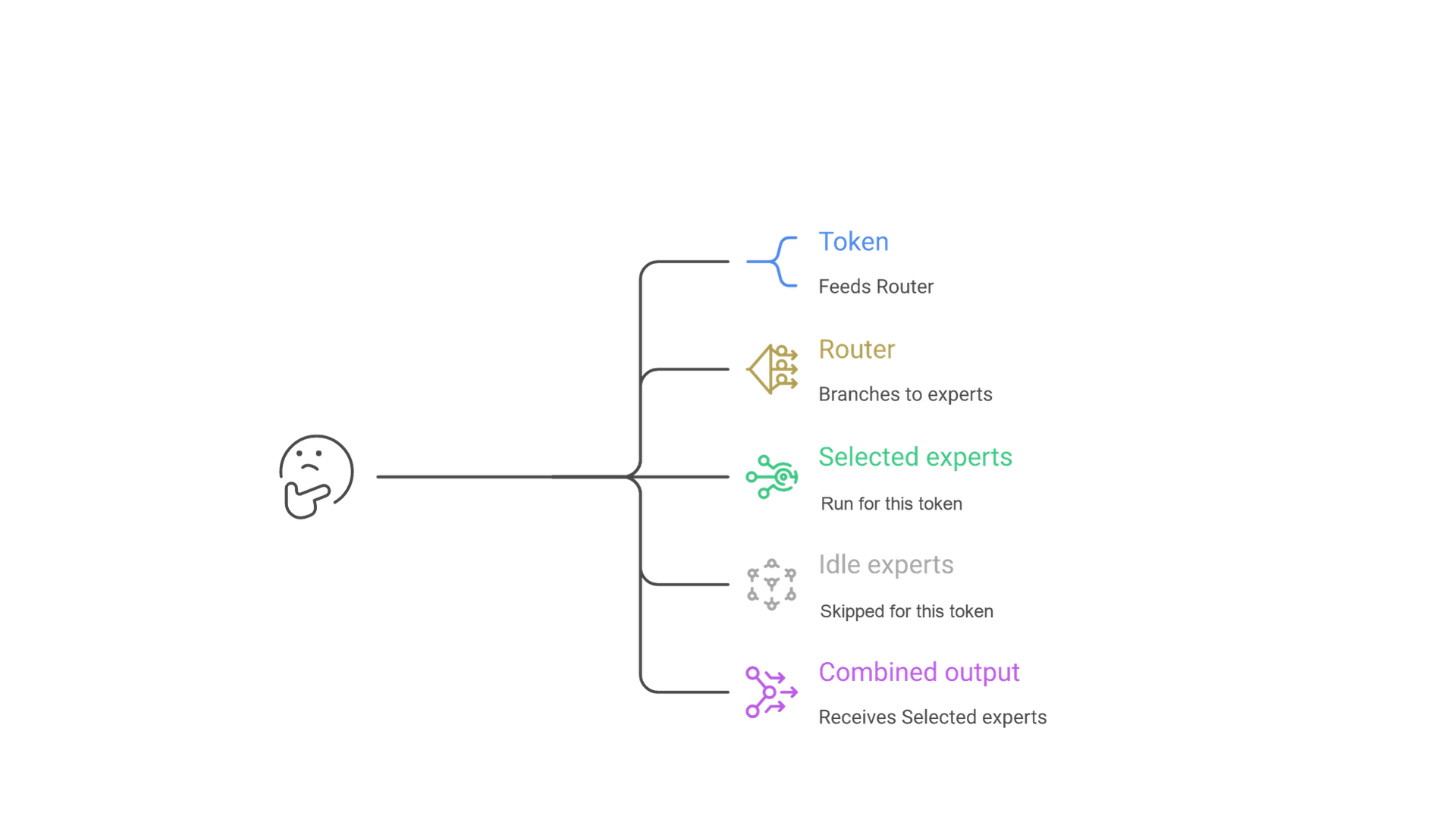
This section explores the underlying structure and the flexible reasoning settings that make gpt-oss-20b efficient and adaptable. The model card describes a 24-layer transformer in which each MoE block contains 32 experts and a router selects the top 4 experts for every token. Attention alternates between banded-window layers and fully dense layers, and the tokenizer is o200k_harmony, a superset of the tokenizer used by recent OpenAI models.
Mixture-of-Experts in practice
MoE routes each token through a small subset of experts, providing more model capacity without activating every parameter. From an operator's perspective, that means bigger-model behavior at smaller-model cost. OpenAI post-trained the MoE weights in the 4-bit MXFP4 format, which is why the released checkpoint is about 12.8 GiB and why the model can run within 16 GB of memory. The detailed GPU, RAM and quantization choices are covered in our guides to GPT-OSS hardware requirements and gpt-oss-120b hardware requirements, so this article does not repeat the sizing.
For developers, MoE is transparent: prompts and APIs look the same as with a dense model. You mainly notice the efficiency, especially when the inference server supports the MXFP4 kernels natively.
Context window of 128k tokens
gpt-oss-20b supports a context length of 131,072 tokens, extended with YaRN in the dense layers. That is enough for long contracts, sizable code files, multi-document retrieval results or long agent transcripts in one request. Long context is not free, though: every extra token adds latency and memory pressure, and models tend to use information in very long prompts less reliably than information in short ones. Retrieval that selects the right passages usually beats stuffing the window.
Configurable reasoning effort
Reasoning effort governs how much the model thinks before answering. You set it in the system message with a line such as "Reasoning: high", and the three levels are low, medium and high, with medium as the default in the harmony format. The model card reports smooth test-time scaling: higher effort produces longer chains of thought and better accuracy on hard problems, at the cost of latency and tokens.
A simple policy is to default to medium for chat, generation and summarization, downgrade to low for deterministic extraction or classification, and upgrade to high for ambiguous, multi-step or high-stakes queries. You can implement dynamic routing with a lightweight check: if confidence is low, a schema validation fails or a tool call fails twice, escalate the effort level, retry and record the reason in your logs.
Prompting and Structured Interactions with Harmony
Effective prompting starts with the format the model was trained on. gpt-oss models use OpenAI's harmony response format, and the official guidance is that they should not be used without it. Most inference servers and chat templates apply harmony automatically, but understanding its structure explains much of the model's behavior.
Roles and the instruction hierarchy
Harmony defines five roles: system, developer, user, assistant and tool. The system message sets identity, knowledge cutoff, current date, reasoning effort and built-in tools. The developer message holds your instructions, which other formats call the system prompt, and your function definitions. When instructions conflict, the model is trained to follow the order system, then developer, then user, then assistant, then tool.
That hierarchy is helpful but not absolute. In the model card's instruction-hierarchy tests, gpt-oss-20b resisted prompt-injection hijacking less reliably than OpenAI o4-mini (a score of 0.639 versus 0.917). Treat tool outputs and retrieved documents as untrusted input and keep critical controls outside the model.
Channels and chain of thought
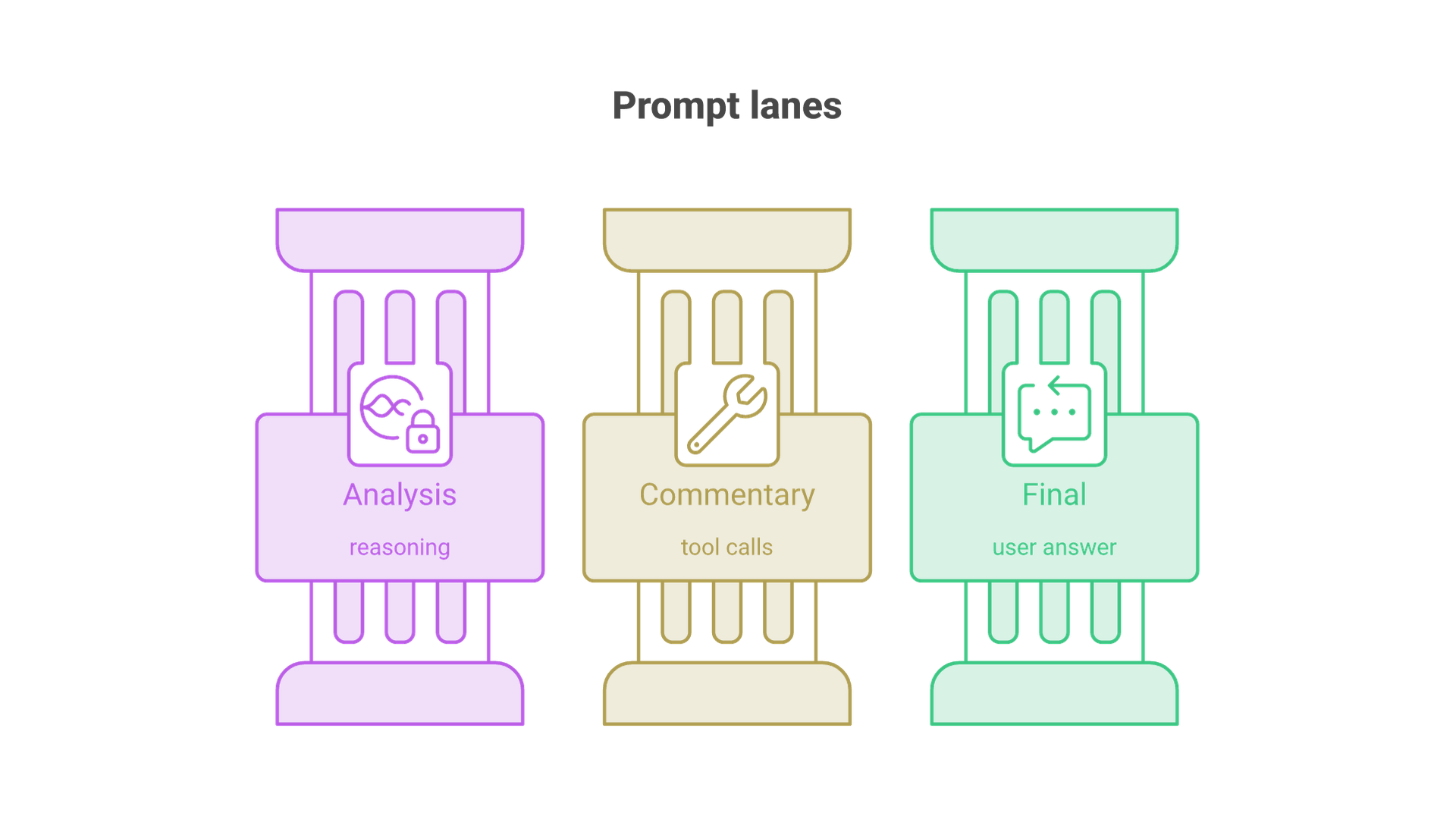
Assistant output flows through three channels. The analysis channel carries the chain of thought, the commentary channel usually carries function calls and short preambles, and the final channel carries the answer for the user. OpenAI advises developers not to show raw chain of thought to end users, because it is not held to the same safety standards as final output; filter, summarize or hide it instead. In multi-turn conversations, drop earlier reasoning once a turn has ended with a final answer, but pass it back during an ongoing sequence of tool calls.
Prompt engineering essentials
Keep developer instructions short and testable: tone, safety posture, output schema and refusal policy. Concise instructions reduce contradictions and help the model generalize across tasks. Use two or three domain-accurate examples that demonstrate edge cases and refusals; short, high-quality examples outperform long, unfocused prompt dumps.
Do not ask the model to print its chain of thought in the final answer. If you need traceability, request a short rationale field in a structured output. OpenAI's repository also recommends sampling with temperature 1.0 and top_p 1.0 as the default starting point.
Function Calling, Tool Use and Structured Outputs
Tool use is where gpt-oss-20b becomes more than a chat model. It was trained to call tools inside its reasoning, which lets it look things up, compute exact answers and act on systems instead of guessing. The model card's jump from 91.7% to 98.7% on AIME 2025 when tools are available shows how much tool access can matter on the right tasks.
Built-in browser and Python tools
Two tools are built into the harmony format. The browser tool exposes search, open and find actions, and the python tool runs code in a Jupyter-style environment. The reference implementations in OpenAI's repository are explicitly educational: the browser needs a third-party search backend, and the Python container should be restricted further before production use because executed code can be steered by prompt injection.
Function calling and schema design
Function calling turns the model into a dependable orchestrator for search, calculators and internal APIs. You define functions in the developer message, and you can pass them as JSON schema through an OpenAI-compatible server. Define strict types, ranges and enums so arguments stay within safe bounds. Start with schema-constrained JSON to verify correctness quickly, reject responses that fail validation and retry once with the exact validation error.
For multi-tool agents, use a dispatcher pattern that selects a tool and supplies arguments, log every call, mask sensitive arguments and design tools to be idempotent so retries are safe. Building agents on this pattern is the core of our AI agent development work, and the same discipline applies whichever model sits underneath.
Responses API compatibility
Harmony mirrors OpenAI's Responses API, and servers such as vLLM expose both the Chat Completions and Responses endpoints for gpt-oss models. That compatibility lets teams already invested in OpenAI-style pipelines swap in a self-hosted model with limited code changes, then route some traffic to hosted models when they need more capability.
Retrieval and Knowledge Grounding
Because the model's factual recall is weak and its knowledge stops in June 2024, retrieval is not optional for knowledge work. Effective retrieval and grounding turn gpt-oss-20b's reasoning strength into accurate, current answers.
RAG pipeline design
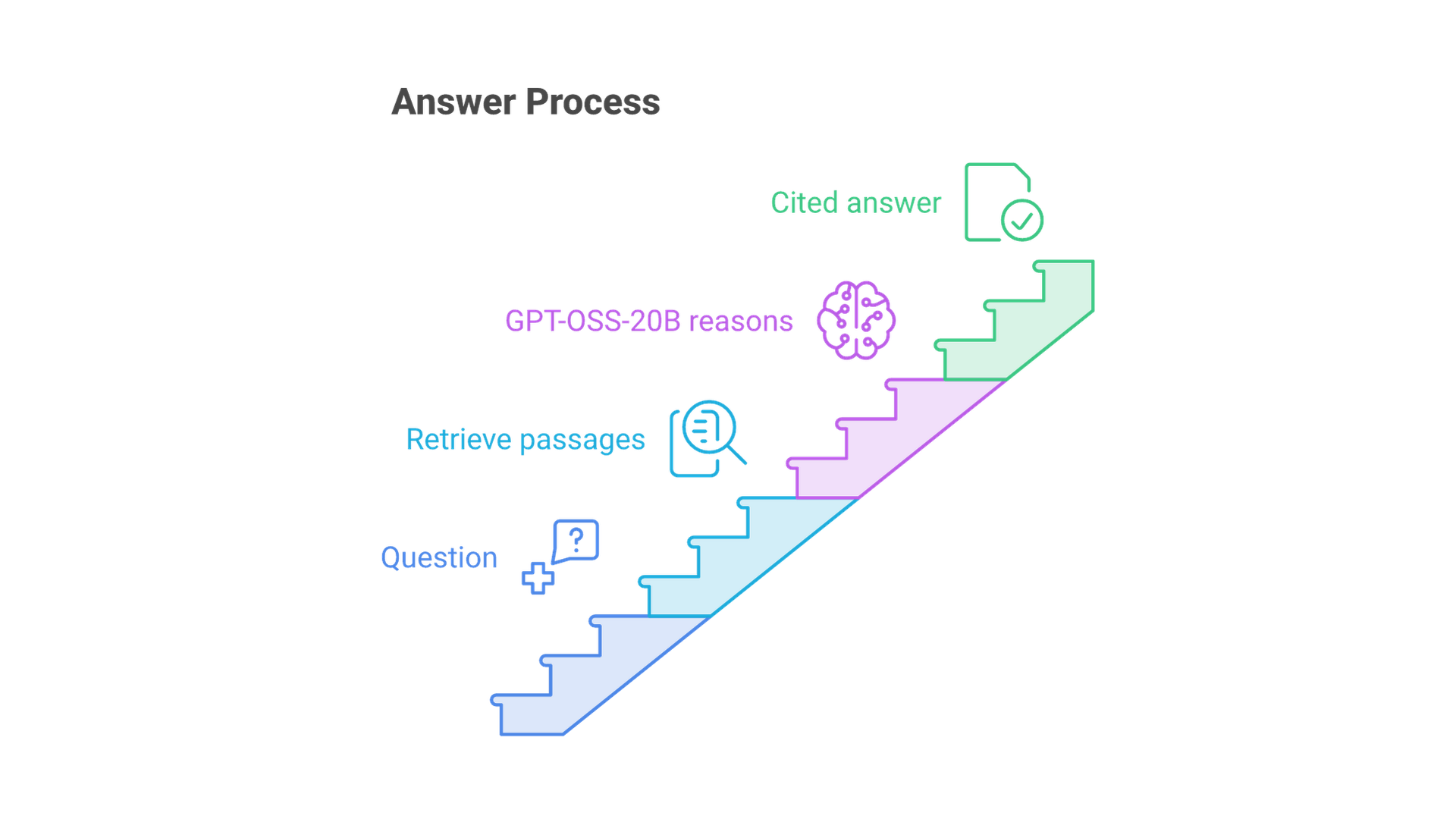
Pair gpt-oss-20b with retrieval-augmented generation for factual grounding. Chunk documents with some overlap, embed them and store them in a vector database that supports metadata filtering and re-ranking. At query time, retrieve candidate passages, re-rank for precision and add compact, cited passages to the prompt. Keep the stuffed context lean even with a 128k window, because long, noisy context hurts latency and dilutes relevance.
When knowledge is volatile, prefer a "tone by tuning, facts by retrieval" strategy: fine-tune for format and policy, and keep factual content fresh through retrieval so you avoid frequent model refresh cycles.
Evaluation and citations
Build test sets that require verifiable citations. Score citation precision and recall, and treat uncited factual claims as failures even when the prose looks good. Probe fabrication with adversarial questions, such as requests for sources that do not exist or prompts that contain contradictory passages, and track failure modes by domain to prioritize corpus curation. Log document IDs, versions and timestamps alongside outputs so audits and rollbacks are straightforward.
Fine-Tuning and Customization
Fine-tuning gpt-oss-20b lets you tailor behavior to your domain, and the official model card notes that the 20b model can be fine-tuned on consumer hardware. Hugging Face reports that the models are integrated with its TRL library, with LoRA examples available.
Data preparation and PEFT
Start with parameter-efficient fine-tuning such as LoRA or QLoRA. Curate instruction and response pairs that reflect your schemas, tone, refusals and red-team prompts. Deduplicate, split by time or source to prevent leakage and redact personal data. Keep training examples in the harmony format; Hugging Face advises dropping earlier chains of thought and training only on the final assistant turn. If parameter-efficient methods plateau below your targets, justify full fine-tuning with ablations and mix in general data to limit forgetting.
A real example: gpt-oss-safeguard-20b
OpenAI's own gpt-oss-safeguard-20b shows how far specialization can go. It keeps the 20b architecture but is trained to classify content against a policy the developer writes at inference time, for uses such as input and output filtering or trust and safety labeling. It illustrates a broader point: a small open-weight model that is narrowly adapted can outperform its general-purpose base on a well-defined job.
Validation and release hygiene
Evaluate across task quality, safety behavior and calibration or abstention. Require schema conformance during evaluation, not only during serving, and confirm that quality holds under the quantization you will deploy. Version datasets, adapters and configurations, deploy adapters behind feature flags and roll out through canaries.
Where GPT-OSS-20B Fits Compared With Larger Models
Choosing gpt-oss-20b is a question of fit, not of ranking. The model card shows the same architecture family at two scales: gpt-oss-120b has about 117 billion total parameters and 5.1 billion active, and it scores higher on knowledge-heavy and agentic benchmarks. Hosted frontier models go further still on breadth, multimodality and difficult open-ended tasks.
When the 20b model is the right choice
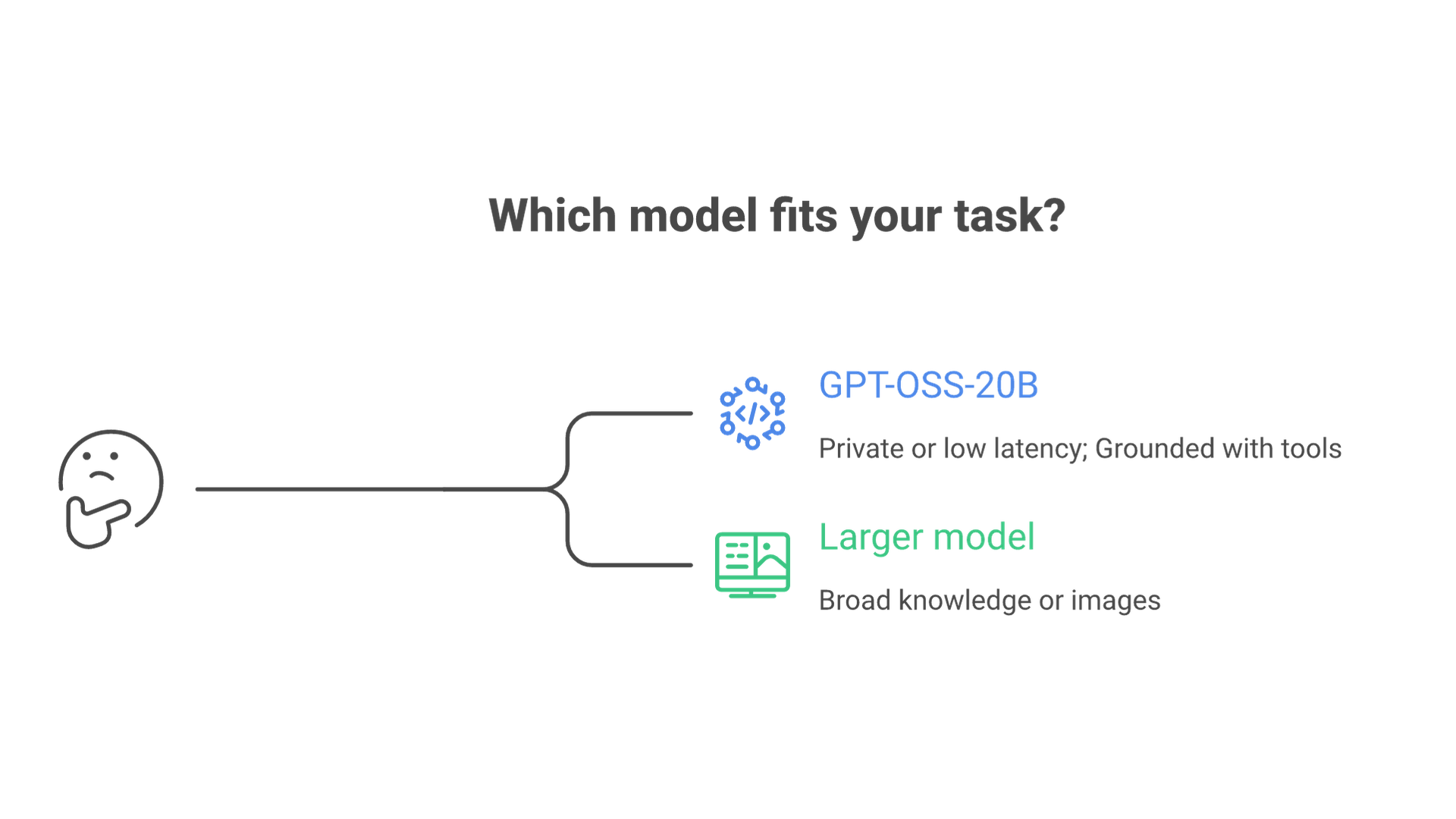
Pick gpt-oss-20b when data must stay on your infrastructure or devices, when latency and cost per request matter, when the task is well defined and can be grounded with retrieval or tools, or when you want to fine-tune and own the resulting model. It is also a strong default for prototyping agent workflows before deciding what needs a larger model.
When to step up
Move to gpt-oss-120b or a hosted frontier model when the task depends on broad world knowledge, long multi-step planning with many tools, image or audio input, or when an error is costly and the larger model measurably reduces it on your evaluation set. The step from 20b to 120b also changes the infrastructure profile, which our hardware guides cover in detail.
Tiered routing
Many teams use both: route routine requests to gpt-oss-20b and escalate rare, ambiguous or high-stakes queries to a larger model. This hybrid approach balances quality, latency and spend, and it works best when the routing rules are tested like any other feature. If you need help designing that model mix, our LLM solutions team works through model selection, grounding and evaluation with you.
Practical Use Cases for GPT-OSS-20B
The capabilities above point to a set of use cases where the 20b model is a strong match. None of these depend on the model knowing facts by itself; each pairs its reasoning with supplied data or tools.
Private and on-premises assistants
Because the weights run on your own hardware, gpt-oss-20b suits internal assistants over contracts, policies, tickets or source code that cannot leave your environment. Combine it with retrieval, access controls and logging; our guide to using LLMs with private data covers the patterns that keep sensitive information protected.
Coding help and developer agents
With a 60.7% SWE-bench Verified score and strong competitive-programming results in OpenAI's evaluations, the model is useful for code explanation, test generation, refactoring suggestions and tool-driven coding agents, particularly when run locally next to the codebase. Keep a human reviewer in the loop for anything merged.
Structured extraction and workflow automation
Low reasoning effort plus strict schemas makes gpt-oss-20b a fast engine for extracting fields from documents, classifying requests and filling forms or tickets. Validated JSON creates clean integration points for downstream services and makes error rates easy to measure.
Moderation and policy checks
The safeguard variant demonstrates that the 20b architecture can apply written policies to content. Teams can use it, or a similarly fine-tuned model, as a first-pass filter in front of user-generated content or other model outputs, with human review for borderline cases.
Security, Governance and Real-World Operations
Ensuring safety and compliance is critical when you deploy any open-weight model, because you, not the vendor, operate the guardrails.
Safety and compliance
OpenAI's preparedness review, summarized in the model card, found that the default gpt-oss models did not reach its High capability thresholds in biological, chemical or cyber risk categories, even after adversarial fine-tuning of the larger model. That is a baseline, not a guarantee for your application. Validate inputs for length, file type and personal data, post-filter outputs, treat policy-mandated refusals as success states and keep audit trails of prompts, retrieved documents, tool calls and outputs.
Serving and observability
The model runs on Transformers, vLLM, SGLang, Ollama, LM Studio, llama.cpp and OpenAI's own reference implementations, and it is also offered by hosted inference providers. Whatever you choose, instrument latency, throughput, schema-error rate, refusal rate and retrieval hit rate, compare reasoning effort levels side by side and ship model or adapter updates through canaries with one-step rollback.
Cost control and deployment patterns
Track cost per correct action rather than raw tokens. Cache frequent prompts and retrievals, compress context with summaries and cap reasoning effort unless escalation is warranted. Standardize deployments with containers, pinned drivers and reproducible builds, and keep kill switches for adapters, retrieval indexes and specific routes.
Frequently Asked Questions
What is gpt-oss-20b?
It is OpenAI's smaller open-weight reasoning model, a Mixture-of-Experts transformer with about 21 billion total parameters and 3.6 billion active per token, released under the Apache 2.0 license in August 2025.
Can gpt-oss-20b be used commercially?
Yes. The Apache 2.0 license allows commercial use, modification and redistribution. You must also follow the short gpt-oss usage policy, which requires compliance with applicable law.
What is the context window of gpt-oss-20b?
The model supports 131,072 tokens, commonly described as 128k. Long prompts still add latency, so retrieving relevant passages is usually better than filling the window.
Does gpt-oss-20b support function calling?
Yes. It supports developer-defined functions, Structured Outputs and built-in browser and Python tools through the harmony response format, and works with OpenAI-compatible servers.
Is gpt-oss-20b multimodal?
No. It accepts and produces text only. Use a separate vision or speech model if your workflow needs images or audio.
Should I use gpt-oss-20b or gpt-oss-120b?
Start with 20b for local, low-latency and well-grounded tasks. Choose 120b when your evaluation shows it reduces costly errors, especially on knowledge-heavy or complex agentic work.
Conclusion: Getting the Most From GPT-OSS-20B
gpt-oss-20b hits a practical sweet spot: open weights under Apache 2.0, MoE efficiency, configurable reasoning effort, a 128k context window, reliable function calling and structured outputs. Its weak spot is factual recall, so its best results come when you supply the facts through retrieval or tools and let the model do the reasoning.
Start with clean schemas, the harmony format, retrieval grounding and medium effort. Add LoRA where consistency matters, keep observability tight so you can trade speed for depth on purpose, and escalate to a larger model only when your own evaluations show it is worth the cost.
If you are weighing gpt-oss-20b against larger or hosted models for a product, agent or internal workflow, talk to Cognativ about your AI project.