
Industrial AI in Manufacturing: Use Cases, Data Requirements and How to Start
How AI in manufacturing works in practice: where predictive maintenance and inspection pay off, how plant data reaches a model, and what to secure before scale.
Industrial AI is the use of machine learning, computer vision and related models on the physical side of a business: machines, production lines, utilities and the people who run them. It predicts failures, spots defects and tunes processes from the data that plant equipment already produces.
Most explanations stop at the use cases. This guide covers them briefly, then spends its length on the part that decides whether a project survives the pilot: how plant data travels from a sensor to a model, how a mid-market manufacturer picks and sequences its first work, which risks belong to operations rather than IT, and what changed in adoption data and regulation by late 2026.
What Industrial AI Means on a Factory Floor
Industrial AI differs from office AI less in its algorithms than in its setting: it reads machine signals, works next to safety systems and can change how physical equipment behaves on a shift.
IBM draws the line clearly: enterprise AI serves business processes such as HR, finance and customer service, while industrial AI serves physical operations such as factories, warehouses and infrastructure. The distinction matters because the inputs are different. Instead of documents and tickets, an industrial model reads vibration, temperature, pressure, current draw, images from inspection cameras and the event logs of controllers.
It also differs from the automation a plant already has. A programmable logic controller follows fixed rules written by an engineer: if a tank level passes a threshold, close the valve. An industrial AI model learns patterns from history, such as the combination of signals that tends to come before a bearing failure, and turns them into a prediction or a recommendation. The controller still executes the action. In most plants the model advises and a person or the existing control logic decides, which is the right default until a use case has a long, monitored record.
For manufacturers, that framing turns industrial AI into an operations project with a software component, not the reverse. Cognativ's overview of software and AI work for manufacturing companies covers how that work is scoped.
Where Industrial AI Pays Off First: Maintenance, Quality and Process Control
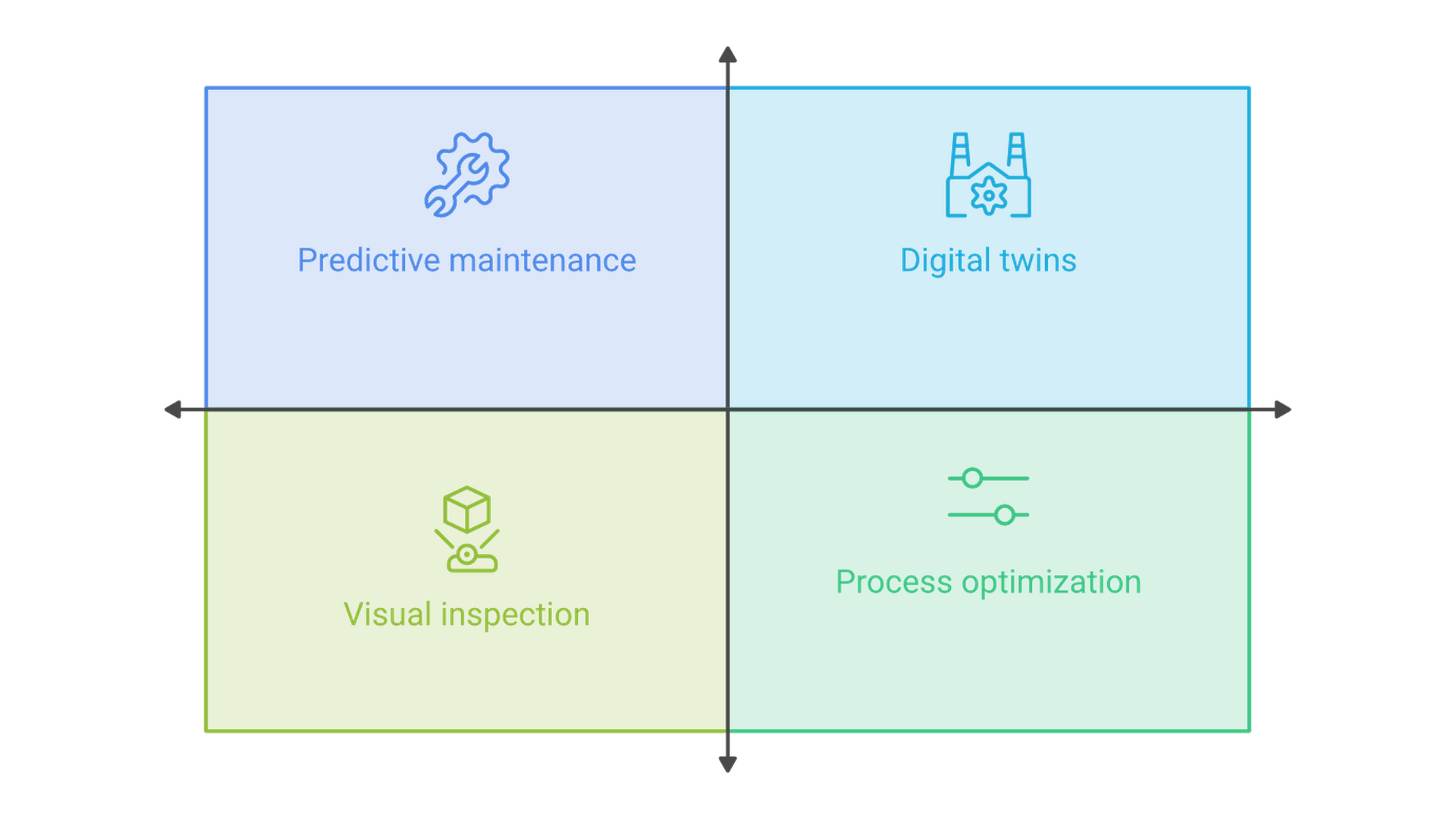
Four use cases appear in nearly every serious guide because they match data most plants already collect and problems that already have an owner, a budget line and a way to measure progress.
Predictive maintenance
Predictive maintenance replaces fixed service intervals with condition-based alerts. Models learn the normal signature of a motor, pump, compressor or gearbox from vibration, temperature and current data, then flag drift from that signature early enough for a planned repair. The value comes from avoiding unplanned stops and from not replacing healthy parts on a calendar. It only works when maintenance teams trust the alerts, so false alarms need to be tracked as carefully as caught failures.
Visual quality inspection
Computer vision models inspect parts, welds, labels, packaging and surfaces at line speed and apply the same standard on every shift. They are strongest on defects that are visible, repeatable and well labeled in historical images. A defect caught at the station is far cheaper than one found after assembly, which is why inspection projects are usually measured against scrap and the rework rate and the cost of reworked units.
Process optimization and energy
In continuous and batch processes, models learn how setpoints such as temperature, speed, pressure or mix ratios affect yield, quality and energy use. They then recommend settings that operators can accept or reject. Energy optimization works the same way on compressed air, chillers, furnaces and peak demand, and it often has the cleanest data because utilities are already metered.
Digital twins and simulation
A digital twin is a virtual model of a machine, line or plant fed by live or recent data. It lets engineers test a new layout, product changeover or control strategy before touching the physical system, and it gives AI models a safe place to be trained and validated. Twins range from a physics model of one asset to a full line simulation; the useful ones are tied to a specific decision rather than built as a showcase.
The Data Path From Sensor to Model
Most industrial AI pilots stall on data plumbing rather than on the model. Knowing which system holds which signal, at what resolution and under whose control, is most of the real work.
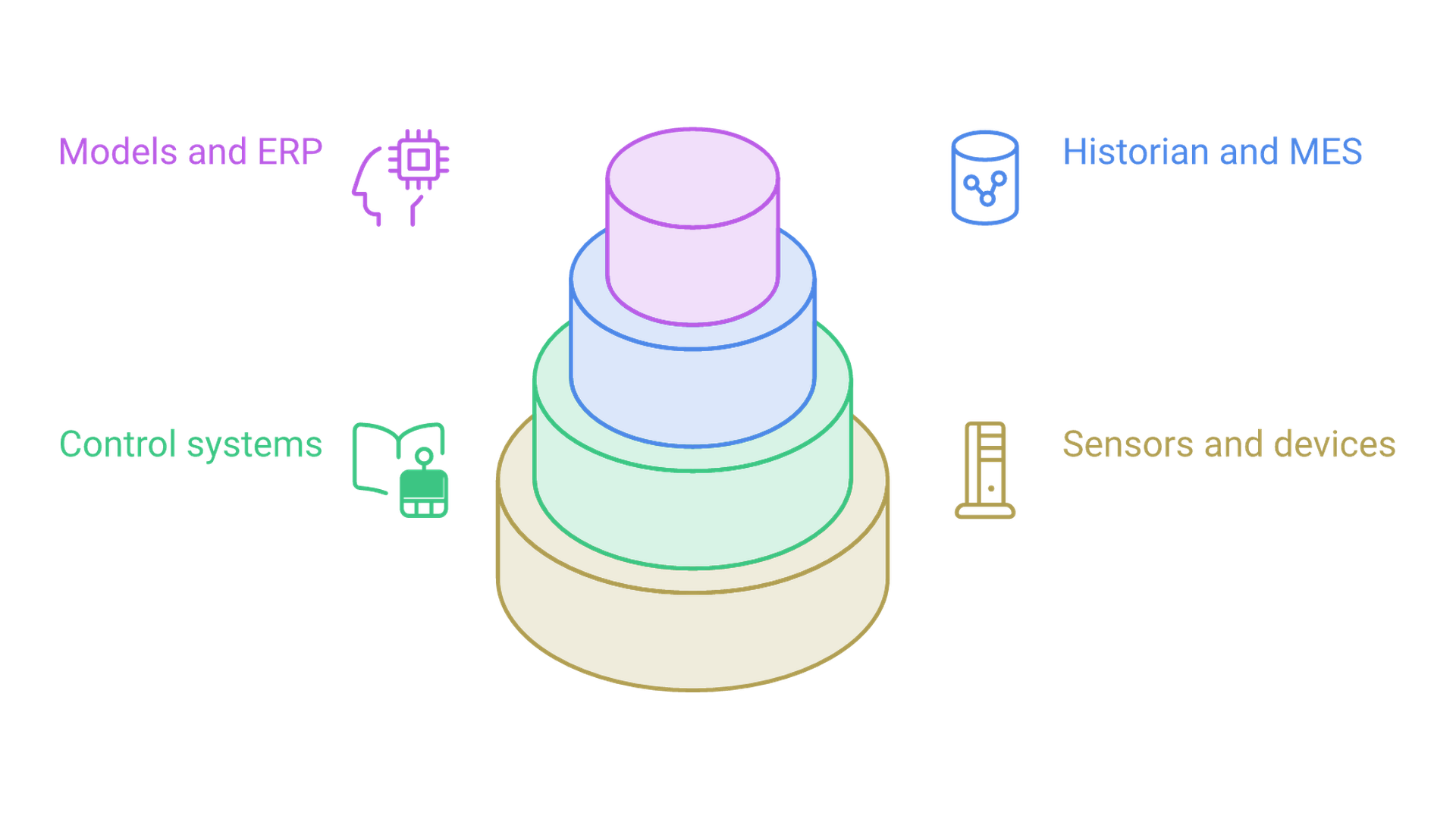
The ISA-95 standard, also published as IEC 62264, gives a shared map of the layers involved. Level 0 is the physical process itself. Level 1 holds the sensors, smart devices and valves. Level 2 holds the control systems, such as PLCs and distributed control systems, that supervise the process. Level 3 is manufacturing operations management, run by systems like MES and SCADA. Level 4 is business planning and logistics, where the ERP lives. An industrial AI model usually needs data from several of these layers at once: machine signals from the bottom and order, product or maintenance context from the top.
Historians hold the time series
A process historian stores timestamped values from controllers and sensors, often for years. It is usually the first and best source for training a predictive model, but it has limits worth checking early: values may be compressed or averaged, sampling rates may be too slow for vibration analysis, and tag names often differ between lines that were commissioned at different times. Cleaning and mapping tags determines whether a model trained on one line can run on the next.
Connectivity and context
Older equipment speaks many protocols, so plants add a connectivity layer that collects data from controllers and translates it into a common format. OPC UA, maintained by the OPC Foundation, is a widely used platform-independent option; it carries data with its structure and supports certificates, encryption and signed messages. Raw tags are not enough on their own. A model needs to know which product, batch, recipe and shift a reading belongs to, and that context lives in MES and ERP records that have to be joined to the time series.
Edge, cloud or both
Inference that must react within a machine cycle, such as rejecting a bad part, runs on edge hardware close to the line. Training, fleet-wide analysis and long-term storage usually run in the cloud or a central data center. Most plants end up with a hybrid, and the trade-offs between latency, bandwidth and remote management are covered in Cognativ's practical guide to running edge AI.
How a Mid-Market Manufacturer Starts With Industrial AI
A mid-market plant rarely has a data science team or a spare budget for experiments, so the first project has to be narrow, measurable and owned by someone who runs production every day.
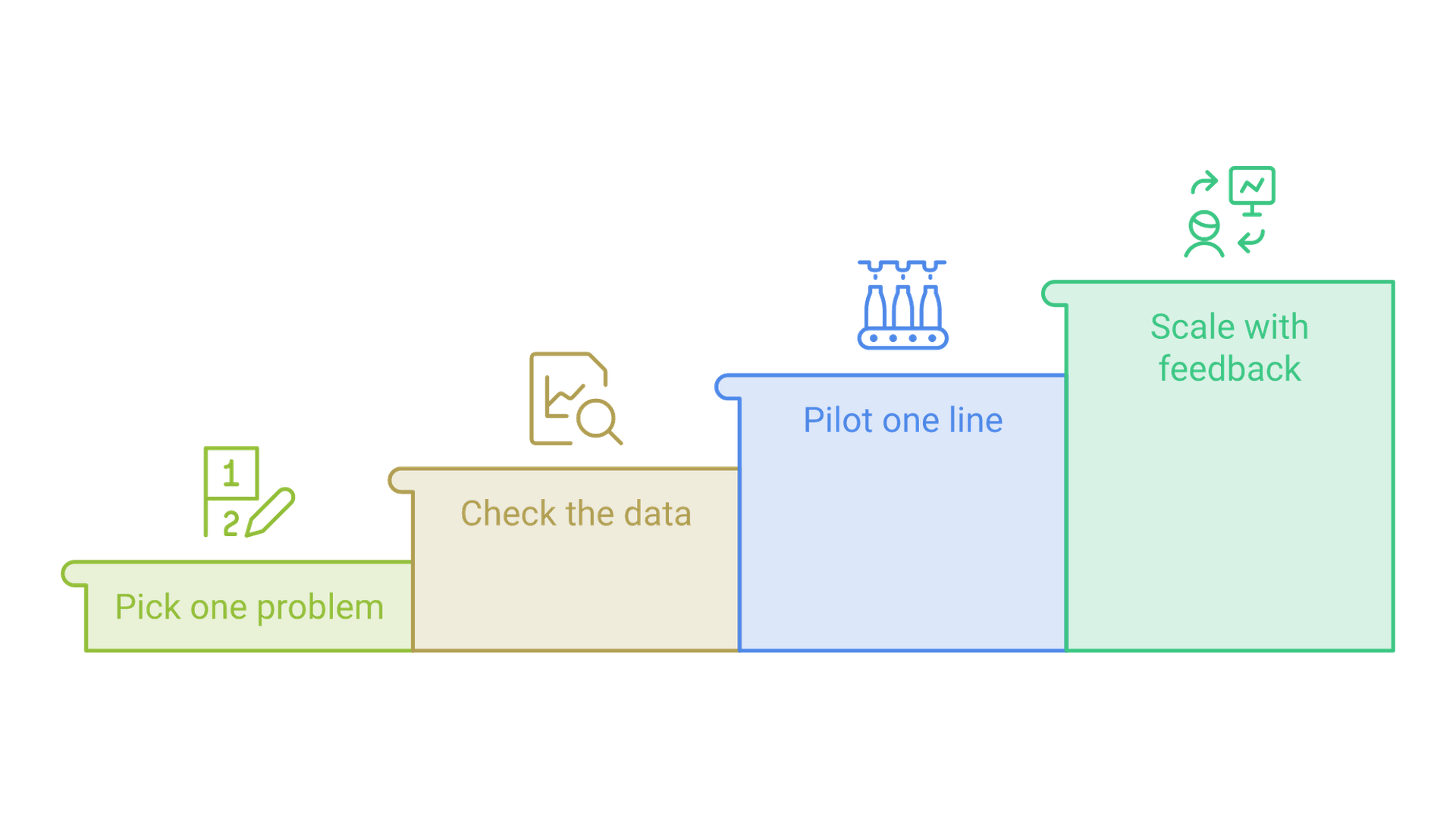
A workable sequence starts with a problem, not a platform. Pick one recurring, costly issue that operations already tracks, such as unplanned downtime on a bottleneck asset, a defect type that drives scrap, or energy use on a single process. Then check whether the data to explain it exists, at the right resolution, with enough history that includes the bad events. If the failures you care about were never recorded with timestamps, the first phase is instrumentation and labeling, not modeling.
Next comes a pilot on one line or asset group with an agreed baseline and a success measure set before any model is trained. The pilot should include the workflow around the model: who receives an alert, how they confirm or reject it and how that feedback flows back into training. Only after that loop works does it make sense to scale to other lines, and the scale step is where integration with MES, maintenance systems and the ERP earns its cost. Much of the surrounding work is ordinary automation, routing alerts into work orders and approvals, which is where AI process automation across plant and office workflows connects the model to the people who act on it.
| First use case | Data it depends on | Who should own it |
|---|---|---|
| Predictive maintenance | Vibration, temperature and current history with recorded failures | Maintenance and reliability lead |
| Visual quality inspection | Labeled images of good parts and each defect type | Quality manager |
| Process optimization | Setpoints, sensor readings and batch quality results joined by time | Process or production engineer |
| Energy optimization | Metered utility use matched to production schedules | Plant or facilities manager |
Skills follow the same logic. A plant can buy or contract the data engineering and modeling, but the process knowledge has to come from its own engineers and operators. Projects that pair the two from the first week avoid models that are statistically accurate and operationally useless.
Industrial AI Risks: OT Security, Model Drift and Operator Trust
The risks of industrial AI are physical as well as digital. A bad prediction can stop a line, damage equipment or hurt someone, so controls belong in the operations plan, not only in IT policy.
Connecting OT widens the attack surface
Feeding models means moving data out of control networks that were often designed to be isolated. Every new connection is a possible path in. The NIST Guide to Operational Technology Security (SP 800-82 Rev. 3), published in September 2023, with a Revision 4 draft open for comment until November 30, 2026, is NIST's guidance for segmenting networks, controlling remote access and planning monitoring for systems that control physical processes. The ISA/IEC 62443 series sets requirements for securing industrial automation and control systems and is widely used to specify security expectations for suppliers. A practical rule: data should flow out of the control layer through managed, preferably one-way paths, and models should not write back to controllers until that path has been reviewed by the people responsible for safety.
Models drift when the plant changes
New raw materials, a replaced sensor, a product changeover or seasonal temperature swings change the data a model sees. A model that was accurate at launch can degrade quietly. Monitoring prediction quality, logging every retraining and keeping the previous model ready to restore are as important as the first deployment.
Operators need to see why
Black-box alerts get ignored. Operators trust a recommendation when they can see which signals drove it and when their rejections visibly improve it. Clear ownership also matters: someone in operations, not only a data team, should decide when a model is allowed to act and when it only advises.
Industrial AI in 2026: Adoption Data and Rule Changes
Two things shape planning in late 2026: adoption at scale is still the exception, and the EU has moved its deadlines for high-risk AI built into machinery and other regulated products.
Deloitte's 2025 Smart Manufacturing and Operations Survey, published in May 2025 and based on 600 executives at large manufacturers with US headquarters or operations, found that 29% were using AI or machine learning at the facility or network level and 24% had deployed generative AI at that scale, while 23% were piloting AI or machine learning and 38% were piloting generative AI. In the same survey, 55% strongly agreed that unauthorized access to operational technology was a high concern. Put simply, fewer than a third of these manufacturers run AI or machine learning at facility or network scale, and OT access is their leading security worry.
On regulation, the EU adopted Regulation (EU) 2026/1744, the Digital Omnibus on AI, which was published in the Official Journal on July 24, 2026 and amends the AI Act. It moves the obligations for stand-alone high-risk AI systems to December 2, 2027 and those for high-risk AI embedded in regulated products to August 2, 2028. For machinery, it shifts the Machinery Regulation into a different part of the AI Act's annex, so the detailed requirements for AI in machines are to be set through delegated acts under the Machinery Regulation itself. Separately, the European Commission states that the Machinery Regulation (EU) 2023/1230 applies from January 20, 2027. US manufacturers that sell equipment with AI features into Europe should track both timelines with their compliance advisers.
The technology direction is also clearer than it was in 2025. IBM's 2026 overview lists physical AI, models that perceive and act through robots and machines, among the AI types industrial systems now use.
FAQs About Industrial AI
These are the questions manufacturers most often ask when they first evaluate industrial AI, from how it relates to Industry 4.0 to whether older machines can take part.
Is industrial AI the same as Industry 4.0?
No. Industry 4.0 describes the broader shift to connected, data-driven production, including sensors, networking and automation. Industrial AI is one layer within it: the models that turn the data those connected systems produce into predictions and recommendations.
Can industrial AI work with older machines?
Often, yes. Older equipment can be fitted with external sensors for vibration, temperature or power, and protocol gateways can read data from older controllers. The limit is usually history: if a machine has never been instrumented, the plant must collect data for a while before a model can learn from it.
What is the difference between industrial AI and machine learning?
Machine learning is a family of techniques for learning patterns from data. Industrial AI is an application area that uses machine learning alongside computer vision, optimization, simulation and, increasingly, generative models, all applied to physical operations and constrained by safety and uptime.
Does industrial AI replace operators?
In practice it changes their work more than it removes it. Models watch more signals than a person can, but operators and engineers still confirm alerts, handle exceptions and supply the process knowledge that makes predictions useful.
Building an Industrial AI Program That Lasts Past the Pilot
The plants that get lasting value from industrial AI treat it as a capability they build step by step, with data foundations and operator trust earned before the next use case is added.
That means keeping a short list of problems ranked by value and data readiness, finishing one before starting the next, and reusing each pipeline, tag map and feedback loop for the following project. Security reviews, drift monitoring and clear decision rights stay in place from the first pilot onward rather than being added after an incident.
If you are weighing where industrial AI fits in your plant, which use case to start with or how to connect plant data to models, talk with Cognativ's team about your manufacturing AI plans.