
Nscale's AI Data Center in West Virginia: Inside the Monarch Compute Campus
Off-grid gas power, wetland permits and uncommitted financing: what enterprise buyers should learn from Nscale's gigawatt-scale AI campus in West Virginia.
Nscale's Monarch Compute Campus is shaping up to be one of the most consequential AI infrastructure projects underway in the United States. Situated in Mason County, West Virginia, the campus pairs a $44.6 billion anchor deal with Anthropic, a proposed NVIDIA loan guarantee worth billions, and a state law that lets data centers generate their own power off-grid. It also comes with real risks: unresolved financing, construction flooding, wetland destruction, and investor skepticism about whether neocloud operators can deliver on promises this large.
Here's what enterprise technology leaders and AI infrastructure strategists need to understand about the project, and what it signals about the next phase of AI compute buildout.
Overview of Nscale's West Virginia AI Data Center
The Monarch Compute Campus spans over 2,250 acres in Mason County, West Virginia, making it one of the largest dedicated AI data center campuses in the world by land area alone. Nscale acquired the site as a long-term AI infrastructure hub, with over $20 billion planned for capital investment across multiple phases. The campus targets 1.35 GW of AI computing capacity by early 2028, and Monarch Compute Campus plans to expand its capacity to over 8 GW in the long term-a scale that would rival the total data center power consumption of many mid-sized countries.
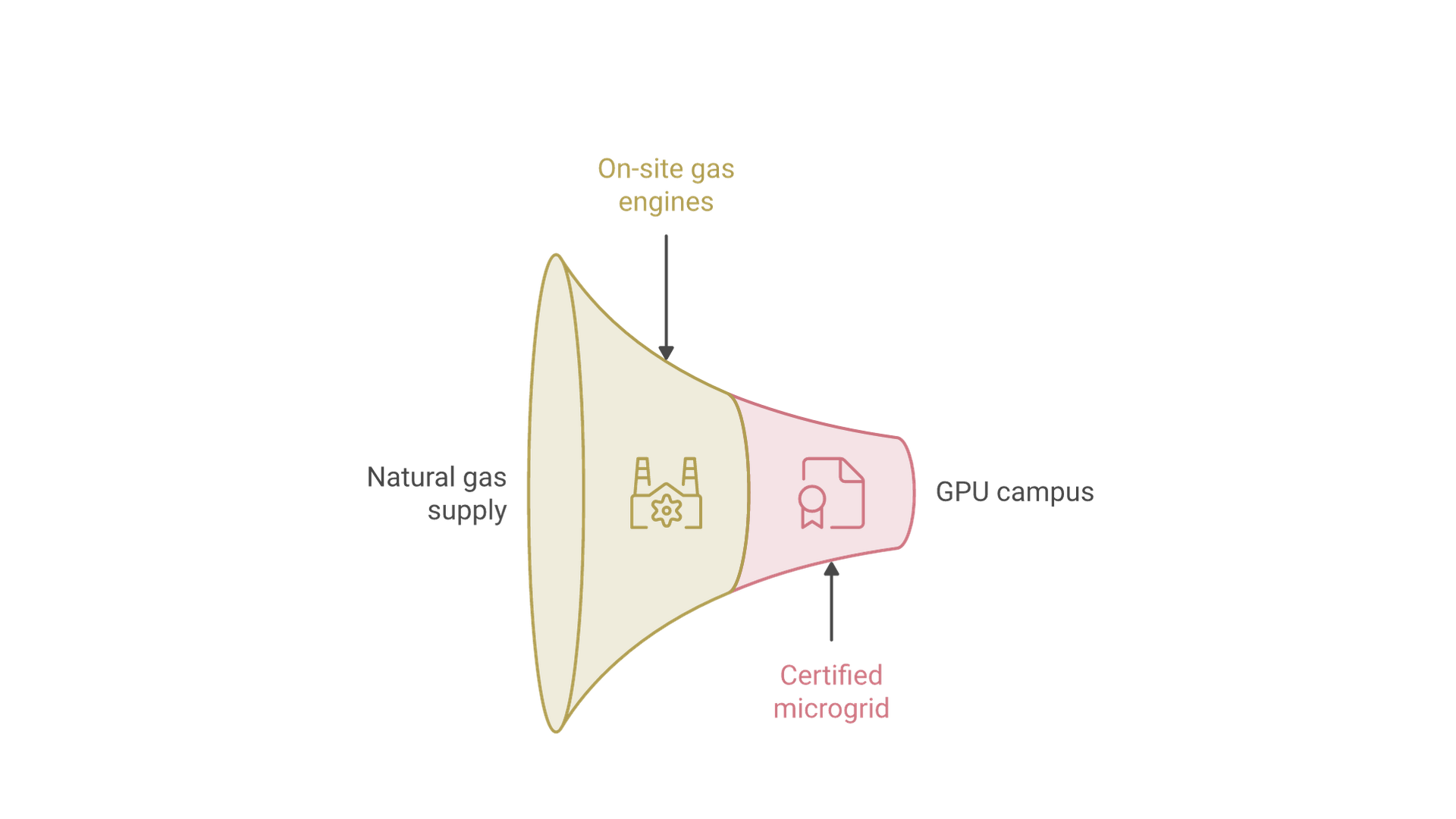
The site is recognized as the first state-certified AI microgrid in the United States, meaning it is designed to generate all of its own power on-site without drawing from the public utility grid. The facility is being designed specifically for large-scale AI model training and inference, with dense GPU superclusters built around NVIDIA's next generation Vera Rubin architecture. The campus uses advanced closed-loop cooling systems that do not rely on municipal drinking water, an increasingly important distinction as water consumption becomes a flashpoint for AI data centers globally.
Two anchor customers define the project's near-term economics. Anthropic signed a deal worth approximately $44.6 billion to lease 460 MW of capacity in the first building, covering a six-year term under GPU services agreements. Microsoft had signed a letter of intent for 1.35 GW of compute capacity, though that arrangement's status is uncertain after Microsoft pulled out of a planned Nscale site in England. The facility will be among the earliest large-scale deployments of NVIDIA's Vera Rubin (NVL72) chips, expected to begin coming online in late 2027.
Nscale operates a broader global network of AI data centers-including campuses in Glomfjord and Narvik (Norway), Sines (Portugal), Keflavik and Blönduós (Iceland), and the U.K.-but the West Virginia campus is its most ambitious U.S. build-out by a wide margin.
Key Facts at a Glance:
Metric | Detail |
|---|---|
Campus area | ~2,250 acres, Mason County, WV |
Phase 1 compute capacity | 1.35 GW (delivery targeted early 2028) |
Full build-out potential | 8 GW+ |
Anchor customer | Anthropic (~$44.6B, 460 MW) |
GPU technology | NVIDIA Vera Rubin (NVL72) |
Cooling | Closed-loop; zero municipal drinking water use |
Power model | Off-grid AI microgrid (first state-certified in U.S.) |
Planned capital investment | $20B+ |

Financing, Partnerships, and NVIDIA's Proposed Loan Guarantee
The money behind Monarch tells a story about the structural fragility-and the strategic ambition-of the neocloud model. Nscale has raised nearly $4 billion for infrastructure projects to date and is pursuing an IPO at a valuation of up to $35 billion, according to its S-1 filing. NVIDIA committed roughly $1 billion in convertible financing to Nscale in September 2026. But as of the IPO filing date, no binding financing commitments had been secured to fully fund the first Anthropic building-a gap that makes the entire project dependent on continued investor confidence and creative financial engineering.
Anthropic's initial contract covers the first 460 MW building at the Monarch campus. The agreement is structured as four separate GPU services tranches, each deploying Vera Rubin NVL72 GPUs, with multi-year service terms triggered upon acceptance of each tranche. Anthropic has the right to terminate any tranche without penalty if Nscale fails to meet delivery timelines-a significant execution risk for Nscale. Beyond the first building, the companies are reportedly in talks for a second deal worth roughly another $45 billion for an additional building, which would make Anthropic's total committed spend at Monarch staggering by any measure.
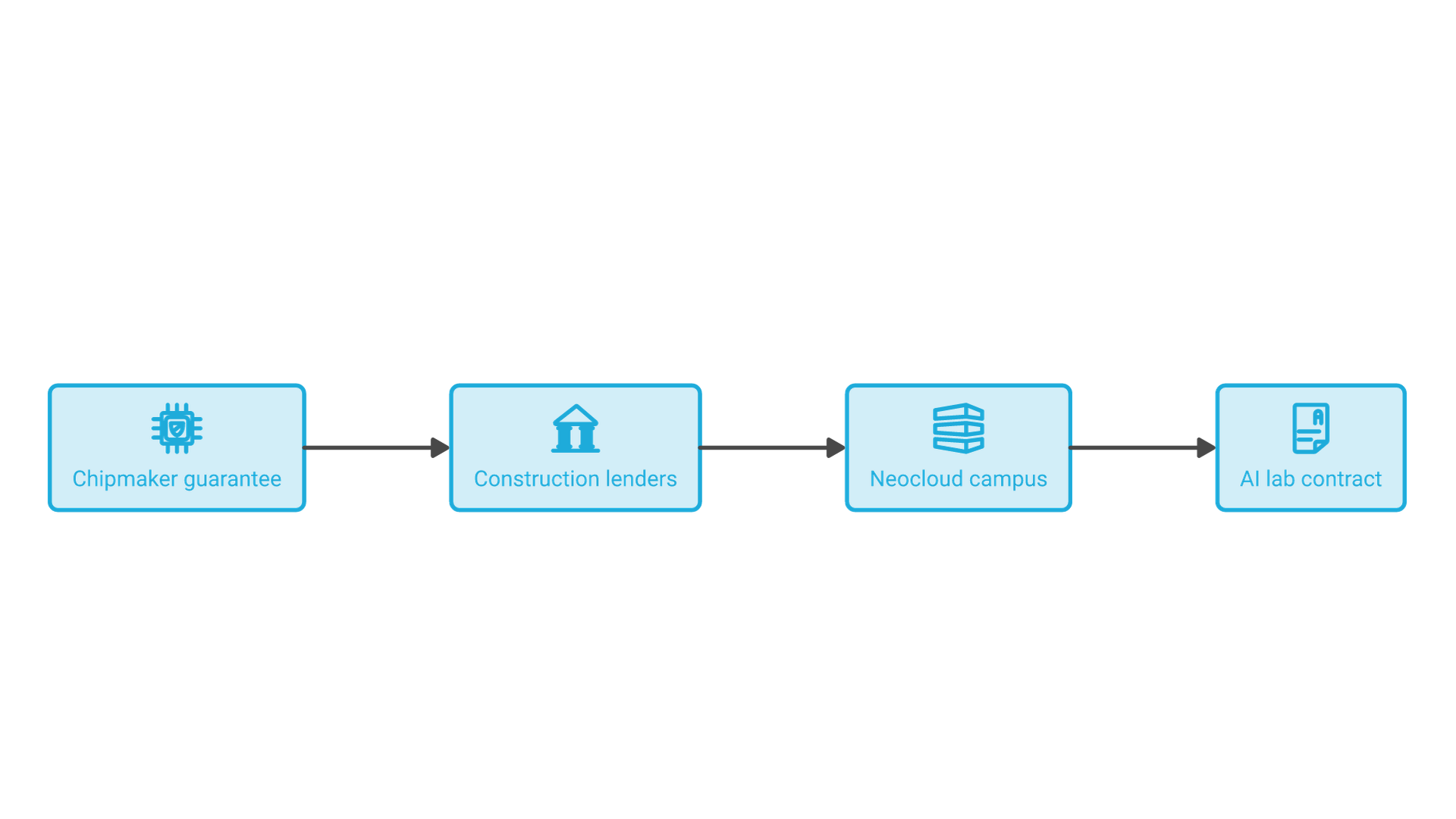
The more interesting development is NVIDIA's proposed role as a financial backstop. In October 2026, Bloomberg and The Information reported that NVIDIA is in talks to provide a residual value guarantee on billions in debt financing for Nscale's West Virginia campus. Under this arrangement, if Nscale defaulted on construction payments, NVIDIA could temporarily take over the facility, stabilize operations, and help find a new buyer or tenant for the AI data center. In effect, the chipmaker would be co-signing a customer's loans-a significant expansion from NVIDIA's prior support, which mostly covered GPU leases and chip purchases rather than physical construction.
This matters because it reveals how deeply intertwined chipmakers, hyperscalers, and neoclouds have become in financing the new generation of AI data centers. NVIDIA has extended roughly $170 billion in investments and credit support to neoclouds and large customers. The incentive is clear: Anthropic is one of the largest buyers of computing power in the world, and keeping Nscale's project on ground means securing a major deployment of NVIDIA's next generation hardware. One investor told The Information that Anthropic's involvement likely explains NVIDIA's willingness to take on infrastructure risk it has historically avoided.
The market context adds pressure. Neocloud providers like CoreWeave, Nebius, and IREN have faced share price declines exceeding 30% in October alone, reflecting investor anxiety about whether companies without cash-rich core businesses can deliver promised AI infrastructure at gigawatt scale. Nscale had about 25,000 advanced AI chips running in August-a fraction of the nearly 500,000 it plans to deploy. Customer concentration is another red flag: Anthropic and Microsoft together account for roughly 85% of Nscale's committed revenue backlog, meaning a single contract failure could unravel the company's entire financial position.
The ability to secure large-scale financing increasingly depends not just on a company's balance sheet but on the strategic interests of its chipmaker and customer ecosystem. NVIDIA is exploring a role that goes well beyond selling GPUs-it's becoming a de facto infrastructure underwriter. For enterprise teams evaluating neocloud partnerships, this entanglement between chip suppliers, cloud operators, and AI labs is not a footnote. It's the structural foundation on which these campuses either get built or collapse.
Power, Microgrid Legislation, and Environmental Impact in West Virginia
The reason Nscale chose West Virginia-and the reason the project is controversial-comes down to a single piece of legislation. In 2025, West Virginia enacted House Bill 2014, the Power Generation and Consumption Act, which created a Certified Microgrid Development Program and a High Impact Data Center certification. Under this law, West Virginia allows off-grid power plants for data centers, provided developers use over 70% of generated electricity on-site. Critically, the law rescinded renewable energy requirements for microgrids, opening the door for gas- or coal-supported baseload power plants tied directly to campuses like Monarch.
HB 2014 does more than streamline energy permitting. Data center developers can redact confidential business information from public filings. Local governments lost rights to enforce zoning ordinances against certified projects, with regulatory authority shifting to the state level. And 60% of property tax revenue from data centers goes to state programs rather than staying entirely with local jurisdictions. The net effect is a regulatory environment that prioritizes speed and scale for AI infrastructure development while sharply limiting local community oversight.
For Nscale's Monarch campus, the power plan reflects this permissive framework. Phase 1 will use an off-grid natural gas plant built with 864 gas-fired internal combustion engines-each roughly 2.5 MW, sourced from Caterpillar's G3500 series-totaling approximately 2.16 GW of generation capacity. Nscale is partnering with major players like NVIDIA and Caterpillar for technology and infrastructure across the project. Nscale's gas generators reduce most nitrous oxide and carbon monoxide emissions compared to older combustion technologies, and Nscale is exploring carbon capture technology for gas generators as a potential future mitigation layer. But carbon capture has not been confirmed for the West Virginia site in any public filing or permit document to date.
The contrast with Nscale's international portfolio is stark. Nscale has prioritized projects using 100% renewable energy at its other campuses: hydropower in Norway, geothermal in Iceland, and seawater cooling in Portugal. The West Virginia site represents a deliberate trade-off-choosing speed of deployment and regulatory ease over the renewable energy credentials that define its European operations. For enterprise customers who track carbon footprint and energy sourcing, that distinction matters.
Local environmental impact has already become a problem. Construction runoff from the Monarch site caused repeated flooding in neighboring subdivisions in May, July, and September 2026. Heavy rainfall overwhelmed temporary erosion controls, sending mud and debris into garages and crawl spaces in the nearby Meadowlands Estates neighborhood. The West Virginia Department of Environmental Protection issued enforcement orders to strengthen stormwater and sediment controls. Meanwhile, Monarch is seeking a Section 401 state-waters permit that would allow alteration or removal of over 28 acres of wetlands-raising concerns from environmental groups about flood protection, hydrology, and aquatic habitat.
After months of negotiations and environmental review, the Monarch Compute Campus earned state certification in September 2026, clearing a major regulatory hurdle. But certification has not eliminated local scrutiny. Communities express concerns about transparency, air quality, noise from hundreds of enclosed generators, and the long-term effects of gas pipelines running through the area. Under HB 2014, their ability to push back through local government channels is sharply constrained.
The broader context is that large-scale AI infrastructure is stressing U.S. power grids and driving demand for alternative energy strategies. Microsoft's shelved Nscale-adjacent project in England-killed by grid power delays pushed into the 2030s-illustrates why off-grid models are attractive despite their environmental trade-offs. The energy demands of frontier AI workloads are growing faster than grid capacity in most regions, making self-generated power a competitive necessity for campuses operating at gigawatt scale.
Risks vs. Benefits of Building AI Data Centers in West Virginia:
- Fast deployment timeline (first power delivery by early 2028) without grid interconnection delays
- Estimated $80M+ in annual tax revenue for Mason County and state programs
- Thousands of construction jobs, hundreds of permanent operations roles
- Off-grid model eliminates grid dependency but relies heavily on natural gas
- Wetland and stormwater impacts create ongoing environmental and legal liability
- Limited local regulatory authority reduces community negotiating power
- Financing remains uncommitted for key phases, creating execution risk
What the Monarch Compute Campus Means for AI Infrastructure and Enterprise Users
Monarch sits at the center of Nscale's global AI infrastructure strategy alongside campuses in Glomfjord, Narvik, Sines, Keflavik, and a planned site in Ward County, West Texas. Each site is optimized for different workload profiles and energy sources, but the West Virginia campus is where Nscale is placing its largest bet on frontier-scale AI compute in the United States. The site aims to provide low-latency connectivity as it is positioned near major technology corridors on the East Coast, giving it a geographic advantage for serving U.S.-based AI labs and enterprise customers.
Technical Profile and Operational Design
The planned technical profile is aggressive. Phase 1 targets 1.35 GW of IT compute load, supported by 2.16 GW of gross generation capacity-the gap accounting for cooling, power conditioning, and redundancy overhead. Dense GPU racks will use NVIDIA Vera Rubin architecture with direct-liquid cooling and low-latency interconnects tailored for advanced AI training and inference. The multi-building campus design allows Nscale to deploy capacity in tranches, with each building brought online as customer agreements are fulfilled and hardware arrives.
Monarch Compute Campus is designed to support AI-driven automation and digital transformation workloads at a scale that few facilities in the world can match today. For customers like Anthropic, this means dedicated capacity for training large multimodal models, running inference for global users of Claude and future models, and experimenting with AI factory-scale workloads that require hundreds of thousands of GPUs running in coordinated clusters.
Nscale is also developing digital twins for AI infrastructure-virtual replicas that simulate physical facilities for operational decisions. Nscale uses NVIDIA DSX Sim for creating digital twins of its campuses, combining design data and operational data over time to build increasingly accurate models of power consumption, cooling performance, and hardware utilization. Nscale aims to optimize facilities using digital twin simulations, enabling predictive maintenance, capacity planning, and what-if analysis before committing physical resources. For enterprise teams evaluating AI infrastructure solutions, digital twins represent a meaningful operational advantage that reduces downtime risk and improves resource allocation.
Economic and Workforce Implications
The campus is projected to generate substantial economic impact for the local region, including estimated tax revenue exceeding $80 million annually. In Phase 1 alone, thousands of construction jobs are expected through 2028, with hundreds of permanent staff for ongoing operations. There is real opportunity for local technical colleges and community education programs to connect into the AI infrastructure ecosystem-training workers in data center operations, power engineering, and environmental monitoring. Whether that opportunity materializes depends on whether Nscale and state institutions invest in workforce development with the same urgency they've applied to permitting and construction.
Execution Risks
The execution challenges are not trivial. Securing and maintaining multi-gigawatt power from on-site generation requires flawless coordination between hundreds of gas engines, fuel supply chains, and maintenance schedules. Managing local environmental impact-stormwater, wetlands, air quality-remains an ongoing liability that could trigger enforcement actions or litigation. The aggressive construction timeline leaves little margin for the kind of weather events that have already stressed temporary controls at the site. And maintaining investor confidence in neocloud data center projects requires demonstrating progress on all fronts simultaneously: financing, construction, customer delivery, and regulatory compliance.
Strategic Guidance for Enterprise Leaders
The question for enterprise leaders is not whether AI infrastructure at this scale will exist. It's how to position their organizations relative to it. The Monarch campus-and projects like it-create a set of strategic options that technology teams should evaluate with clear eyes.
Key takeaways for CIOs, CTOs, and technology decision-makers evaluating AI data center options:
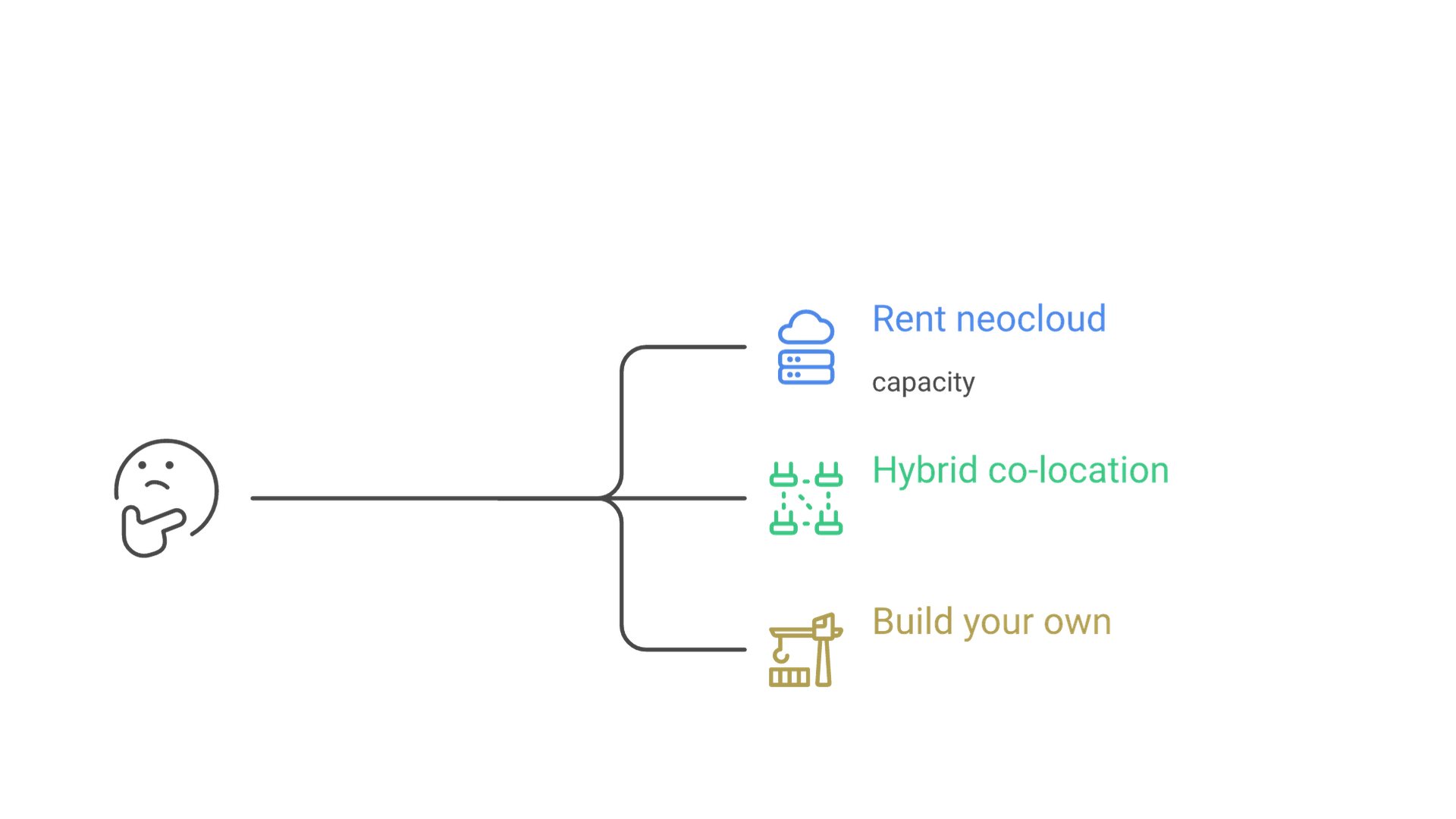
- Renting from neocloud providers like Nscale can be more cost-efficient than internal AI data center builds for organizations that need frontier compute capacity but lack the scale, power expertise, or regulatory appetite to build their own campuses. The trade-off is vendor dependency and concentration risk.
- Co-location and hybrid approaches allow enterprises to use neocloud infrastructure with direct connectivity while maintaining some operational control. This is particularly relevant for regulated industries that need secure, governance-aware AI infrastructure.
- Building your own AI data center remains viable for hyperscalers and large enterprises with sufficient cash, energy access, and in-house expertise-but the complexity of power, cooling, and regulatory compliance at gigawatt scale is increasing faster than most organizations can adapt.
- Governance, compliance, and energy sourcing should be part of any AI infrastructure evaluation. Contracts with neocloud providers should include audits of delivery timelines, environmental compliance, power source transparency, and operational performance metrics.
- Digital twin capabilities, modular deployment models, and flexible infrastructure orchestration are emerging as differentiators among AI data center operators. Ask potential providers how they model, monitor, and optimize their facilities.
Monarch represents a bet-by Nscale, by NVIDIA, by Anthropic-that the demand for frontier AI compute will outpace every concern about financing, emissions, and execution risk. Whether that bet pays off depends on construction discipline, regulatory navigation, and whether the billions in committed agreements translate into actual revenue over the years ahead. For enterprise teams, the lesson is more immediate: the AI infrastructure landscape is consolidating around a few massive campuses, a handful of chipmakers, and a set of financial arrangements that look more like project finance than traditional cloud contracts. Understanding that structure-and its risks-is now a core competency for any organization whose future depends on AI.
Talk to Cognativ about building a secure AI infrastructure strategy tied to measurable business outcomes-or start with a focused assessment of your compute needs, governance requirements, and vendor dependency risks.