


OpenAI $500 Billion Valuation: The Share Sale, the Revenue and What Came Next
From a $6.6 billion employee share sale to an $852 billion round and $1.25 trillion talks, see what is behind OpenAI's price and what it means for AI buyers.
The OpenAI $500 billion valuation was set on October 2, 2025, when current and former employees sold about $6.6 billion of stock to outside investors. It made the ChatGPT maker the world's most valuable private company, ahead of SpaceX, and the reference point for how markets price AI.
A year later, OpenAI had closed a $122 billion round at an $852 billion post-money valuation in March 2026, filed confidentially for an IPO in June, and in late October was reportedly finishing a raise at a $1.25 trillion pre-money valuation. Revenue grew fast, and so did questions about compute and revenue accounting.
In this guide: the October 2025 share sale, how AI valuations are built, what drives OpenAI revenue, a dated timeline to October 31, 2026, and what it means for AI buyers.
How OpenAI Reached a $500 Billion Valuation
The $500 billion figure did not come from a new fundraising round. It came from a secondary sale, in which existing shareholders sell stock they already own to new buyers. According to CNBC's report on the completed sale, OpenAI authorized up to $10.3 billion of shares, up from an initial target of about $6 billion, and eligible employees who had held shares for more than two years sold roughly $6.6 billion, about two-thirds of the capacity.
Reuters, citing a person familiar with the deal and republished by BNN Bloomberg, named the buyers as Thrive Capital, SoftBank, Dragoneer Investment Group, Abu Dhabi's MGX and T. Rowe Price. The same report put OpenAI's first-half 2025 revenue at about $4.3 billion, citing The Information. The previous price was $300 billion, set by a SoftBank-led financing of up to $40 billion earlier in 2025, as Crunchbase News noted.
Why a Secondary Sale Sets a Valuation
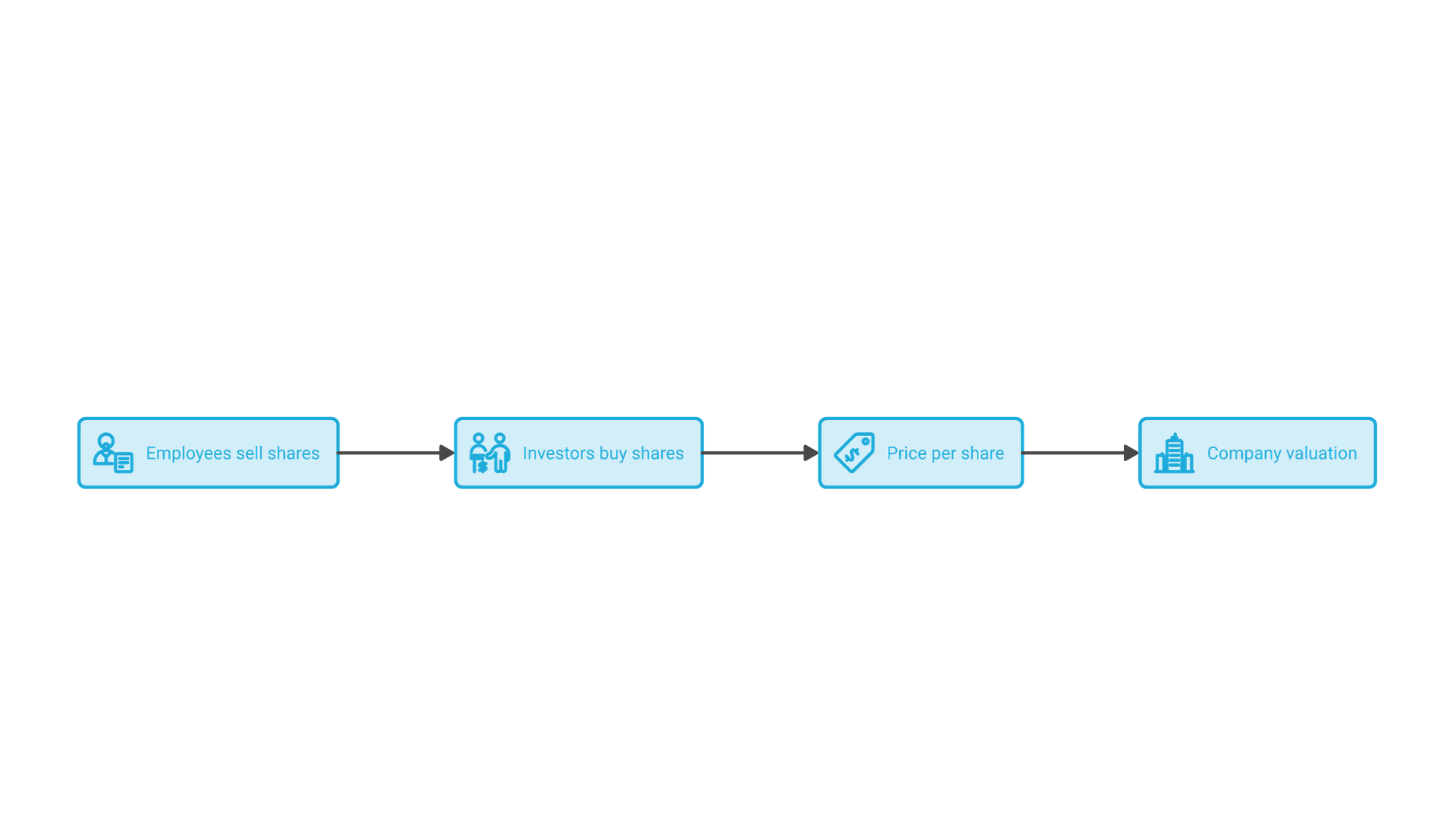
A secondary sale puts no new money on OpenAI's balance sheet; the cash goes to the sellers. It still sets a market price, because sophisticated buyers agreed to a price per share. Multiply that price by the fully diluted share count and you get the headline valuation, one of the few observable signals of value for a private company.
Why the Sale Mattered
Liquidity is a retention tool: letting heavily recruited researchers sell part of their stake without an IPO helps keep them. The fact that sellers used only about two-thirds of the authorized amount was read internally, according to CNBC, as a sign of confidence: many employees preferred to keep their shares at a $500 billion price.
How AI Company Valuations Work
Private AI valuations combine ordinary venture math with features specific to frontier models.
Growth and Revenue Multiples
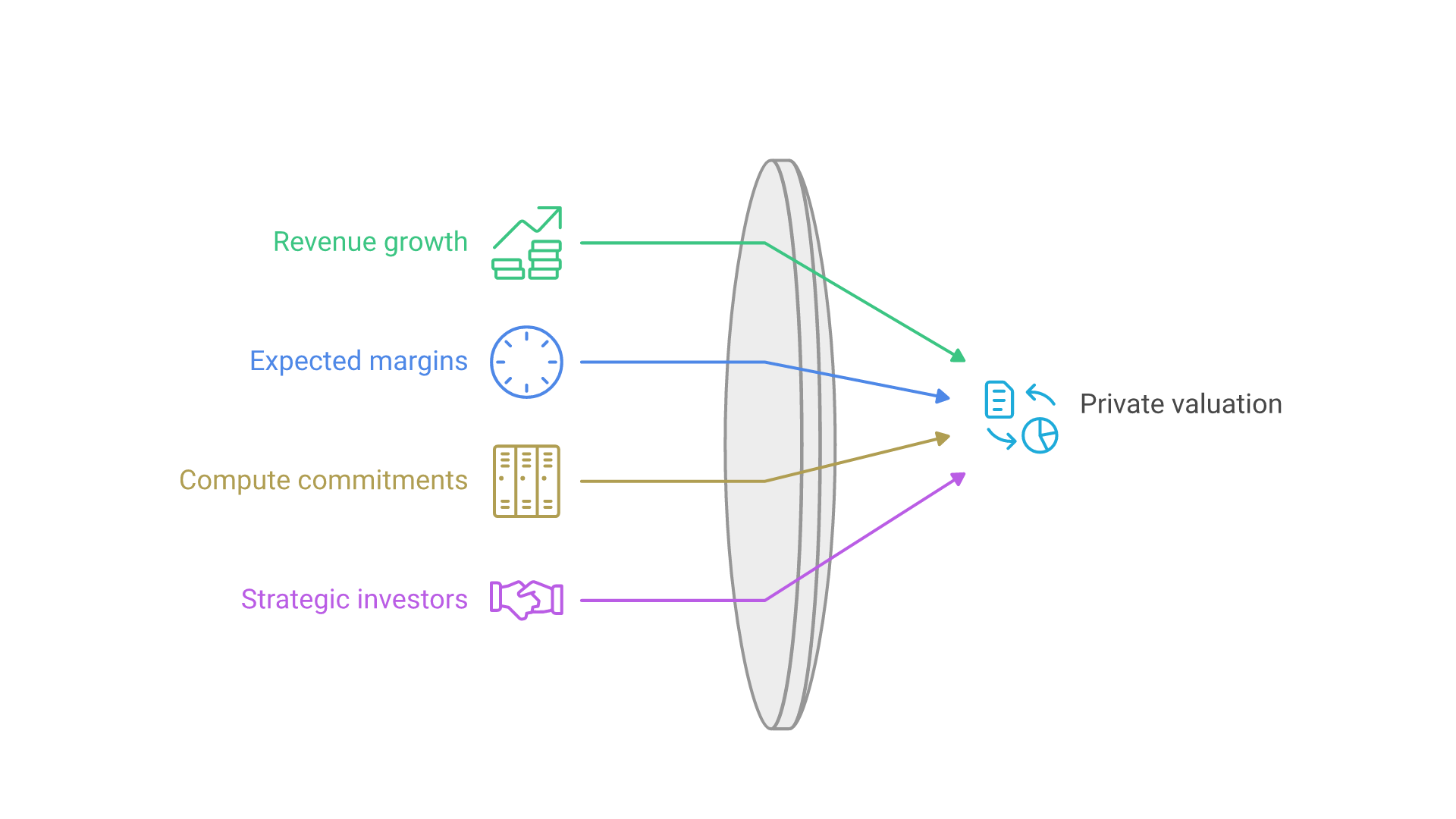
Fast-growing software companies are usually priced as a multiple of forward revenue, adjusted for growth and expected margins. OpenAI is not profitable, so there is no earnings ratio to anchor the number; the valuation rests on projections, including the more than $280 billion of 2030 revenue that CNBC reported OpenAI had shown investors.
Pre-Money, Post-Money and Secondary Prices
A pre-money valuation is the company's value before new capital arrives; post-money adds the new cash. The March 2026 figure of $852 billion is post-money, while the reported October 2026 figure of $1.25 trillion is pre-money, so the two are not directly comparable. Secondary prices can also differ from primary-round prices because the shares carry different rights.
Strategic Investors and Compute
Many of OpenAI's largest backers also sell it compute: Microsoft, Nvidia and Amazon among them. Part of such an investment can return as purchases, and some commitments are conditional. CNBC reported that Amazon's $50 billion commitment in the March 2026 round started with $15 billion, with the remaining $35 billion due once certain conditions are met.
What Drives OpenAI Revenue
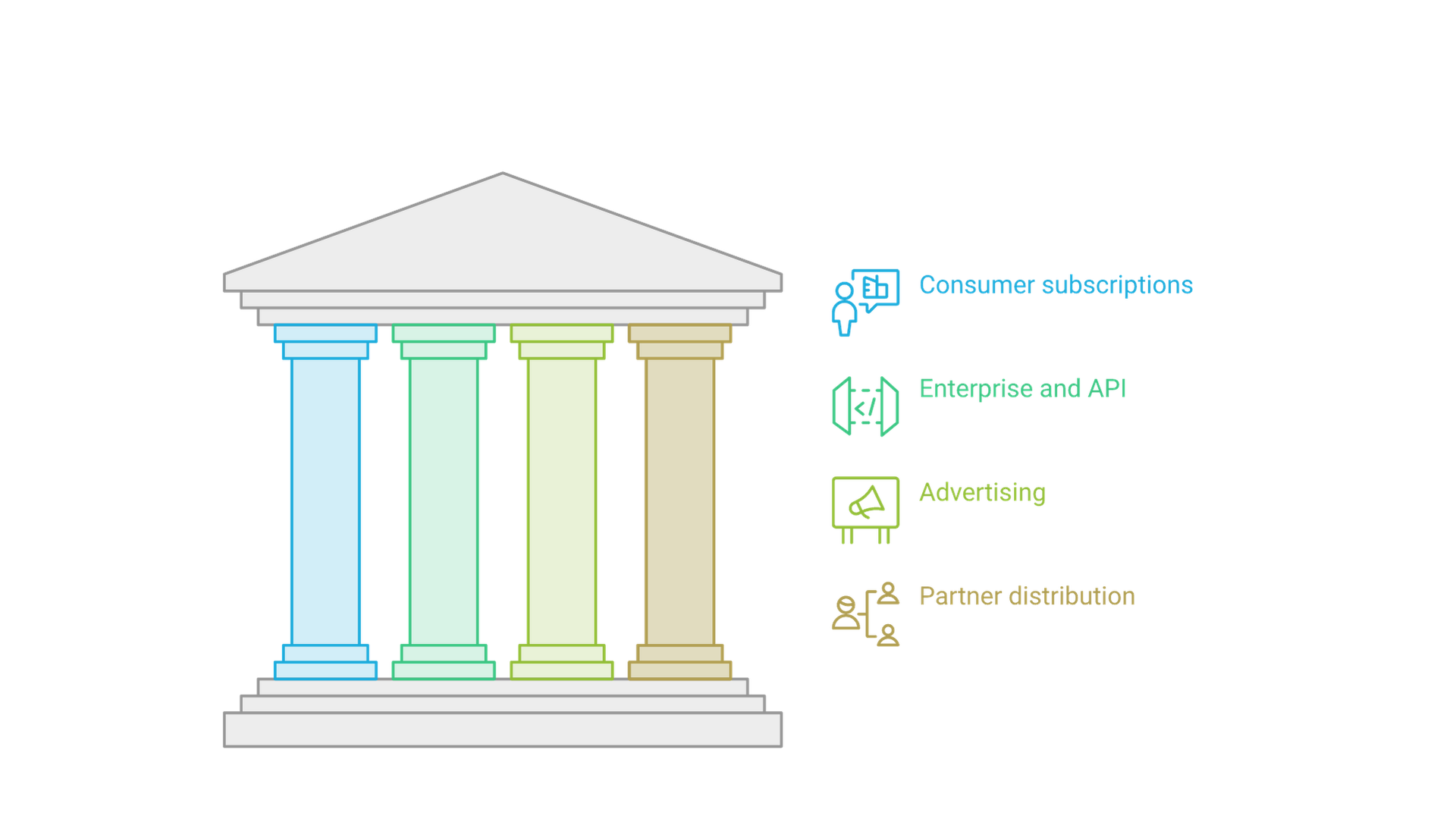
The 2025 debate was whether roughly $13 billion of annual revenue could support a $500 billion price. On a November 2025 episode of the BG2 podcast, Sam Altman said the company was doing "well more revenue than that," as TechCrunch reported. CNBC later reported, citing people familiar with the matter, that 2025 revenue came in at $13.1 billion, above a $10 billion target, with cash burn of about $8 billion. Revenue comes from four streams.
Consumer Subscriptions
ChatGPT's paid plans remain the foundation. When the March 2026 round closed, CNBC reported more than 900 million weekly active users, more than 50 million subscribers and revenue of about $2 billion per month.
Enterprise Seats and the API
Business plans, enterprise agreements and pay-per-token API access let companies embed OpenAI models in their products. It is OpenAI's main growth focus: in its third-quarter 2026 investor update, CNBC reported, enterprise run-rate grew 107%, compared with 77% for the company overall.
Advertising
OpenAI began testing labeled ads in the Free and Go tiers of ChatGPT in the U.S. in February 2026. By August 31, CNBC reported, the company said ads had reached a $1 billion annualized run rate across more than 40 countries, with ChatGPT serving about 1 billion weekly users.
Partner Distribution
Models also reach customers through partners such as Microsoft, whose agreement with OpenAI includes revenue-sharing terms. How that partner revenue is counted became a material question in October 2026, covered below. For background on how the Microsoft revenue share has been structured and capped, see our analysis of the OpenAI and Microsoft revenue share cap.
The Cost Side: Compute, Energy and Cash Burn
Unlike traditional software, generative AI has meaningful marginal costs: every answer runs on GPU clusters that consume power and need constant expansion. That makes OpenAI's valuation inseparable from its infrastructure commitments.
When OpenAI completed its recapitalization on October 28, 2025, Microsoft said OpenAI had contracted to purchase an incremental $250 billion of Azure services, while Microsoft gave up its right of first refusal as compute provider. Oracle has a $300 billion, five-year compute deal with OpenAI, according to CNBC. In February 2026, CNBC reported that OpenAI told investors it now targets roughly $600 billion of total compute spending by 2030, a lower and more defined figure than the much larger infrastructure commitments discussed in late 2025.
For enterprise teams the same economics apply at smaller scale: inference cost and capacity decide whether an AI feature pays off. Our guide to AI inference infrastructure considerations covers those trade-offs in more detail.
What Has Happened Since: October 2025 to October 2026
Key dated events after the $500 billion sale, from the sources cited here. Figures attributed to people familiar with the matter were not publicly confirmed by OpenAI.
| Date | Event |
|---|---|
| Oct 2, 2025 | Employee secondary sale of about $6.6 billion at a $500 billion valuation |
| Oct 28, 2025 | Recapitalization: OpenAI Foundation controls OpenAI Group PBC; Microsoft holds about 27% on an as-converted diluted basis, valued at about $135 billion |
| Feb 2026 | Ads testing begins in ChatGPT Free and Go tiers in the U.S. |
| Mar 31, 2026 | $122 billion round closes at an $852 billion post-money valuation, including $3 billion from individual investors through banks |
| Apr 28, 2026 | The Wall Street Journal reports missed user and revenue targets; OpenAI disputes the report |
| Jun 2026 | OpenAI announces a confidential draft IPO registration with the SEC |
| Aug 31, 2026 | Ads business reaches a $1 billion annualized run rate |
| Oct 8, 2026 | OpenAI reports about $50 billion of annualized revenue at the end of September |
| Oct 22, 2026 | Reported to be nearing a raise of up to $30 billion at a $1.25 trillion pre-money valuation |
The Revenue Accounting Question
The most consequential update for valuation came on October 8, 2026. CNBC confirmed a Financial Times report that OpenAI told investors it reached about $50 billion of annualized revenue at the end of September, below a widely reported $68 billion figure. A person familiar with the matter said the higher number had included gross revenue from partners. Shares of Nvidia, Oracle and CoreWeave fell that day.
The Path to a Trillion-Dollar Price and an IPO
On October 22, CNBC reported that OpenAI was close to finalizing a round of up to $30 billion at a $1.25 trillion pre-money valuation, led by UAE investors and Coatue. The same report said CFO Sarah Friar told employees in August that OpenAI "will be a public company in 2027." As of October 31, 2026, we found no announcement that the round had closed. Competition is also priced in: CNBC reported that Anthropic closed a $65 billion round in May at a $965 billion valuation.
Risks Behind the Number
A valuation is a bet on future execution. The main risks in 2026 reporting are concrete.
- Revenue quality. The gap between gross and net annualized revenue showed that headline run rates depend on accounting choices.
- Compute obligations. Multi-year capacity contracts are fixed costs; if growth slows, they weigh on cash.
- Competition. Anthropic, Google and open-weight models compete for the same enterprise budgets.
- Supplier concentration. A few cloud and chip providers supply most of the compute.
- Regulation and disclosure. An IPO would require audited financials and public risk factors.
They also explain market concern that AI spending is concentrated in a few companies, which we examine in our article on the AI boom and financial risks in U.S. markets.
What It Means for Enterprise AI Buyers and Builders
OpenAI's valuation is not a procurement metric, but the forces behind it affect every company that depends on frontier models. Vendors under pressure to justify trillion-dollar prices will push enterprise contracts and change pricing and packaging.
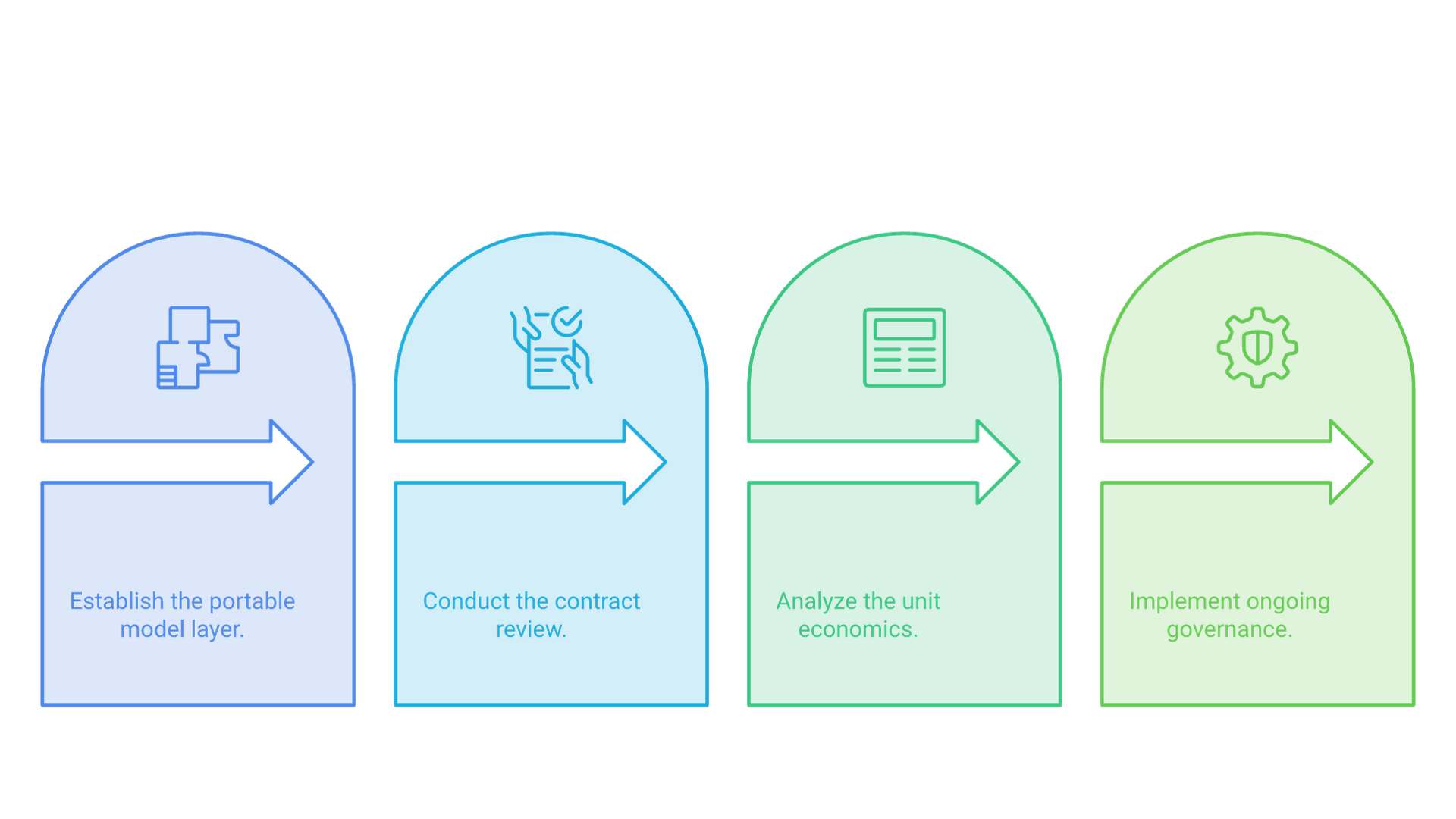
Design applications so the model layer can be swapped, and test an alternative provider or open-weight model for critical workloads. Read contracts for data use, price changes, rate limits and exit rights. Measure unit economics per use case, and keep governance over prompts, outputs and data retention regardless of vendor.
Teams choosing models, providers and deployment patterns can start with an independent technology strategy review. After that, retrieval, fine-tuning or private deployment is where LLM solutions turn a vendor choice into a production system.
Frequently Asked Questions
How much is OpenAI worth?
OpenAI's last closed round, in March 2026, valued it at $852 billion post-money. In late October 2026 it was reported to be finishing a raise at a $1.25 trillion pre-money valuation, which had not been announced as closed by October 31.
When did OpenAI reach a $500 billion valuation?
On October 2, 2025, when current and former employees sold about $6.6 billion of shares to investors including Thrive Capital, SoftBank, Dragoneer, MGX and T. Rowe Price, according to Reuters.
How does OpenAI make money?
Through ChatGPT consumer subscriptions, business and enterprise plans, API usage billed by tokens, advertising in the Free and Go tiers, and revenue from distribution partners such as Microsoft.
Is OpenAI profitable?
No. CNBC reported that OpenAI burned about $8 billion of cash in 2025 on $13.1 billion of revenue, and it still spends more than it earns.
Who owns OpenAI?
After the October 2025 recapitalization, the nonprofit OpenAI Foundation controls OpenAI Group PBC. Microsoft holds about 27% on an as-converted diluted basis; the Foundation, employees and other investors hold the rest of the equity.
Can you buy OpenAI stock?
Not on a public exchange. OpenAI filed confidentially for an IPO in June 2026 but has no public listing yet.
Conclusion: What the $500 Billion Valuation Tells Us Now
The OpenAI $500 billion valuation came from an employee share sale, not a new round, and marked the moment private markets began pricing AI labs like infrastructure companies. Within a year the price rose to $852 billion and talks reached $1.25 trillion, while revenue reached a reported $50 billion run rate and questions about accounting and compute grew with it.
For enterprises, the lesson is about dependency: these vendors will keep changing products, prices and terms on the way to public markets, so the safest AI strategy stays portable, measured and governed. If you are weighing which AI platforms to build on and how to keep that choice flexible, talk to Cognativ about your AI roadmap.