

Qualcomm AI200 and AI250: How Qualcomm Turned Smartphone Chip Parts into Data Center AI Chips
Qualcomm scaled its Snapdragon Hexagon NPU into AI200 and AI250 inference racks. See the specs, Humain's 200 MW plan and what buyers should weigh in 2026.
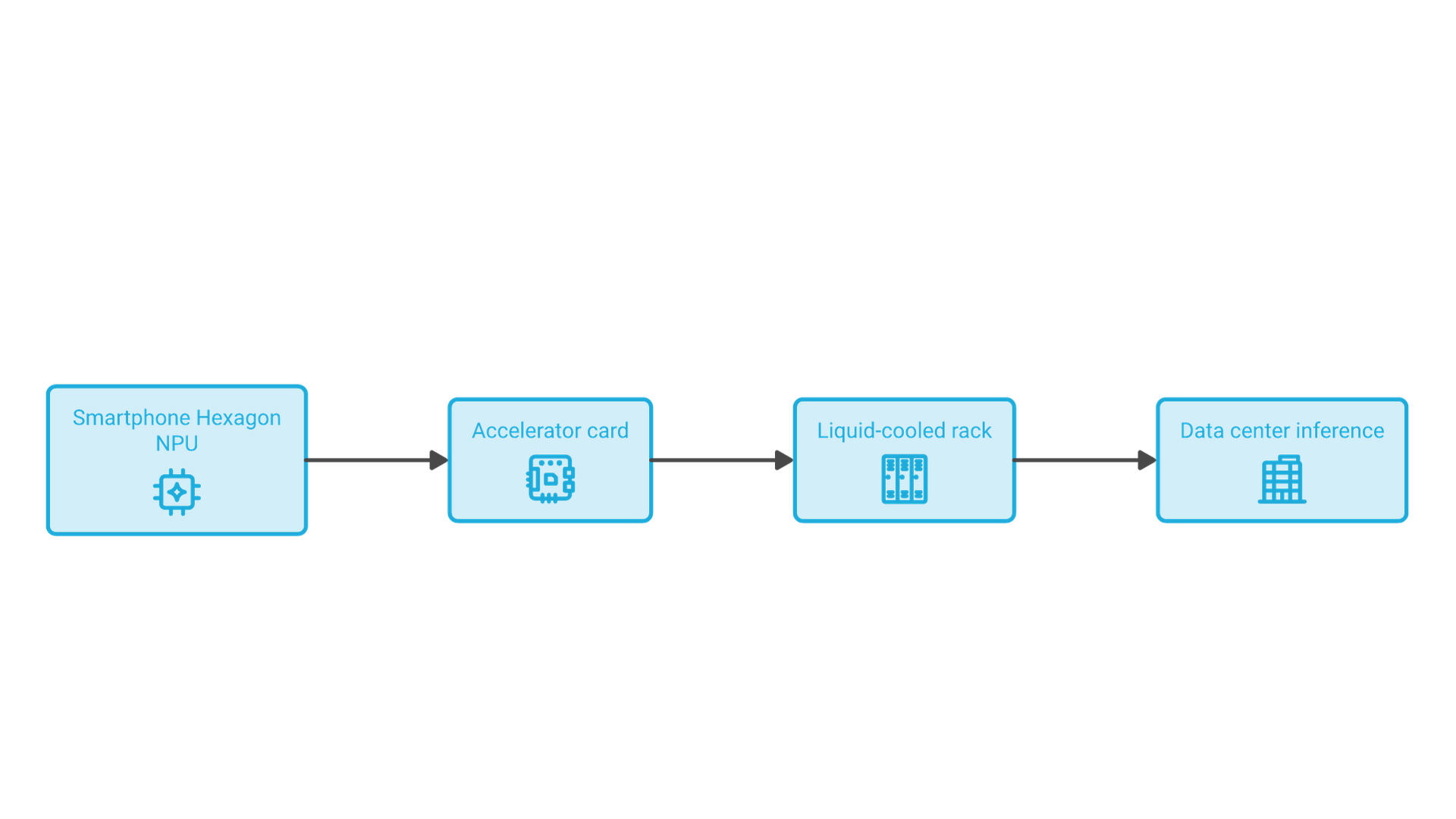
On October 27, 2025, Qualcomm announced the AI200 and AI250, its first rack-scale AI chips for data centers. The headline idea was unusual: instead of designing a GPU from scratch, Qualcomm took the Hexagon neural processing unit (NPU) that runs AI features in its smartphone chips and scaled it up into accelerator cards and liquid-cooled server racks built to run trained AI models. Investors noticed. Qualcomm shares closed up about 11% that day, and the launch was widely framed as a direct challenge to Nvidia and AMD.
A year later, the story has grown. Qualcomm has put its data center products under a new brand, Dragonfly, added a third-generation accelerator and a server CPU to the roadmap, named Meta as a CPU customer and agreed to buy the AI software company Modular. This guide anchors on the original announcement, explains the key numbers, tracks what has happened through October 31, 2026, and sets out what Qualcomm's AI chips mean for enterprises that buy or build AI inference capacity.
Short answer: the AI200 and AI250 are inference accelerators, not training chips, built on the bet that cheap, memory-rich, low-power model serving will outgrow training.
What Qualcomm Announced on October 27, 2025
In its October 2025 press release, Qualcomm introduced two accelerator cards and the racks that hold them. Both target inference for large language models (LLMs) and large multimodal models, and Qualcomm committed to an annual cadence for its data center AI roadmap.
Qualcomm AI200
The AI200 is the first generation. Each card carries 768 GB of LPDDR memory, a lower-cost, lower-power memory type borrowed from the mobile world rather than the expensive high-bandwidth memory (HBM) stacked on most data center GPUs. Qualcomm said the AI200 would be commercially available in 2026.
Qualcomm AI250
The AI250 keeps the same idea but adds what Qualcomm called a near-memory computing architecture, moving compute closer to where model weights are stored. At launch Qualcomm claimed more than 10 times higher effective memory bandwidth than the AI200 at much lower power, plus support for disaggregated inference, where the stages of serving a model run on separate hardware. Availability was set for 2027.
The rack
Both cards ship in racks with direct liquid cooling, PCIe for scale-up inside the rack, Ethernet for scale-out across racks, confidential computing for protected workloads, and a rack-level power draw of 160 kW. CNBC noted that 160 kW is comparable to some Nvidia GPU racks.
How Qualcomm Is Turning Smartphone Chip Parts into AI Chips
The "smartphone parts" in this story are mainly the Hexagon NPU. For years Qualcomm has shipped Hexagon inside Snapdragon phone chips to run on-device AI tasks such as photo processing, speech and, more recently, small generative models, all within a phone's tight battery and heat limits. According to CNBC, the AI200 and AI250 are based on those same Hexagon NPUs.
Qualcomm has tried the data center before. It announced the Cloud AI 100 inference accelerator in April 2019, pitched on performance per watt. The AI200 and AI250 extend that line from a single card to complete racks. Durga Malladi, the Qualcomm executive who led the launch, told CNBC the company "first wanted to prove ourselves in other domains" before moving into data centers at scale.
The mobile heritage shows up in three choices: an efficient NPU instead of a GPU, cheaper LPDDR memory instead of HBM, and a focus on total cost of ownership (TCO) over peak compute. Memory is the strategic point. HBM competes for the same constrained memory supply chain, a pressure we cover in our look at the global memory shortage, so an accelerator that leans on mobile-style memory sidesteps part of that bottleneck.
Qualcomm AI200 vs AI250: Key Specs Explained
The table combines figures from the October 2025 launch with the updated numbers Qualcomm gave in June 2026. All performance figures are Qualcomm's own claims; no independent benchmarks of either rack had been published as of October 31, 2026.
| Item | AI200 | AI250 |
|---|---|---|
| Generation | First | Second |
| Memory per card | 768 GB LPDDR (LPDDR5X) | Near-memory compute (HBC Gen 1) |
| Effective memory bandwidth | Baseline | Over 10x AI200 at launch; 133 TB/s per card and 18x AI200 per the June 2026 update |
| Cooling | Direct liquid cooling | Direct liquid cooling |
| Rack power | 160 kW | 160 kW |
| Scale-up / scale-out | PCIe / Ethernet | PCIe / Ethernet |
| Stated timing | Commercially available in 2026 | 2027; commercial sampling expected mid-2027 |
The 768 GB per card matters because large models must fit in memory to serve quickly; CNBC reported it exceeds comparable Nvidia and AMD offerings. The bandwidth claim matters because large-model inference is often limited by memory, not raw compute.
Why Qualcomm Targets AI Inference, Not Training
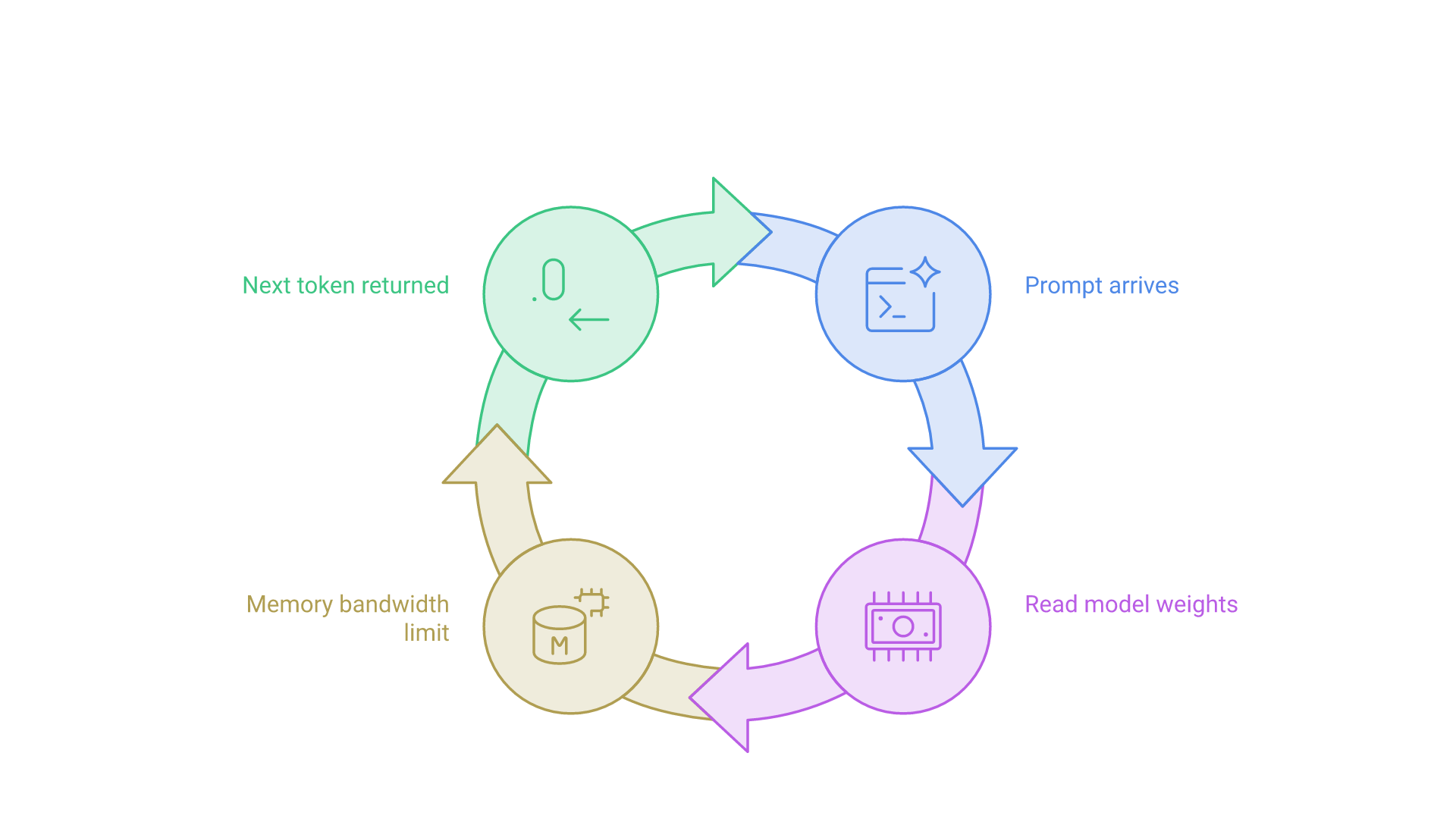
Training builds a model once on huge clusters; inference runs it every time a user asks a question or an agent calls a tool. In production, inference is the recurring cost, so Qualcomm bets buyers will care more about tokens per watt and cost per token than training speed.
That is why the AI200 and AI250 focus on memory capacity and bandwidth. When a model answers a prompt, the accelerator repeatedly reads model weights and the growing context from memory to produce each new token. If memory is too small, the model must be split across more cards; if bandwidth is too low, tokens arrive slowly. Our guide to AI inference infrastructure considerations walks through how these trade-offs shape real deployments.
Agentic AI sharpens the point, because agents make many model calls per task. In June 2026 CEO Cristiano Amon said agentic AI is driving a significant increase in data center inference demand.
Humain: Qualcomm's First Data Center AI Customer
Qualcomm launched with a named customer. Humain, the Saudi Arabian AI company, first agreed in May 2025 to use Qualcomm inference chips, according to CNBC, committing to systems drawing up to 200 megawatts of power. On launch day the two companies announced that Humain is targeting 200 MW of AI200 and AI250 rack solutions starting in 2026, for inference in Saudi Arabia and globally.
Note that 200 MW is a capacity target, not a chip count or a dollar figure. As of October 31, 2026, we found no public confirmation from either company that the first Humain racks are in production service, so the deployment should still be treated as planned and in progress.
Qualcomm vs Nvidia and AMD in the Data Center
Qualcomm is entering a market where, CNBC reported at launch, Nvidia's GPUs held over 90% of AI chip sales. Nvidia's lead rests on its CUDA software ecosystem as much as its silicon, a dynamic we examine in Nvidia's competitive edge in the AI chip market. AMD competes with its own GPU accelerators and rack systems, and hyperscalers increasingly design custom chips.
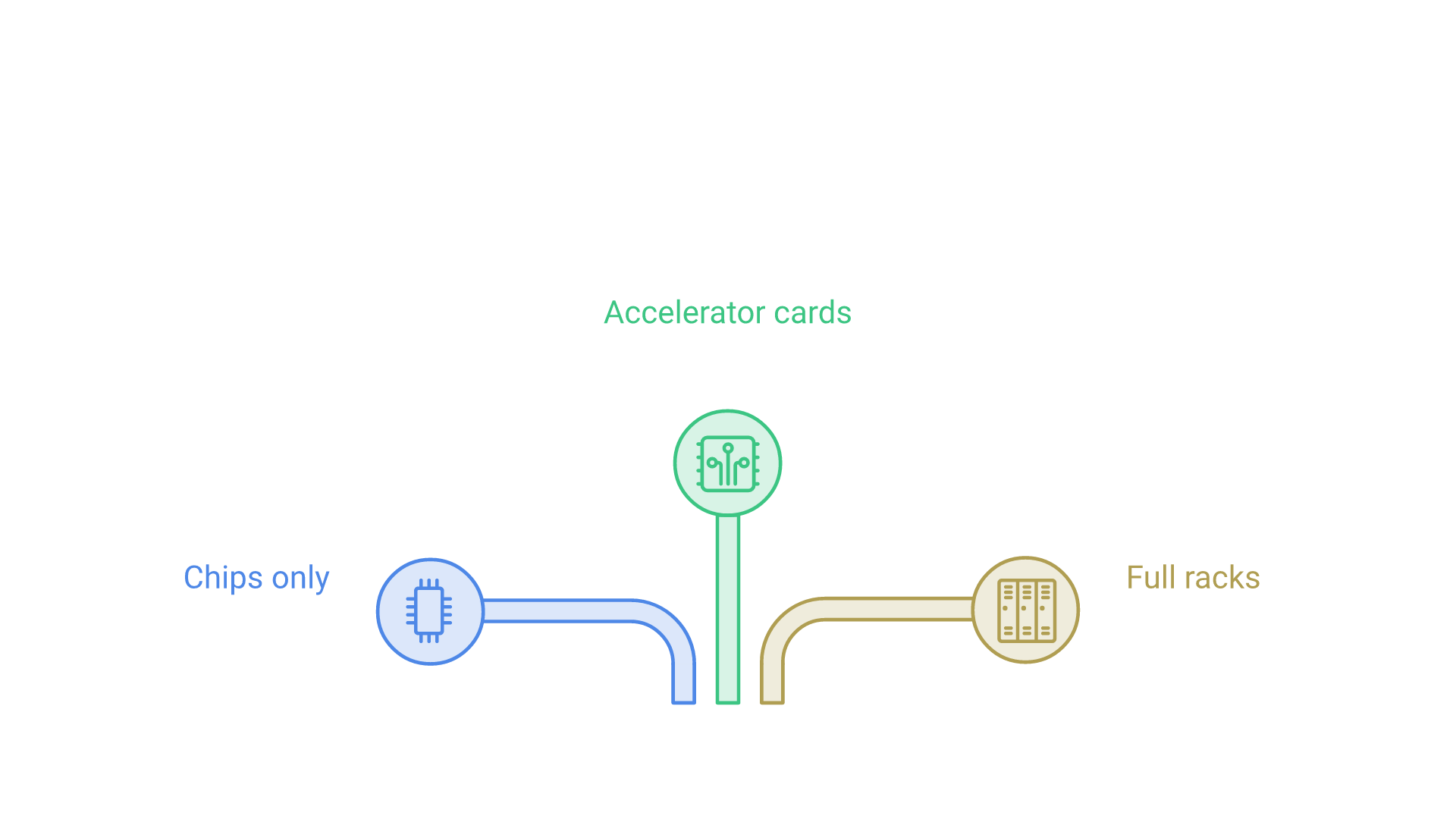
Qualcomm's angle is flexibility. Malladi told CNBC that customers can "take all of it" or mix and match, buying chips, cards or full racks. That suits hyperscalers that design their own racks, and Malladi even said Nvidia or AMD could become customers for parts such as Qualcomm's CPU. Selling components separately is a different motion from the integrated systems that dominate GPU sales.
The market Qualcomm is chasing is large. CNBC cited a McKinsey estimate of nearly $6.7 trillion in data center capital spending through 2030, most of it on systems built around AI chips.
What Has Happened Since: Dragonfly, AI300 and Modular
At Computex in early June 2026 it introduced Dragonfly as the brand for its data center products, so the chips are now marketed as the Qualcomm Dragonfly AI200 and AI250. At its June 2026 Investor Day it laid out a fuller Dragonfly roadmap, and CNBC reported a target of $15 billion in data center sales by fiscal 2029.
| Date | Development |
|---|---|
| May 2025 | Humain agreement for up to 200 MW of Qualcomm inference systems (per CNBC) |
| October 27, 2025 | AI200 and AI250 announced; Humain named first rack customer |
| Early June 2026 | Dragonfly brand introduced at Computex |
| June 2026 | Investor Day: Dragonfly C1000 CPU, AI300 and High Bandwidth Compute announced; Meta named as C1000 customer |
| June 24, 2026 | Qualcomm agrees to acquire Modular; closing expected in the second half of 2026 |
New Dragonfly products
The roadmap adds the Dragonfly C1000, a server CPU built on Qualcomm's Oryon cores with commercial availability expected in 2028, which Meta plans to use. It also names High Bandwidth Compute (HBC), a 3D-stacked near-memory design: HBC Gen 1 powers the AI250, and HBC Gen 2 powers the AI300, a third-generation accelerator with commercial sampling expected in 2028. Qualcomm cites multi-year agreements with unnamed customers.
The Modular acquisition
On June 24, 2026, Qualcomm agreed to acquire Modular, whose software lets developers build once and deploy across CPUs, GPUs, NPUs and custom accelerators. CNBC described it as Qualcomm's answer to Nvidia's CUDA. The deal addresses the biggest open question about the AI200 and AI250: whether developers can move models onto new hardware without costly rewrites.
What Qualcomm's AI Chips Mean for Enterprise AI Buyers
Most enterprises will not buy a 160 kW rack directly; they will meet Qualcomm hardware through cloud providers, colocation partners or sovereign AI programs like Humain's. The practical effect is more choice and more price pressure on inference capacity.
Plan for hardware portability
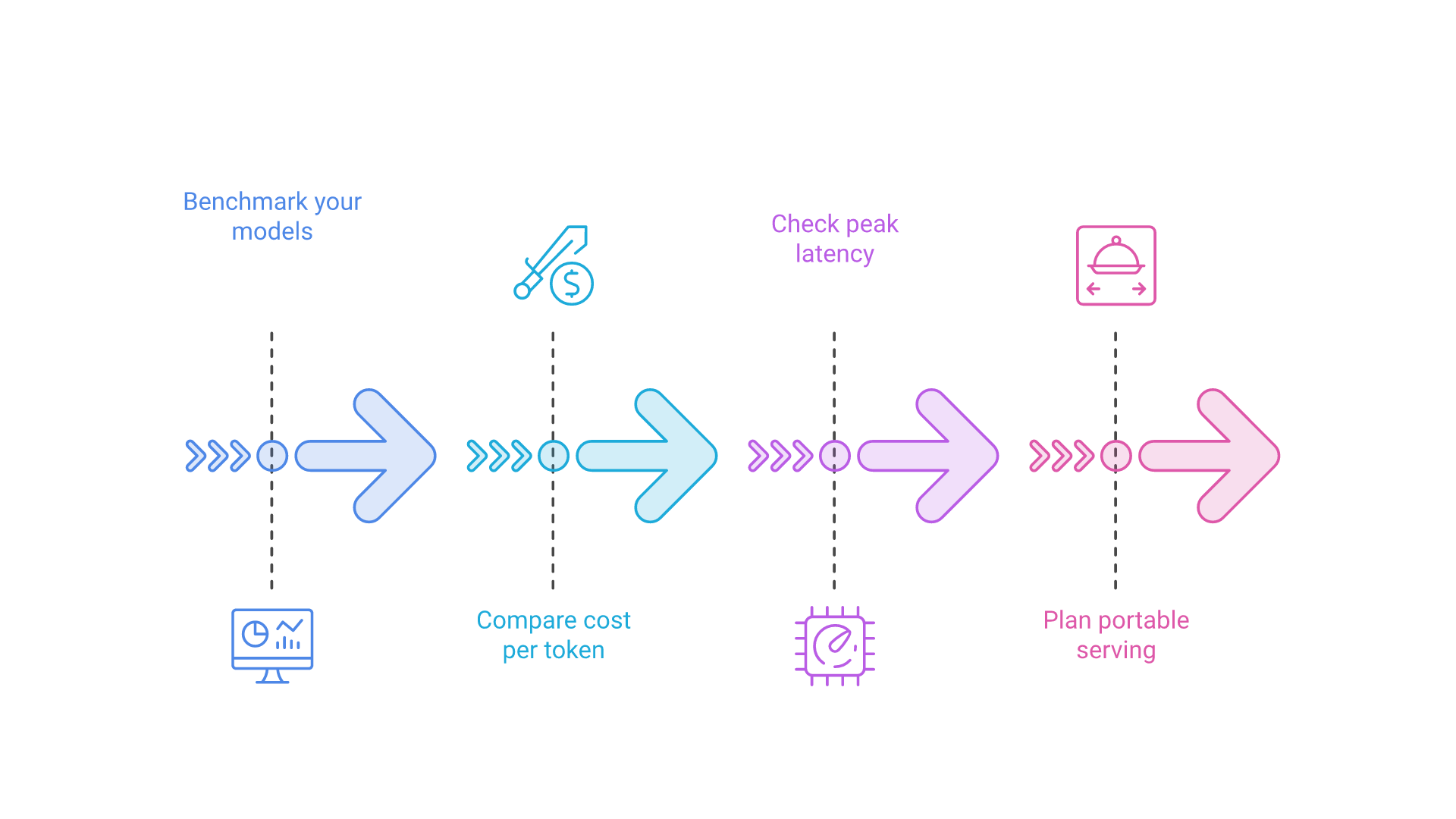
More accelerator vendors make portable model serving pay off. Standard model formats, open inference engines and a hardware abstraction layer let you move workloads to the best cost per token. Our AI infrastructure services are built around that kind of vendor-neutral design.
Measure what you actually pay for
Vendor tokens-per-watt claims are a starting point, not a decision. Benchmark your own models and concurrency, and compare cost per token, peak-load latency and porting effort. Teams evaluating where to run workloads can use cloud infrastructure consulting to structure that comparison.
Frequently Asked Questions
What are the Qualcomm AI200 and AI250?
They are Qualcomm's data center AI inference accelerators, sold as cards and liquid-cooled racks. The AI200 was announced for 2026 with 768 GB of LPDDR memory per card, and the AI250, planned for 2027, adds near-memory computing for much higher effective bandwidth.
Is Qualcomm making AI chips to compete with Nvidia?
Yes. The AI200 and AI250 compete with Nvidia and AMD for data center inference, where Qualcomm emphasizes memory capacity, power efficiency and lower total cost of ownership rather than training performance.
Are Qualcomm's data center chips based on smartphone technology?
Yes. According to CNBC, they are based on the Hexagon neural processing unit used in Qualcomm's Snapdragon smartphone chips, scaled up for data center inference.
Who is the first customer for Qualcomm's AI200?
Humain, the Saudi AI company, is the first announced customer. It is targeting 200 megawatts of AI200 and AI250 rack solutions starting in 2026.
What is Qualcomm Dragonfly?
Dragonfly is the brand Qualcomm introduced in June 2026 for its data center products, including the AI200, AI250 and AI300 accelerators, the C1000 server CPU and related connectivity and custom silicon.
When will the Qualcomm AI250 be available?
Qualcomm originally said 2027. Its June 2026 update put commercial sampling of the AI250 in mid-2027, with the AI300 following with sampling expected in 2028.
Conclusion: Qualcomm's Bet on Efficient AI Inference
Qualcomm's AI200 and AI250 turned a smartphone strength, efficient on-device AI, into a data center strategy built on memory capacity, power efficiency and flexible buying options. The October 27, 2025 announcement gave the company a named customer in Humain, and the year since has added the Dragonfly brand, a multi-generation roadmap, a Meta CPU win and the Modular acquisition to address software.
The open questions are execution and adoption: volume shipments, independent benchmarks and whether developers embrace the software stack. For enterprises, the takeaway is to design inference workloads that can move as the hardware market widens. If you are planning AI inference capacity or a vendor-neutral serving architecture, talk to Cognativ about your AI infrastructure.