


What Are LLM Embeddings? A Simple Guide to Their Importance and Use
LLM embeddings map content to vectors so similar meanings sit close together. A plain guide to how they power search, clustering, retrieval and recommendations.
Embeddings are numerical vectors that capture meaning. Instead of treating words as symbols, we map them into a high-dimensional vector space where distances encode semantic relationships. Close vectors suggest similar meanings; distant vectors suggest differences.
LLM embeddings, short for large language model embeddings, are vector representations produced by large language models or by embedding models built on the same transformer architecture. They are the bridge between raw strings and computation, and they power search, clustering, retrieval, recommendations and classification.
Short answer: an LLM embedding is a list of numbers, typically hundreds to a few thousand of them, that places a piece of content at a point in a shared space so that similar meanings land close together. In October 2026 the practical questions are which embedding model to use, how many dimensions to store, where to index the vectors and how to evaluate retrieval. This guide covers the fundamentals first and then those decisions.
Introduction to LLM Embeddings
LLM embeddings are numerical representations that capture the semantic meaning of words, phrases or entire documents. They map natural language into a high-dimensional space where the distance between vectors reflects semantic and contextual relationships, which lets systems move beyond keyword matching.
By encoding text into dense vectors, embeddings support text classification, sentiment analysis, information retrieval, deduplication and machine translation. They sit underneath chatbots, enterprise search, recommendation engines and retrieval-augmented generation (RAG) systems.
The term covers two related things. Inside every LLM, an embedding layer turns each token into a vector that the model refines layer by layer. Separately, dedicated embedding models output one vector per input (a query, a passage, an image) optimized for comparison. When people build semantic search or RAG, they almost always mean the second kind.
Why Embeddings Matter in LLMs?
LLMs do not "understand" language the way humans do; they operate on numbers. Embeddings provide that numeric substrate, with an embedding model turning raw data into an embedded representation the rest of the system can compute with.
Good embeddings pack semantic and syntactic relationships into high-dimensional vectors, which makes reasoning over topics, entities and relations feasible with simple linear algebra. A dot product can tell you that a ticket about "card declined at checkout" is close to a help article titled "payment failures," even though they share almost no words.
Because modern embedding models are trained on massive, diverse data, their embeddings generalize across tasks and domains. One general-purpose model can often serve search, clustering and classification before any fine-tuning.
From One-Hot Encoding to Vector Embeddings
Classical one-hot encoding assigns each token a sparse, orthogonal vector as long as the vocabulary. It preserves identity but throws away relationships: every word is "equally different," so "cat" is as far from "kitten" as it is from "carburetor."
Embedding techniques replace one-hot vectors with dense vectors learned from data. Neural networks learn them by predicting words from context, so words used in similar contexts get similar vectors. Now "cat" is closer to "kitten" than to "carburetor," and dimensionality drops from vocabulary size to a few hundred or thousand values.
Two milestones made this mainstream. Word2vec, introduced by Mikolov and colleagues in Efficient Estimation of Word Representations in Vector Space (2013), learned vectors from local context windows. GloVe (Pennington, Socher and Manning, EMNLP 2014) learned them from global co-occurrence statistics.
The Idea of the Embedding Space
An embedding space is a geometric landscape of meaning. Neighborhoods correspond to topics, styles and intents. Because it is high-dimensional, intuition from two or three dimensions can mislead, and "close" is only meaningful relative to other distances in the same space.
We rely on metrics and projections to inspect structure. Not all elements of the space, such as individual dimensions or clusters, are human-interpretable, yet they yield robust behavior for retrieval, ranking and reasoning.
One practical consequence: every embedding model defines its own space. A vector from one model cannot be meaningfully compared with a vector from a different model, or usually from a different version of the same model. Unless a vendor documents a shared space, changing models means re-embedding your corpus.
Contextual Embeddings vs. Static Embeddings
Static word vectors such as word2vec and GloVe give one vector per word. GloVe uses a co-occurrence matrix to capture how frequently words appear together across a corpus. Static vectors cannot disambiguate multiple meanings, so "bank" gets the same vector whether the sentence is about a river or a loan.
Contextual embeddings change with the surrounding words. The same token gets different vectors in different sentences, because the model uses attention to align each token with its context. That is why transformer embeddings adapt to varied phrasing and domains.
BERT made contextual embeddings practical at scale, and BERT-family encoders still underpin many embedding models. Our guide on whether BERT is an LLM explains why an encoder that is not a chat model can still be the right tool for retrieval.
How Transformer Models Produce Embedded Representations?
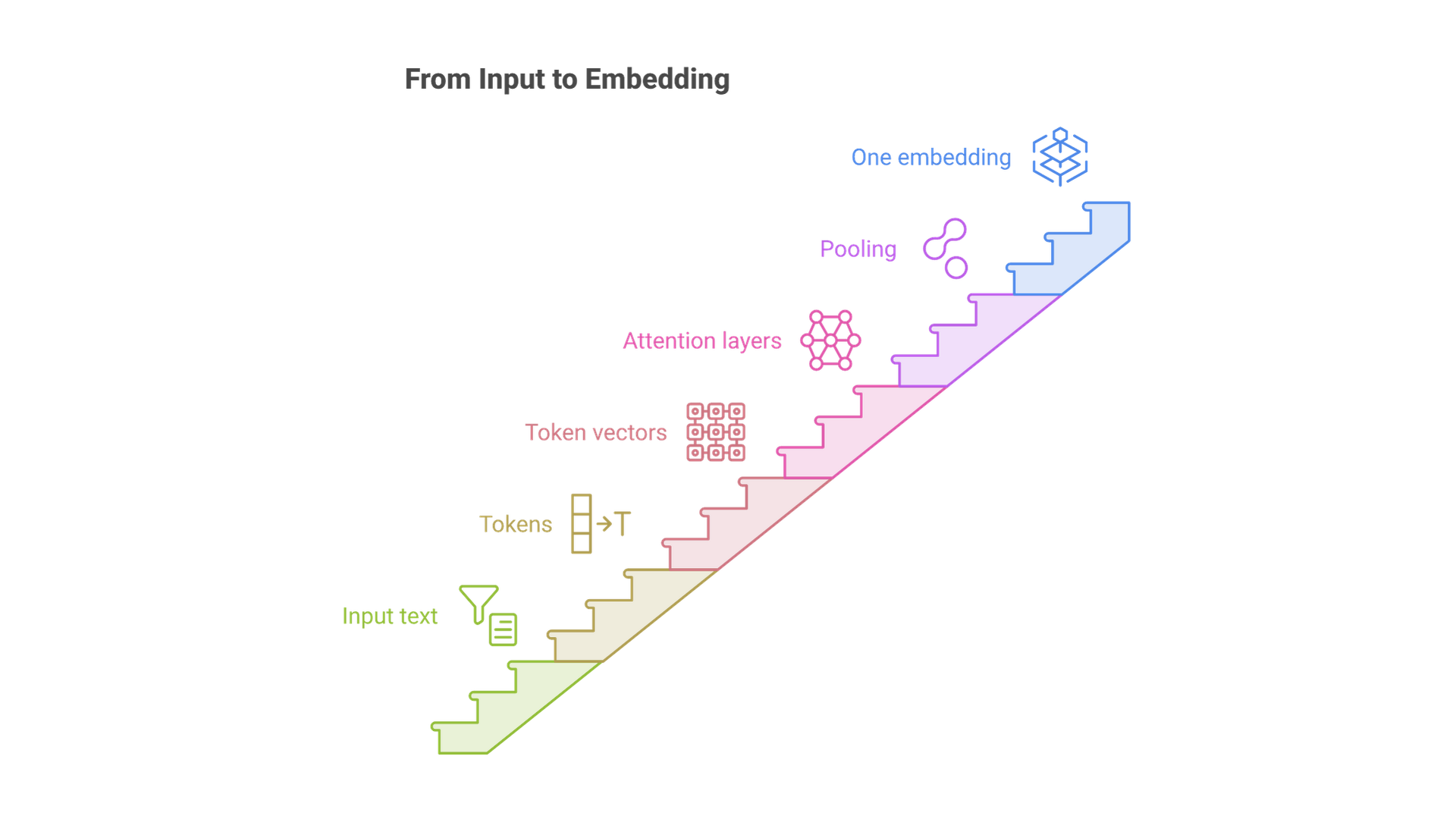
LLMs are transformer-based models that ingest a sequence of tokens and build context-aware representations through stacked layers. The self-attention mechanism lets every token weigh the other tokens in the input, and each layer refines meaning. In a generative LLM those representations feed a head that predicts the next token. In an embedding model they are pooled into a single vector and returned to you.
From token vectors to one embedding
Pooling turns many token vectors into one. Common strategies are mean pooling, a special classification token, or the final token's hidden state, which is typical for embedding models adapted from decoder LLMs. The model is then trained, usually with contrastive learning on related and unrelated pairs, so that pooled vectors of related inputs end up close together.
This training step matters more than the base architecture. In Sentence-BERT, Reimers and Gurevych cut the time to find the most similar pair among 10,000 sentences from about 65 hours with BERT to about 5 seconds, by comparing precomputed sentence embeddings instead of scoring every pair.
Tokens, Positional Encoding, and Semantic Context
Before attention, a tokenizer splits text into tokens, and each token ID is looked up in an embedding matrix to get its initial vector. Transformers then add positional information, either as positional encodings added to token vectors or, in many current models, as rotary position embeddings applied inside attention.
Position matters because attention on its own ignores order: without it, "dog bites man" and "man bites dog" would look the same. With position infused, attention can model long-range dependencies, and embeddings reflect sequence structure as well as semantic context. The resulting token vectors can be pooled into sentence or document embeddings.
Types of Text Embeddings (Word, Sentence, Document)
Word embeddings focus on individual tokens and remain useful for lexicon analysis, tagging and analogy tests. Sentence embeddings summarize a sentence into one vector and power intent detection, semantic similarity and semantic search. Document embeddings scale the idea to paragraphs or articles and support clustering, topic labeling and retrieval.
Dense, sparse and multi-vector embeddings
Embeddings also differ in shape. Dense embeddings store a fixed number of values per input. Sparse embeddings assign weights to vocabulary terms, behaving like learned keyword search. Multi-vector embeddings keep one vector per token and compare them at query time, the "late interaction" approach introduced by ColBERT. The BGE-M3 paper describes one model that supports all three across more than 100 languages with inputs up to 8,192 tokens.
Audio, Image, and Multimodal Embeddings
Embeddings are not just for text. Audio embeddings encode timbre, phonetics and prosody. Image embeddings map pixels into concepts such as objects, scenes and styles. Multimodal embeddings place several data types in one space, so a text query can retrieve a product photo, a diagram inside a PDF or a clip from a training video.
2026 is the year multimodal embeddings became a mainstream API feature. Google introduced Gemini Embedding 2 on March 10, 2026 as its first natively multimodal embedding model. Its current documentation lists text up to 8,192 tokens, up to six images per request, audio up to 180 seconds, video up to 120 seconds and PDFs up to six pages.
Cohere's documentation lists Embed v5 Pro and Fast with text, image and mixed inputs such as PDFs. On the open-weight side, the EmbeddingGemma 2 model card describes a 740-million-parameter model that maps text, code, images, video and audio into a shared 768-dimensional space under the Apache 2.0 license.
Current Embedding Models in 2026: Open and Commercial
The embedding model you pick determines quality, cost, latency and where your data goes. The table summarizes what each vendor's documentation or model card states as of October 30, 2026. It is a shortlist, not a ranking, and it leaves out prices, which change often.
| Model | Type | Modalities | Default dimensions | Max input |
|---|---|---|---|---|
| OpenAI text-embedding-3-large | Hosted API | Text | 3,072 (shortenable) | 8,192 tokens |
| OpenAI text-embedding-3-small | Hosted API | Text | 1,536 (shortenable) | 8,192 tokens |
| Google gemini-embedding-2 | Hosted API | Text, image, video, audio, PDF | 3,072 (128 to 3,072) | 8,192 tokens |
| Cohere embed-v5.0-pro / fast | Hosted API | Text, image, mixed | 2,048 (256 to 2,048) | 128K tokens |
| Voyage voyage-4-large / 4 / 4-lite | Hosted API | Text | 1,024 (256 to 2,048) | 32K tokens |
| Qwen3-Embedding 0.6B / 4B / 8B | Open weights, Apache 2.0 | Text | 1,024 / 2,560 / 4,096 | 32K tokens |
| EmbeddingGemma 2 | Open weights, Apache 2.0 | Text, code, image, video, audio | 768 (down to 128) | 8,192 tokens |
| BGE-M3 | Open weights | Text (dense, sparse, multi-vector) | Dense vector | 8,192 tokens |
Commercial embedding APIs
OpenAI's embeddings guide still lists text-embedding-3-small and text-embedding-3-large as current. They accept a dimensions parameter and return vectors normalized to length 1, and the guide notes that a 256-dimension text-embedding-3-large vector outperforms a 1,536-dimension text-embedding-ada-002 vector on MTEB. Google's text-only gemini-embedding-001 remains available with a 2,048-token limit, while gemini-embedding-2 replaces its task_type parameter with short task prefixes in the input.
The Voyage documentation lists the voyage-4 family plus code, finance and law models, and states that voyage-4-large, voyage-4 and voyage-4-lite produce compatible embeddings. Cohere documents the same for Embed v5 Pro and Fast and recommends indexing with Pro and querying with Fast. Shared spaces like these let you index with a stronger model and serve queries with a cheaper one.
Open-weight embedding models
Open-weight models run on your own hardware, which matters for data residency, offline use and predictable cost at volume. The Qwen3-Embedding model card describes 0.6B, 4B and 8B models with 32K tokens of context, 100+ languages, instruction-aware inputs and matching rerankers. It reported first place on the MTEB multilingual leaderboard, with a mean score of 70.58, as of June 5, 2025; treat that as a point-in-time result.
EmbeddingGemma 2 is small and modular, so you can load only the text, vision or audio encoders you need. Its model card warns against float16, which can silently produce degraded or NaN embeddings (use bfloat16 or float32), and says omitting the recommended task prefixes lowers quality.
Embedding Dimensions and Matryoshka Representation Learning
Dimensions are the number of values in each vector. More dimensions can hold more information, but each one costs storage, memory and search time across every vector in your index. Moving from 3,072 to 768 dimensions cuts raw vector storage by a factor of four.
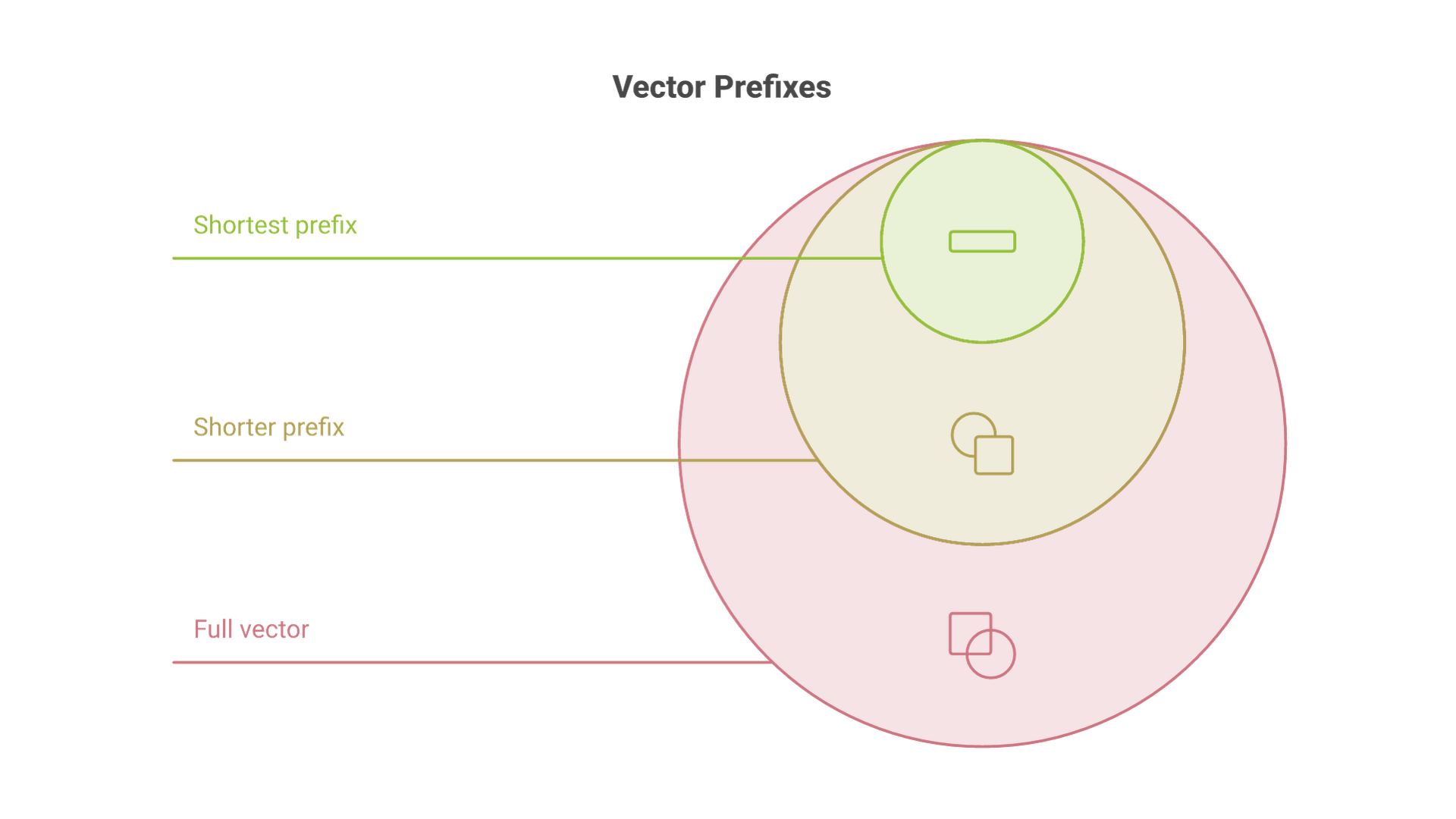
Matryoshka Representation Learning (MRL), introduced in the Matryoshka Representation Learning paper by Kusupati and colleagues, trains a model so that the leading values in a vector carry the most important information, nested like Russian dolls. You can truncate the vector to a shorter prefix and still get a usable embedding. The authors reported up to 14 times smaller embeddings at the same accuracy on ImageNet-1K classification.
How Matryoshka embeddings are used in practice
Most current models support it: OpenAI through the dimensions parameter, Gemini from 128 to 3,072 (768, 1,536 and 3,072 recommended), Voyage 4 and Cohere Embed v5 from 256 to 2,048, Qwen3-Embedding-8B from 32 to 4,096, and EmbeddingGemma 2 at 512, 256 and 128. A common pattern is to search with short vectors and rescore the top candidates with full-length ones.
Normalization trips teams up. OpenAI says manually shortened vectors must be normalized again. Google documents that gemini-embedding-2 renormalizes truncated sizes automatically, while gemini-embedding-001 needs manual normalization below 3,072. The EmbeddingGemma 2 card says 128 dimensions substantially degrades multimodal quality. Normalize when in doubt, and test short sizes on your own data.
Creating Embeddings: Data, Training, and Pre-Trained Models
You can train embeddings from scratch, but it is expensive and demands large amounts of paired data or clever self-supervision. Most teams start from a pre-trained embedding model and use it as is or fine-tune it, adapting general knowledge to a specific domain.
Fine-tuning usually means contrastive training on pairs, such as a query and the passage that answers it, with hard negatives that look relevant but are not. Instruction-aware models such as Qwen3-Embedding offer a lighter alternative: a task description prepended to the query shifts behavior without retraining. A fine-tuned model defines a new space, so the corpus must be re-embedded after each training run.
Measuring Semantic Similarity
To compare vectors, we use distances or similarities. Cosine similarity measures the angle between vectors rather than their magnitude. Dot product equals cosine for normalized vectors and is cheaper to compute. Euclidean distance is also used; OpenAI's guide notes that for its normalized embeddings, cosine and Euclidean distance produce identical rankings.
Use the metric your model was trained for and stay consistent between indexing and querying. Thresholds separate matches from non-matches, and tuning them balances recall (find more) and precision (find the right ones). Absolute scores are not comparable across models, so recalibrate thresholds whenever the model changes.
Vector Stores and Similarity Search
A vector store, often called a vector database, stores and searches high-dimensional embeddings efficiently. It indexes points in high-dimensional space and answers nearest-neighbor queries at scale, which is essential for semantic search and RAG.
Options range from dedicated vector databases to extensions for databases you already run. pgvector for PostgreSQL performs exact nearest-neighbor search by default and adds approximate HNSW and IVFFlat indexes. Its README lists indexable limits of 2,000 dimensions for vector, 4,000 for half-precision halfvec and 64,000 for binary bit vectors, one more reason to watch embedding size.
Production stacks combine vector proximity with metadata filters for time, tenant, permissions or user preferences. Filters interact with approximate search: pgvector applies them after the index scan, which can return fewer rows than requested, and offers iterative index scans to compensate. Test filtered queries, not just unfiltered ones.
Retrieval-Augmented Workflows: Finding Relevant Documents
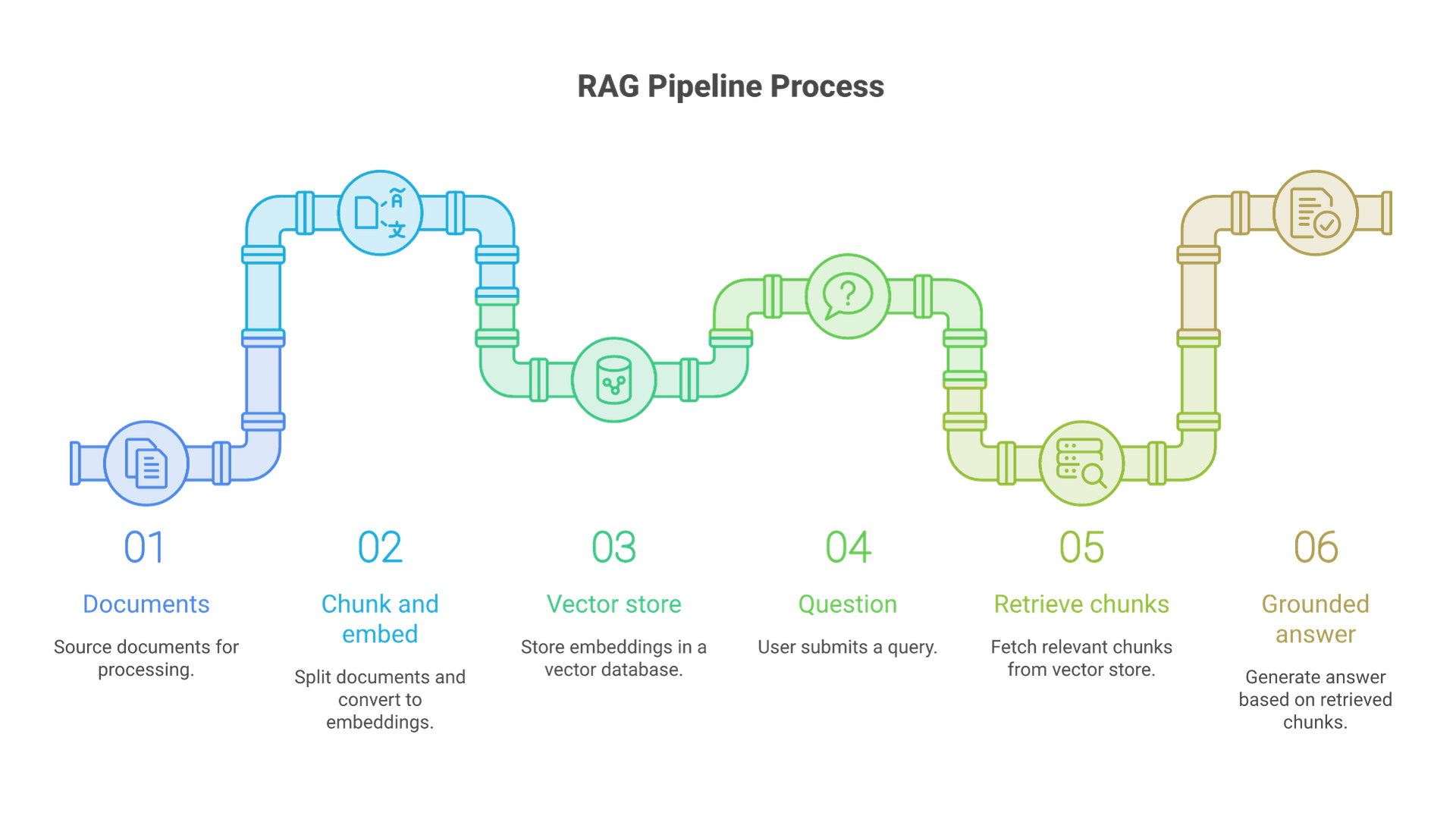
In RAG, we embed the corpus ahead of time and embed each question at query time. We fetch relevant documents by semantic similarity, and the LLM reads the retrieved chunks in its context window. The pattern was formalized by Lewis and colleagues in Retrieval-Augmented Generation for Knowledge-Intensive NLP Tasks (NeurIPS 2020), which paired a generator with a dense vector index queried through a neural retriever.
Grounding answers in retrieved text lets the model cite sources and reduces irrelevant or invented responses, without retraining. It also keeps proprietary content out of model weights, so updating knowledge means re-indexing documents. For sensitive corpora, our guide to using an LLM with private data covers access control and deployment choices around this pattern.
Long-context LLMs have not made retrieval obsolete. Sending only the most relevant passages is cheaper, faster and easier to audit, and it scales to corpora far larger than any context window.
Hybrid Search and Reranking
Dense embeddings are strong at paraphrase and intent but can miss exact identifiers such as product codes, error strings or legal citations. Hybrid search runs a keyword or sparse retriever alongside dense search and merges the result lists, often with reciprocal rank fusion. Models that emit sparse and dense outputs together, such as BGE-M3, simplify that setup.
Reranking adds a second stage. A fast embedding search retrieves a broad candidate set, then a cross-encoder reranker reads each query and candidate together and reorders them. Rerankers are slower per item but more precise, so they run only on the top results. Qwen3, for example, publishes dedicated reranking models alongside its embedding models.
Practical Applications: Search & Recommendations
Semantic search retrieves by meaning, not keywords, so misspellings and paraphrases no longer break queries. Embeddings also support sentiment analysis and text classification, often through a lightweight classifier trained on frozen vectors.
In recommendation systems, embeddings place items and users in the same space, and proximity suggests affinity. Support teams cluster and route tickets by topic, analysts detect near-duplicate records, and multimodal models extend all of this to images, video and scanned documents.
Choosing Embedding Techniques and Models
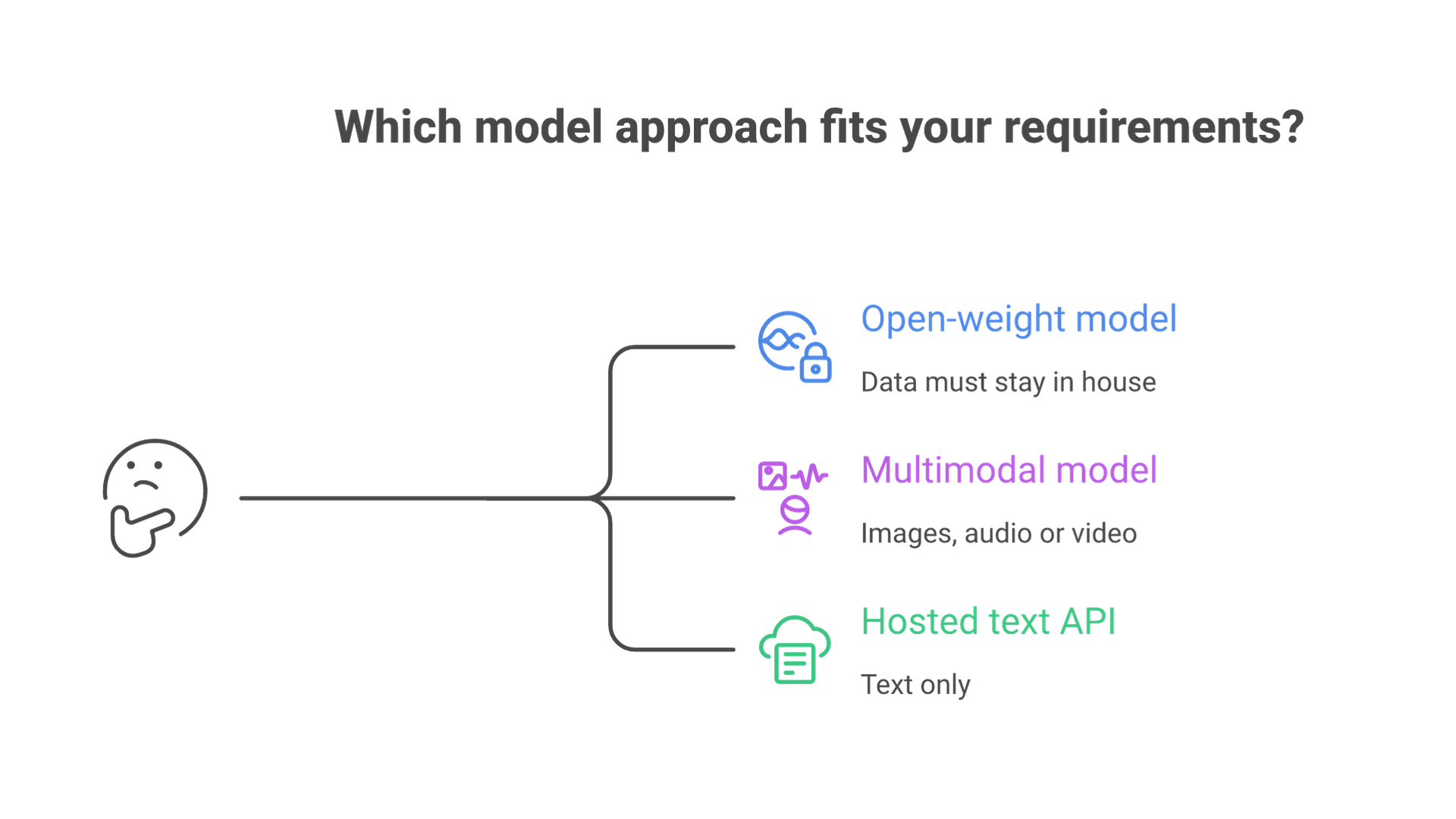
Start with four questions. Which languages and modalities must the model handle? Can the data leave your environment? How long are the inputs? What latency and storage budget do you have per query and per vector?
Sentence-level vectors suit intent and short queries; chunk-level vectors suit retrieval. Legal, medical and code content benefit from domain-tuned models such as Voyage's code, finance and law models, and general models may need adaptation for specialized vocabulary.
If data cannot leave your infrastructure, an open-weight model such as Qwen3-Embedding or EmbeddingGemma 2 can run on your own servers; our guide to what a local LLM is and how to use one explains hosting trade-offs that apply equally to embedding models. For help selecting and benchmarking models for a specific product, see Cognativ's LLM solutions.
Quality, Bias, and Evaluating Performance
Embeddings inherit biases from their training data. Audit results across user cohorts, languages and content types, and mitigate with balanced evaluation sets, filtering or targeted fine-tuning.
Using MTEB and MMTEB without overfitting to them
The standard public benchmark is the Massive Text Embedding Benchmark. The original MTEB paper covered 8 task types, 58 datasets and 112 languages and concluded that no single method dominated across all tasks. Its successor, MMTEB, expanded to more than 500 quality-controlled tasks in over 250 languages, adding instruction following, long-document retrieval and code retrieval. MMTEB found that the best publicly available model in its evaluation was multilingual-e5-large-instruct, with 560 million parameters.
Use the live MTEB leaderboard to build a shortlist, filtering by language and task type, especially retrieval, and checking size and license. Then build a test set from your own documents and real queries, measure recall@k and nDCG, and compare two or three candidates. Small leaderboard gaps rarely survive contact with a specific corpus.
Beyond offline scores, track answer correctness in RAG, user ratings and task success. Inspect outliers, A/B-test chunk sizes and index settings, and measure latency and cost alongside quality.
Storage, Indexing, and Distances
Indexes trade speed, memory and recall. HNSW, described by Malkov and Yashunin in their HNSW paper, builds a layered graph that scales logarithmically and offers a strong speed-recall balance at the cost of memory and build time. IVF and IVF-PQ approaches partition vectors into lists and search only the closest ones.
Quantization now happens at both ends. Voyage and Cohere document int8 and binary output types, and pgvector can index a binary-quantized copy for fast Hamming search and re-rank candidates with the original vectors. Combining Matryoshka truncation with quantization can shrink storage substantially; measure recall after each step.
Be consistent with cosine or Euclidean distance, and normalize if you switch. Sharding and replication improve scale and resilience. Keep metadata synchronized with vectors, and store the model name and version next to every vector.
Building an Embeddings Pipeline (Step-by-Step)
A typical retrieval pipeline follows the same sequence regardless of vendor:
- Collect and clean content; strip boilerplate and remove personal data you do not need.
- Chunk documents along natural boundaries, with some overlap to preserve context.
- Embed chunks with your chosen model, using its document prefix or input type.
- Index vectors in a vector store with metadata, permissions and the model version.
- At query time, embed the question with the matching query prefix or input type.
- Retrieve candidates, optionally merge with keyword results, and re-rank.
- Assemble a prompt for the LLM and generate the response with citations.
- Log feedback and failures to refine chunking, models and your evaluation set.
Steps 3 and 5 are where asymmetric models differ. Gemini Embedding 2, EmbeddingGemma 2 and Qwen3-Embedding all document distinct handling for queries and documents in search tasks, and skipping it is a common cause of weak retrieval.
Optimization: Parameters, Temperature, and Sampling
Temperature, top-k and top-p are generation parameters. They shape how an LLM samples its next token and have no effect on the vectors an embedding model returns.
They still matter in RAG, because generation follows retrieval. Low temperature yields consistent, focused responses; higher temperature encourages exploration. Top-k samples from the k highest-probability tokens, and top-p, also called nucleus sampling, from the smallest set whose cumulative probability passes p. For grounded answers, lower values are usually the safer starting point. Tune for your task and measure.
Handling Ambiguity and Polysemy
Context disambiguates multiple meanings, and good contextual embeddings reflect which sense is intended. Very short queries are the hard case: a single word like "Java" gives the model little to work with.
When data is sparse, enrich queries with synonyms, examples or a task instruction, and anchor ambiguous queries with metadata filters. Some senses are domain-specific. Banking jargon differs from rivers, and a domain-tuned model may be needed to teach the distinction.
Multilingual and Cross-Lingual Embeddings
Multilingual models align languages in one geometry, so "doctor" and "médico" end up as neighbors. This powers cross-language search and question answering, and one index can serve queries in many languages.
Qwen3-Embedding, Gemini Embedding 2, EmbeddingGemma 2 and BGE-M3 each state support for more than 100 languages. The EmbeddingGemma 2 card notes that performance may not be equal across languages, which applies to every model, so make sure your evaluation set mirrors real usage in each language you serve.
Privacy, Compliance, and Safety
Embeddings are not anonymization. In Text Embeddings Reveal (Almost) As Much As Text, Morris and colleagues reconstructed 92% of 32-token inputs exactly from their embeddings with an iterative inversion method. Treat vectors with the same care as the source text and apply the same access controls to the index.
Hash identifiers and separate personal fields from embedded content. Implement deletion and re-indexing workflows, honor retention policies, and review a hosted vendor's data retention terms. Human review remains vital in high-stakes settings.
Costs and Computational Trade-Offs
Bigger embedding models can deliver better quality but bring higher latency and compute cost. Smaller models often stay strong, as MMTEB's 560-million-parameter leader shows.
Batching amortizes overhead, and caching vectors for unchanged documents avoids recomputation. Storage is often the larger long-term cost: shorter Matryoshka vectors, half precision and int8 or binary quantization shrink indexes with modest quality loss. Shared spaces, as documented for Voyage 4 and Cohere Embed v5, let a cheaper model handle queries.
Debugging and Interpreting an Embedding Space
Project vectors with PCA, t-SNE or UMAP for sanity checks. Are topics clustered and labels coherent? Probe the neighbors of known items; unexpected neighbors often point to boilerplate or navigation text dominating chunks.
Check the basics before blaming the model: query and document prefixes, normalization after truncation, consistent metrics and the stored model version. Interpretability is limited, so use diagnostics and evaluation sets, not anecdotes.
From Prototype to Production
Start with a pilot on a narrow slice of content and a defined set of real questions. Verify uplift against current search and confirm that latency fits your budget, including query embedding, search and reranking.
Monitor drift, errors and recall@k over time, schedule refreshes when content changes, keep a rollback plan for index corruption, and treat model upgrades as full re-indexing projects. Connecting retrieval to existing content systems, permissions and applications is usually the larger engineering effort; Cognativ's AI integration work focuses on that part of the stack.
Common Pitfalls and How to Avoid Them
Over-chunking breaks context, and under-chunking dilutes each vector. Start with chunks of a few hundred tokens that respect paragraph boundaries, then tune empirically against your evaluation set.
Mixing metric types silently degrades quality. Mixing embeddings from different models in one index is worse: unless the vendor documents a shared space, the vectors are not comparable. Forgetting to re-normalize truncated vectors and skipping query prefixes are two more quiet failures.
Assuming bigger is always better is a trap. Older sequential models such as RNNs struggle with complex dependencies, but the largest transformer is not automatically best either. Match model size to task, throughput and budget.
Future Advancement of LLM Embeddings
The clearest 2026 trend is natively multimodal embeddings, with text, images, audio, video and documents in one space from both commercial APIs and open-weight models. That enables retrieval over content that previously needed separate captioning or transcription pipelines.
Flexible size is now standard: Matryoshka dimensions and built-in quantization let teams tune storage and speed after training. Shared spaces across model tiers reduce serving costs, and instruction-aware or task-prefixed inputs let one model behave differently for search, classification or clustering.
Domains such as healthcare, finance, law and code will keep benefiting from domain-tuned models, and vector search will keep moving into general-purpose databases. As embedding models get smaller and easier to run locally, they will play an even larger role in how AI systems find and ground information.
Key Takeaways and Next Steps
- Embeddings convert text and other content into vectors that models can compare.
- They unlock search, retrieval, clustering, classification and recommendations.
- Choose the model by language, modality, data constraints and budget, then verify on your own data.
- Use Matryoshka dimensions and quantization to control storage, and re-normalize truncated vectors.
- Combine embeddings with hybrid search, reranking and RAG to ground answers.
- Log outcomes, store model versions with vectors and iterate.
Mini-Glossary
- Embedding space / vector space: the geometry where vectors from one model live.
- Contextual embeddings: vectors that depend on surrounding words.
- Text embeddings: vectors for words, sentences or documents.
- Vector store: a database for vectors and fast nearest-neighbor queries.
- Matryoshka embeddings: vectors whose leading values form usable shorter embeddings.
- Reranker: a model that rescores a short list of retrieved candidates.
- Nucleus sampling (top-p): sampling from tokens whose cumulative probability reaches p.
A Simple Mental Model
Think of embeddings as pins on an invisible map. Words, documents, images and clips become coordinates, and related things are pinned near each other. Search finds the pins closest to your question. RAG hands those pins to an LLM so it can write an answer from them.
Frequently Asked Questions
What are embeddings in simple terms?
Embeddings are lists of numbers that represent meaning. Content with similar meaning gets similar numbers, so a computer can find related items by measuring the distance between vectors.
How do LLMs use embeddings?
An LLM maps each token to a vector, refines those vectors with attention across its layers and generates output from the result. Dedicated embedding models pool those representations into one vector per input for search and comparison.
Are embeddings the same as tokens?
No. Tokens are the discrete pieces of text a tokenizer produces. Embeddings are the dense vectors the model assigns to those tokens or to whole inputs.
How many dimensions should my embeddings have?
Start with the model's recommended size, then test shorter Matryoshka sizes such as 768 or 512 on your own queries. Use the smallest size that keeps retrieval quality acceptable, and re-normalize truncated vectors.
Do generation parameters affect embeddings?
No. Temperature, top-k and top-p only affect how an LLM generates text. They matter in the answer step of RAG, not in the embedding step.
Can I mix embeddings from different models?
Usually not. Each model defines its own vector space. Mix only models whose vendor documents a shared space, and otherwise re-embed the corpus when you change models.
Conclusion: Why LLM Embeddings Matter
LLM embeddings turn language and other content into vectors that capture meaning, and that idea underpins semantic search, recommendations, classification and retrieval-augmented generation. The fundamentals are stable: dense vectors, a consistent similarity metric and a well-indexed vector store.
What has changed by late 2026 is the toolkit. Multimodal models, Matryoshka dimensions, built-in quantization and shared embedding spaces give teams more control over quality, cost and storage, and MTEB and MMTEB make shortlisting easier. The decisive step is still evaluating candidates on your own data.
If you are planning semantic search, a RAG assistant or an embedding pipeline for your product or internal knowledge, talk to Cognativ about your AI project.