

Enterprise AI Implementation Challenges and How to Overcome Them
Why do AI pilots stall before production? A practical look at the data, systems, controls, skills and adoption gaps enterprises face, and how to close them.
Most large organizations now use artificial intelligence somewhere. Far fewer have turned it into measurable, enterprise-wide value. McKinsey's 2025 global survey found that 88 percent of respondents' organizations use AI in at least one business function, yet nearly two-thirds had not begun scaling it across the enterprise (McKinsey, The state of AI in 2025). The 2026 edition, fielded in May and June 2026, shows progress but not a breakthrough: 44 percent of respondents say AI is scaling across their enterprise, up from 38 percent a year earlier, while 37 percent report that AI has contributed positively to EBIT, essentially unchanged from 2025 (McKinsey, The state of AI in 2026).
That gap between adoption and impact is the subject of this guide. Enterprise AI implementation rarely fails because the models lack capability. It stalls because organizations treat AI as a plug-and-play tool rather than a change to data, systems, controls, skills and daily work. The barriers are well documented, and most of them can be anticipated and planned for before a pilot ever reaches production.
What This Guide Covers
This guide examines the most common technical, organizational and strategic barriers to enterprise AI adoption: data readiness, integration with existing systems, governance and privacy, evaluation and reliability, cost, skills and change management. For each one it explains why the challenge appears and the practical steps organizations use to overcome it, with references to primary frameworks such as the NIST AI Risk Management Framework and to published surveys from their original publishers.
Who This Is For
The guide is written for IT leaders, executives, transformation owners and AI project managers in enterprise organizations. Whether you are launching your first AI project or trying to scale existing AI initiatives across business processes, you will find a structured way to diagnose why initiatives stall, mitigate AI risks and align AI efforts with business objectives.
Why This Matters
Analysts have been warning about the pilot-to-production gap for several years. In July 2024, Gartner predicted that at least 30 percent of generative AI projects would be abandoned after proof of concept by the end of 2025, citing poor data quality, inadequate risk controls, escalating costs or unclear business value (Gartner). In June 2025 it applied the same reasoning to agents, predicting that over 40 percent of agentic AI projects will be canceled by the end of 2027 (Gartner). These are forecasts rather than measured outcomes, but the causes they name are exactly the challenges this guide covers.
Understanding Enterprise AI Implementation Fundamentals and AI Strategy
Enterprise AI implementation is the systematic integration of artificial intelligence into business processes, systems and decisions. It is different from running an isolated pilot or giving employees access to a standalone AI tool. A pilot proves that a model can do something useful in a controlled setting. Implementation proves that the organization can run that capability reliably, securely and economically, at scale, inside real workflows.
That difference explains the "pilot trap" many companies describe. A pilot can succeed with a hand-picked dataset, a small group of enthusiastic users, a manual workaround for integration and no formal risk review. None of those shortcuts survive contact with production. Implementation therefore demands changes to data infrastructure, integration architecture, governance frameworks and organizational culture that pilot projects never have to address.
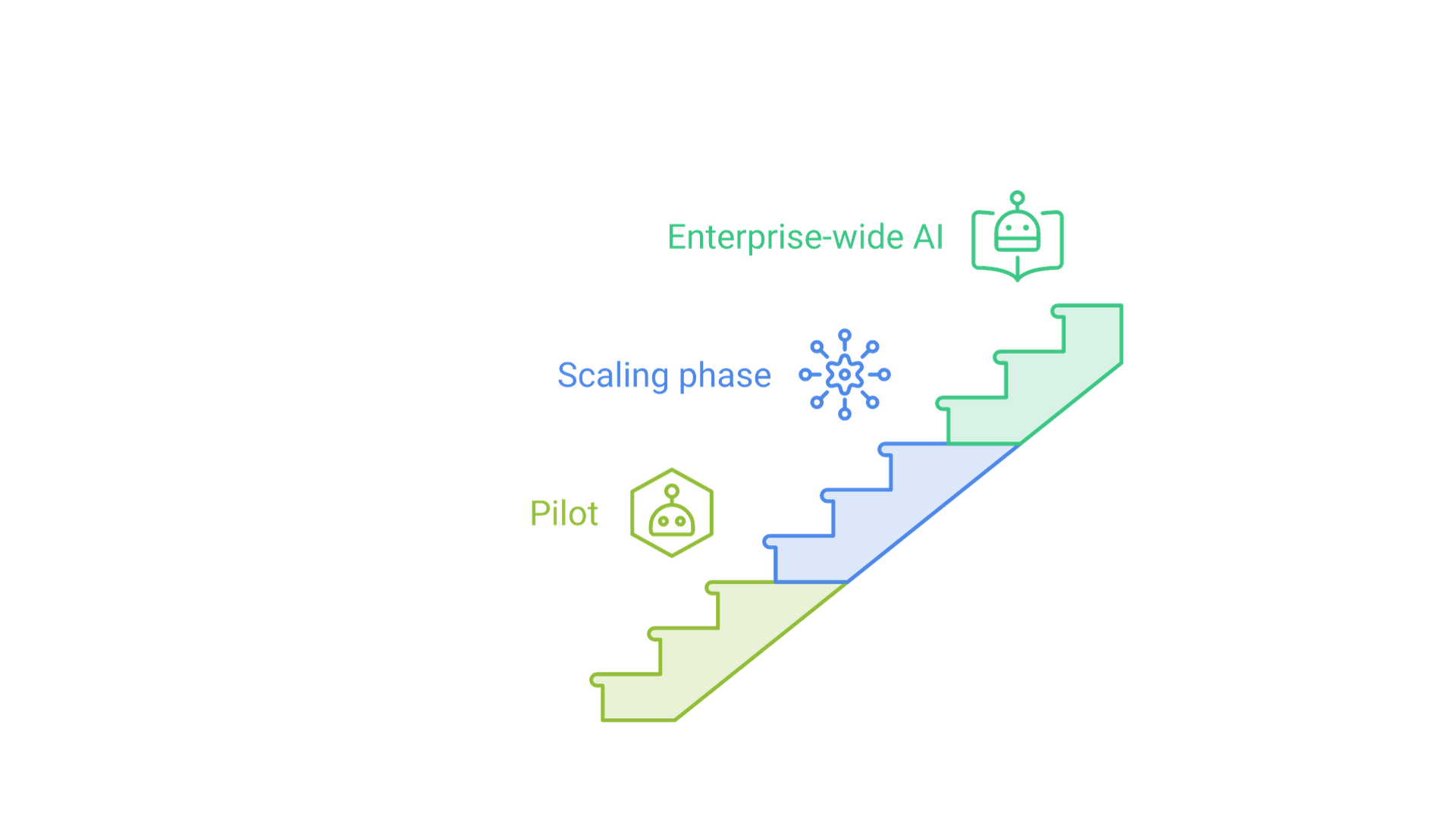
The Implementation Maturity Spectrum and Using AI Effectively
Pilot phase. Organizations test AI capabilities in controlled environments with simplified workflows and limited users. Many initiatives remain here because pilots do not confront real-world integration complexity, legacy infrastructure constraints or enterprise-wide governance requirements.
Scaling phase. Moving beyond the pilot requires security reviews, formal change management, staff training, systems integration, monitoring and a cost model that holds up at production volume. This phase usually demands considerably more organizational effort than the pilot itself, which is why it is where most stalled initiatives stop.
Enterprise-wide integration. At this stage AI systems, including AI agents that take actions in other systems, are part of core business processes and are managed like any other critical capability: owned, measured, audited and improved. McKinsey's 2026 survey suggests this group is still small; only about 6 percent of respondents qualify as "high performers" that attribute at least 5 percent of EBIT to AI (McKinsey).
Core Implementation Pillars for AI Success
Data foundation. AI models can only produce valuable insights from data that is accurate, accessible, well-governed and representative of the decisions being automated. Fragmented, poorly documented data produces fragmented outputs.
Technical infrastructure and integration. Production AI needs scalable compute, reliable connections to systems of record, strict access controls to protect sensitive data, observability and a deployment path that does not disrupt operations.
Governance and risk management. Clear ownership, policies, risk assessments and human oversight need to exist before scaling, not after the first incident.
Organizational readiness and technical expertise. Cultural preparation through change management, upskilling and workflow redesign determines whether a technically successful AI project is actually used. Building internal expertise and a culture ready for AI-driven transformation is a significant challenge, but it is what turns individual projects into long-term AI success.
Understanding these fundamentals shows why the specific challenges below compound one another, and why a holistic approach outperforms fixing them one at a time.
The Top Enterprise AI Implementation Challenges and How to Mitigate AI Risks
Organizations face interconnected barriers that span technical, organizational and strategic dimensions. When several converge, for example poor data quality combined with a skills gap and legacy infrastructure, implementation complexity rises sharply and initiatives stall even when the underlying model performs well. The challenges most frequently cited by enterprises and analysts are:
- Data readiness: data quality, bias and insufficient proprietary data for model customization.
- Integration: connecting AI to legacy systems and infrastructure in the physical world of existing operations.
- Governance, privacy and security: regulatory compliance, data protection, new attack surfaces and intellectual property concerns.
- Evaluation and reliability: proving that AI outputs are accurate enough, consistently, once real users and edge cases arrive.
- Cost and financial justification: hidden costs, unclear ROI and budgets that do not survive the move to production.
- Skills and AI expertise: shortages of specialist talent and low AI literacy across the workforce.
- Change management: treating AI projects as isolated experiments instead of strategic initiatives that redesign work.
- Risk mitigation over time: the absence of a lifecycle approach to monitoring, drift and accountability.
The sections below take each challenge in turn, explain how it shows up in practice and describe the approaches organizations use to overcome it.
Challenge 1: Data Quality, Bias and AI-Ready Data
Data is the most frequently cited barrier to enterprise AI. Gartner reported in February 2025 that 63 percent of organizations either do not have, or are unsure whether they have, the right data management practices for AI, and predicted that through 2026 organizations will abandon 60 percent of AI projects unsupported by AI-ready data (Gartner). The forecast matters less than the definition behind it: data is "AI-ready" only for a specific use case, and only when its quality, lineage and governance are known.
Data Quality and Bias Issues
Inaccurate or incomplete training and reference data leads to unreliable AI outputs that undermine decision making and create compliance risk. The problem shows up in several ways. Historical bias is reproduced when models learn from datasets that reflect past discriminatory patterns in hiring, lending or customer service. Many organizations discover these biases only after deployment, when they become legal and reputational risks rather than engineering tasks.
Data fragmentation is equally damaging. When customer, product and operational data live in different systems, formats and ownership domains without unified access, AI capabilities stay limited to narrow use cases.
Insufficient Proprietary Data for Model Customization
Generic foundation models are available to every competitor. Differentiation comes from domain-specific data: historical cases, product knowledge, process documentation and labeled outcomes. Many organizations lack consistent, well-curated proprietary datasets, or underestimate how much curation is needed before data can support fine-tuning, evaluation sets or retrieval. Without that foundation, specialized AI agents and industry-specific generative AI stall at a generic level of capability.
How to Overcome Data Readiness Challenges
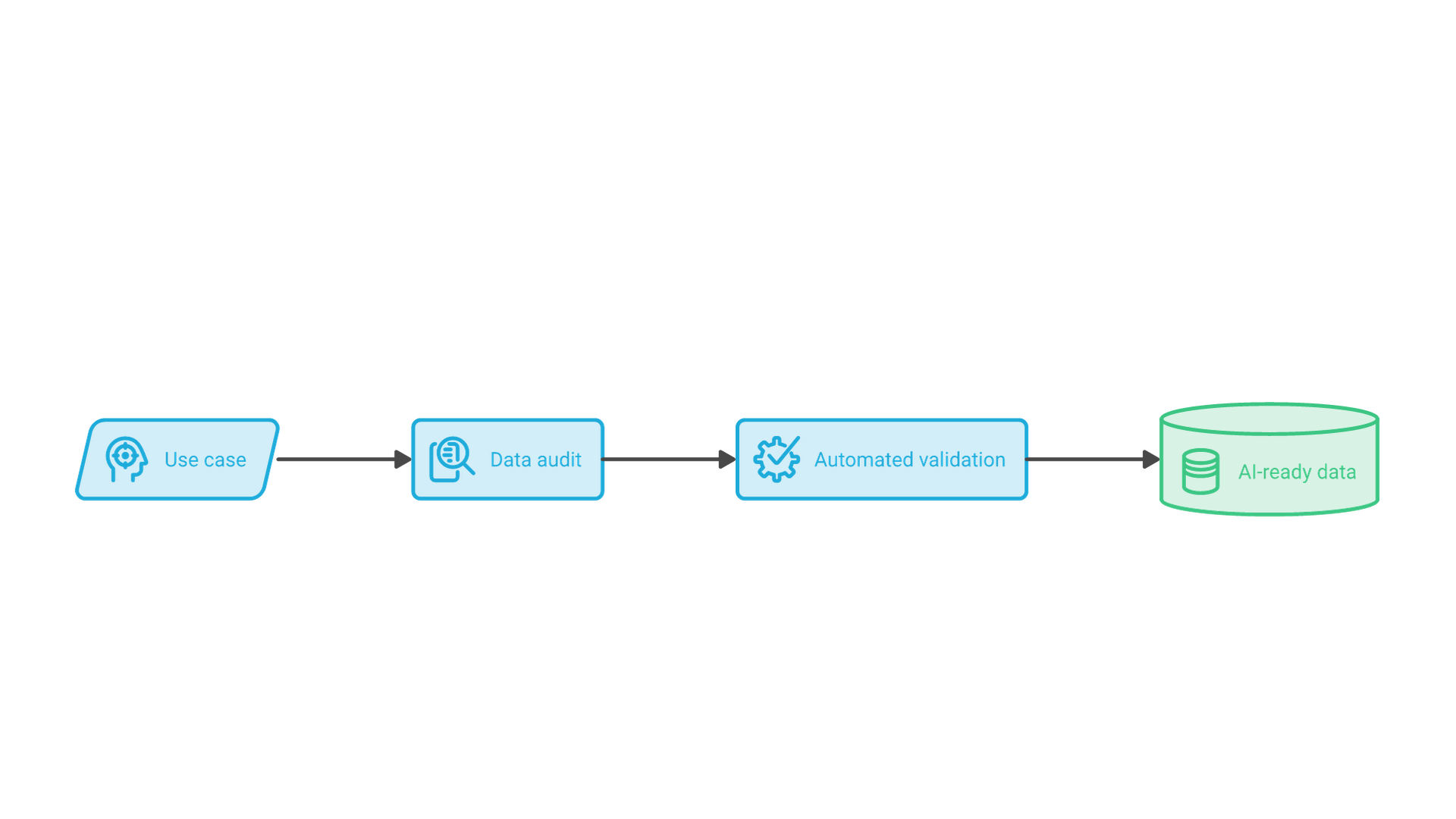
Start from the use case, not the data lake. Identify the decision or task the AI system will support, then audit only the data that task depends on: where it lives, who owns it, how current it is, what it is allowed to be used for and how it will be refreshed.
Next, make data quality operational rather than a one-time cleanup. Gartner's guidance emphasizes metadata management, data observability and governance as ongoing practices. In practice this means automated validation at ingestion, documented lineage, freshness checks and clear owners who are accountable when quality degrades. A well-designed data pipeline that validates, transforms and monitors data before it reaches a model does more for AI reliability than most model upgrades.
Finally, address bias and coverage deliberately. Test training and evaluation data for representation across the groups and scenarios that matter, document known gaps, and where proprietary data is thin, consider targeted labeling, careful use of synthetic data for augmentation, or a narrower first use case where existing data is strong.
Challenge 2: Integration With Existing Systems and Infrastructure
An AI model that cannot read from and write to the systems where work happens is a demo, not an implementation. Integration is where many pilots fail to translate into value, because pilots tend to rely on exported files, copy-and-paste or manual review that cannot scale.
Infrastructure and Integration Limitations in the Physical World
Legacy infrastructure creates scaling bottlenecks. ERP, CRM, ticketing and core operational systems were not designed for AI workloads, often expose limited or inconsistent APIs, and carry business rules that are poorly documented. Integration complexity escalates when every new AI use case requires its own point-to-point connection. The result is inconsistent data across platforms, AI insights that never reach the business process they were meant to inform, and operational inefficiency that cancels out the intended benefit.
Agentic AI raises the stakes. When an AI agent can create tickets, update records or trigger workflows, integration is no longer just about reading data; it is about safe, permissioned, auditable action inside systems of record.
How to Overcome Integration Challenges
Decide where the integration belongs before choosing tools. Some use cases fit inside an existing application through a vendor's native AI features; others need a separate service that orchestrates several systems.
Build a reusable integration layer rather than one-off connections. Standard APIs, event streams and shared connectors let multiple AI use cases reuse the same governed access to data and actions. Open protocols such as the Model Context Protocol are making it easier to expose tools and data sources to AI applications in a consistent way, but they do not remove the need for authentication, authorization and logging on every call.
Give AI components the minimum permissions required, separate read and write access, and require human approval for high-impact actions until reliability is proven. Teams that want a structured way to connect AI to CRM, ERP and business applications can review Cognativ's approach to AI integration for business workflows, which starts from the workflow and the system of record rather than from the model.
Challenge 3: Governance, Privacy, Security and Intellectual Property
AI systems introduce new risks around sensitive data, security and regulatory compliance, and organizations must manage them without freezing innovation. Governance is often treated as a final approval gate. In successful implementations it is designed in from the start and scaled with the risk of each use case.
The Regulatory Landscape in 2026
Existing data protection law already applies to AI. Regulations such as the EU's GDPR and California's CCPA set requirements for processing personal information, including purpose limitation, transparency and individual rights, and they do not pause because a model is doing the processing.
AI-specific regulation is now in force as well. The EU AI Act entered into force on August 1, 2024, with prohibitions and AI literacy provisions applying from February 2, 2025, and obligations for general-purpose AI models from August 2, 2025 (European Commission, AI Act). In 2026 the EU adopted the Digital Omnibus on AI, which entered into force on July 27, 2026, and moved the application of rules for stand-alone high-risk AI systems to December 2, 2027 and for high-risk AI embedded in regulated products to August 2, 2028 (European Commission). The delay buys time, but it does not remove the need to inventory AI use cases and classify their risk now.
Security Risks Specific to AI Systems
AI widens the attack surface. Models that can access enterprise data across systems create new paths for data leakage, and generative AI introduces risks that traditional application security does not fully cover. The OWASP Top 10 for Large Language Model Applications lists prompt injection, sensitive information disclosure and excessive agency among the leading risks, and recommends limiting extensions to the minimum necessary and requiring human approval for high-impact actions (OWASP Gen AI Security Project; OWASP LLM06:2025 Excessive Agency). Retrieved documents, emails and web content should be treated as untrusted input, because instructions hidden in that content can manipulate an assistant or agent.
Intellectual Property Concerns
Organizations worry about intellectual property in both directions: confidential information leaking into third-party services, and generative AI outputs that may reproduce copyrighted or licensed material. Practical controls include reviewing vendor terms on data retention and training use, routing sensitive workloads to approved environments, keeping records of which models and data produced which outputs, and setting review rules for externally published AI-generated content.
How to Overcome Governance and Compliance Challenges
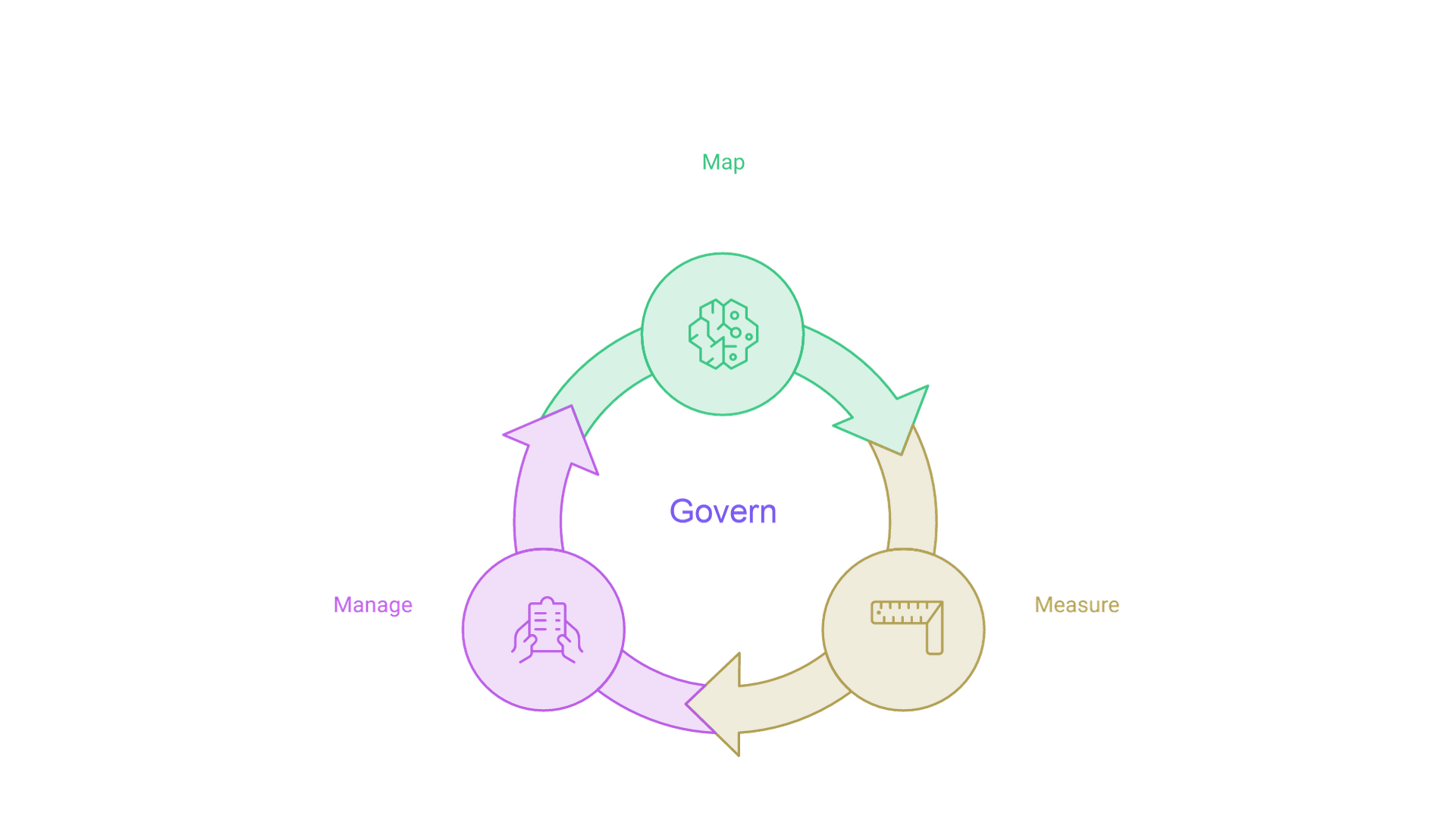
Use a recognized framework rather than inventing one. The NIST AI Risk Management Framework (AI RMF 1.0), released on January 26, 2023, organizes AI risk work into four functions: Govern, Map, Measure and Manage (NIST; NIST AI 100-1). Its Generative AI Profile, NIST AI 600-1, published on July 26, 2024, adds risks and suggested actions specific to generative AI (NIST AI 600-1). NIST states that AI RMF 1.0 is being revised under the White House AI Action Plan, so teams should track updates. Organizations that want a certifiable management system can also look at ISO/IEC 42001:2023, the international standard for AI management systems (ISO).
Translate the framework into a few concrete mechanisms: an inventory of AI systems and their owners, risk tiers that determine the level of review, documented intended use and limitations, data protection impact assessments where personal data is involved, and defined points of human oversight. For teams designing this operating model, Cognativ outlines how it approaches AI governance and human oversight as part of day-to-day delivery.
Challenge 4: Evaluation, Reliability and Model Performance
Many AI pilots are judged on a handful of impressive demonstrations. Production systems are judged on thousands of ordinary and unusual cases. That shift exposes the reliability problem: generative models can produce fluent, plausible and wrong answers, and their behavior can change when a vendor updates a model, when prompts are edited or when the underlying data drifts.
Why Model Accuracy Alone Is Not Enough
Organizations often track technical metrics such as accuracy on a test set rather than the outcome the business cares about. A model can score well on a benchmark and still fail on the cases that matter most, such as rare product configurations, ambiguous customer requests or regulatory exceptions. Understanding why AI models struggle with edge cases helps teams design evaluation around the long tail rather than the average case.
Inaccuracy is also a governance concern, not only a quality concern. The NIST Generative AI Profile treats confabulation, the production of confidently stated but false content, as a distinct generative AI risk to be measured and managed.
How to Overcome Evaluation and Reliability Challenges
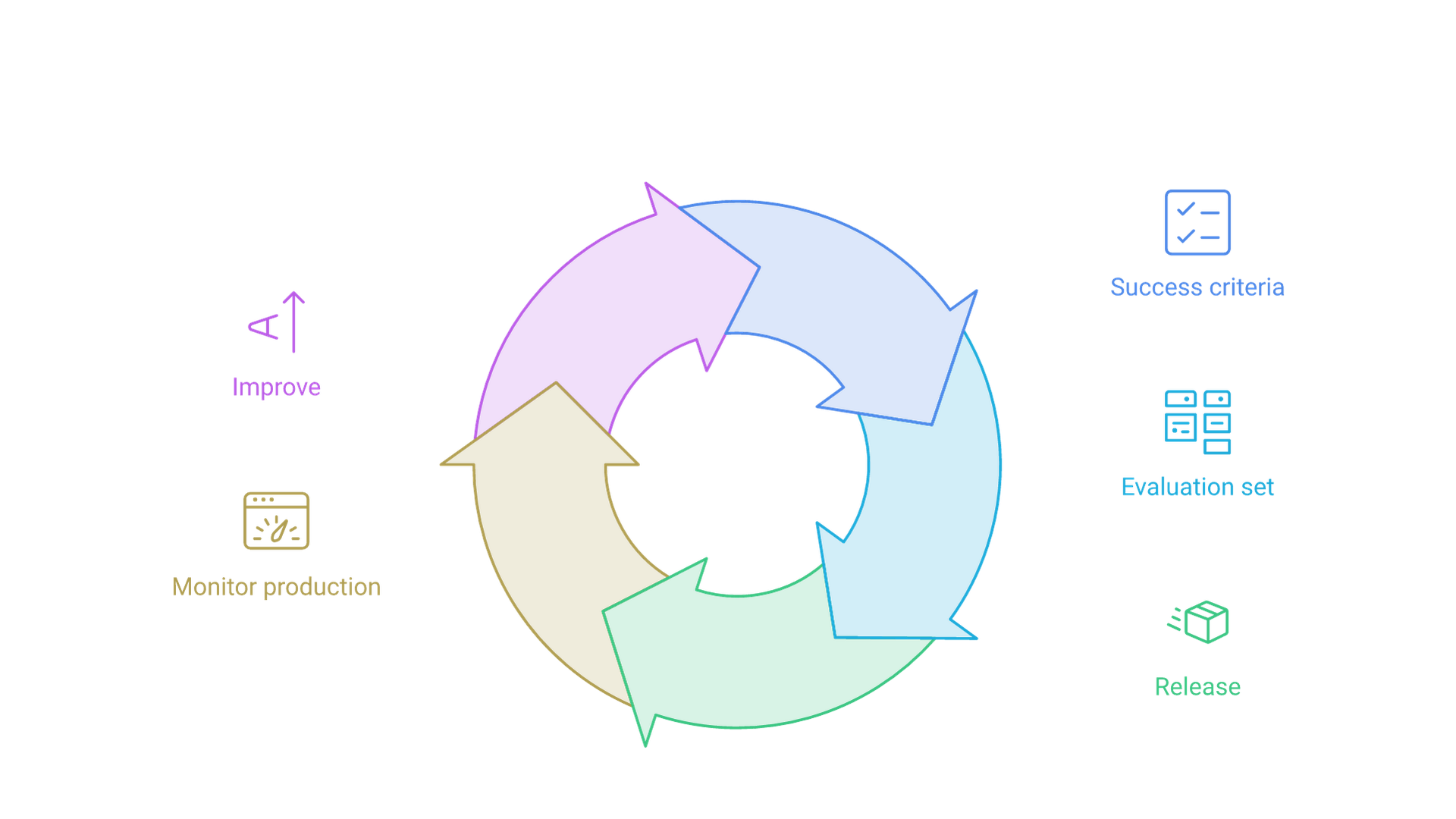
Define what "good enough" means before building. For each use case, agree on the task-level success criteria, the tolerable error types, and which errors require human review. Then build an evaluation set from real, representative examples, including known edge cases and adversarial inputs, and rerun it whenever the model, prompt, retrieval index or tools change.
Evaluate the workflow, not just the model response. In a RAG system, measure whether the right sources were retrieved as well as whether the answer was correct. In an agent, measure whether the correct action was taken with the correct permissions. Combine automated checks with structured human review for samples of production traffic.
Once live, monitor continuously. Track quality signals, user feedback, escalation rates, latency and cost, and set alerts for degradation. This is the "Measure" and "Manage" work described in the NIST AI RMF, applied to day-to-day operations.
Challenge 5: Cost, ROI and Financial Justification
Organizations struggle to quantify AI business value and to secure ongoing stakeholder support when benefits are vague or long term. High upfront costs for data work, integration, talent and training create budget obstacles, especially when leadership cannot see a credible model of returns.
Hidden Costs of AI Implementation
The visible cost of an AI project is the model or platform subscription. The less visible costs are usually larger: data preparation and labeling, integration and security work, evaluation and monitoring, human review, change management, and inference at production volume. McKinsey's 2026 survey found that about one in five organizations say operating costs have constrained their use of AI (McKinsey).
Unit prices for a given level of model capability have fallen sharply. Stanford's AI Index 2025 reported that the cost of querying a model at GPT-3.5-level performance on the MMLU benchmark fell from $20 to $0.07 per million tokens between November 2022 and October 2024 (Stanford HAI, AI Index 2025). Total spending can still rise, because usage grows, agents make many model calls per task, and organizations often adopt the newest, most expensive models by default.
How to Measure and Justify AI ROI
Measure the business outcome, not the model. Tie each initiative to a specific KPI such as cycle time, cost per case, first-contact resolution, error rate or revenue per account, and capture a baseline before deployment.
Model the full cost of ownership, including the hidden costs above, and calculate cost per completed task rather than cost per token. Right-size models to tasks, cache repeated work, and consider whether some workloads are better served by smaller or self-hosted models. The infrastructure trade-offs are covered in more depth in our guide to AI inference infrastructure considerations.
Finally, sequence the portfolio for confidence. Early use cases with clear baselines and short payback periods build the credibility needed to fund foundational investments, such as data platforms and governance, that pay off across many later initiatives.
Challenge 6: Inadequate AI Expertise and the Skills Gap
Skills shortages affect both specialist roles and the broader workforce. The World Economic Forum's Future of Jobs Report 2025 found that 63 percent of employers identify skill gaps as the main barrier to business transformation over 2025 to 2030, and 85 percent plan to prioritize upskilling their workforce (World Economic Forum).
At the specialist level, organizations compete for AI engineers, data scientists, ML operations specialists and security professionals who understand AI systems. Small teams create dangerous single points of failure, where one departure can stall an initiative.
At the workforce level, the issue is AI literacy. Employees who do not understand what an AI tool is good at, where it fails and how to check its output either avoid it or trust it too much.
How to Close the AI Skills Gap
Build a blended talent strategy. Hire for the few roles that must be owned internally, such as AI product ownership, architecture and governance, and upskill existing staff who already understand the business processes and data.
Make literacy role-specific. Executives need to understand risk and value; process owners need to redesign workflows; frontline employees need practical guidance on when to rely on AI output and when to escalate. Use partners and vendors to accelerate delivery, but pair external specialists with internal staff so knowledge stays in the organization.
Challenge 7: Change Management and Treating AI Projects as Strategic Initiatives
Organizations often treat AI projects as isolated technology experiments, run by a central team or a single enthusiastic department, without embedding them into broader business objectives or new workflows. This leads to fragmented efforts, unclear leadership ownership and tools that are technically available but rarely used.
The underlying issue is that AI changes how work is done. If a process is simply augmented with an AI tool while every other step stays the same, the benefit is usually small. Value tends to come from redesigning the workflow around what AI does well, which changes roles, handoffs, controls and performance measures, and that requires leadership sponsorship and employee involvement.
How to Lead AI-Driven Change
Give every significant initiative a business owner, not only a technical owner, and make that owner accountable for adoption and outcomes. Involve affected employees in redesigning the workflow, because they know the exceptions that will break a naive design. Communicate openly about how roles will change, provide training at the moment of use, and measure adoption alongside performance so that resistance is visible early.
Challenge 8: Lack of Comprehensive Risk Mitigation Across the AI Lifecycle
Without a lifecycle approach to AI risk, organizations expose themselves to model drift, bias, security breaches and regulatory non-compliance that emerge after launch. A model approved at deployment can degrade as data, users and upstream models change. Mitigating AI risks requires continuous monitoring, strict access controls and clear accountability structures that persist after the project team moves on.
Successful enterprises embed AI risk management into operational processes: periodic reviews of each system against its intended use, incident reporting channels, defined triggers for retraining or rollback, and alignment with evolving standards and regulations.
Strategic Solutions and Implementation Framework for AI Success
Organizations that scale AI address these interconnected challenges through coordinated strategies rather than isolated technical fixes. They recognize AI implementation as organizational transformation that requires planning, stakeholder alignment and phased execution, and they establish governance before scaling beyond pilot stages.
Step-by-Step: Building AI Implementation Readiness and Using AI to Achieve Business Objectives
This sequence is designed for organizations moving from pilot projects to scaled AI deployment across multiple business processes.
- Prioritize use cases: Rank candidate use cases by business value, data readiness, risk and integration effort, and choose a small portfolio with measurable outcomes.
- Conduct a targeted data audit: Assess quality, accessibility, ownership and permitted use for the data each priority use case needs, and set up automated validation and lineage.
- Establish an AI governance framework: Adopt a recognized framework such as the NIST AI RMF, create an AI inventory, define risk tiers and set review checkpoints from design through production monitoring.
- Design the integration architecture: Define where AI sits in each workflow, build reusable and permissioned connections to systems of record, and plan infrastructure for production volume.
- Define evaluation and monitoring: Agree on success criteria, build representative evaluation sets, and instrument quality, cost and latency monitoring before launch.
- Develop a talent strategy: Combine targeted hiring, role-specific upskilling and partner support, with deliberate knowledge transfer.
- Redesign workflows and manage change: Involve the people doing the work, assign business ownership and measure adoption as well as performance.
- Manage the portfolio and risks continuously: Review outcomes, costs and risks regularly, scale what works and retire what does not.
Comparison: In-House vs. Partner-Assisted Implementation
| Criteria | In-House Development | Partner-Assisted Implementation |
|---|---|---|
| Speed to first production use | Depends on hiring and ramp-up time | Often faster when the partner brings tested delivery methods |
| Customization control | Full control over architecture and AI capabilities | High, if ownership of code and data is agreed contractually |
| Long-term costs | Higher fixed staffing costs, lower external fees | Ongoing service fees, lower fixed staffing costs |
| Technical expertise | Requires significant internal hiring and retention | Draws on external specialists; knowledge transfer must be planned |
| Risk management | Full internal responsibility for compliance and security | Shared delivery responsibility; accountability for outcomes stays with the organization |
Organizations with strong technical teams and unique requirements often benefit from building in-house, while companies that need to move faster or lack AI expertise often achieve better results through a partnership that includes explicit knowledge transfer.
Common Implementation Pitfalls and Proven Solutions to Mitigate AI Risks
Enterprise AI initiatives tend to fail in predictable ways. These pitfalls reflect execution gaps rather than technology limitations, which means planning and organizational readiness can prevent most of them.
Challenge: Treating AI as Plug-and-Play Technology
Solution: Implement change management that prepares the organization for AI-driven workflow transformation. Organizations that expect immediate productivity gains from AI tools without redesigning workflows usually face adoption resistance and limited impact.
Challenge: Underestimating Data Governance Requirements
Solution: Establish data quality frameworks with automated validation, clear ownership and ongoing monitoring. Where data residency or privacy rules prevent centralizing data, techniques such as federated learning or privacy-preserving retrieval can help, and synthetic data can augment limited datasets when it is validated against real-world distributions.
Challenge: Scaling Beyond the Proof-of-Concept Stage
Solution: Adopt portfolio management with clear success metrics, executive sponsorship and deliberate resource allocation. Plan for production from the start: define the production owner, the systems to integrate, the controls required and the cost at expected volume before the pilot begins.
Challenge: Inadequate Risk Mitigation Planning
Solution: Implement AI risk management protocols covering performance monitoring, bias detection and continuous compliance validation. Establish measurement that tracks performance continuously, automated alerts for degradation, and defined processes for retraining, rollback and incident response.
Frequently Asked Questions
What is the biggest challenge in enterprise AI implementation?
Data readiness is the most frequently cited barrier, because model output can only be as reliable as the data behind it. In practice, data, integration, governance and change management problems usually compound one another, so no single fix is enough.
Why do so many AI pilots fail to reach production?
Pilots often succeed with curated data, manual workarounds and no formal risk review. Production requires integration with systems of record, security and compliance controls, monitoring, a sustainable cost model and real user adoption, which pilots rarely plan for.
Which framework should we use for AI governance?
The NIST AI Risk Management Framework and its Generative AI Profile are widely used starting points. ISO/IEC 42001 provides a certifiable AI management system standard, and organizations operating in the EU must also map their systems to the AI Act.
How do you measure the ROI of enterprise AI?
Tie each initiative to a business KPI such as cycle time, cost per case or error rate, capture a baseline before launch, and compare against it after deployment. Include data, integration, review and inference costs in the total cost of ownership.
When do EU AI Act high-risk rules apply?
After the 2026 Digital Omnibus on AI, rules for stand-alone high-risk AI systems apply from December 2, 2027, and rules for high-risk AI embedded in regulated products apply from August 2, 2028. Earlier obligations, such as prohibitions and general-purpose AI rules, already apply.
Should we build AI in-house or work with a partner?
It depends on internal expertise, urgency and how unique the requirements are. Many enterprises use a hybrid approach, with a partner accelerating early use cases and internal teams taking over operation through planned knowledge transfer.
Conclusion and Next Steps: Embracing AI Strategy for Long-Term Success
Enterprise AI implementation success depends on addressing interconnected challenges systematically rather than following a technology-first strategy that ignores organizational readiness. Data readiness, integration, governance, evaluation, cost, skills and change management are not separate workstreams to be tackled after the pilot. They are the work of implementation itself.
The path forward favors proactive mitigation over reactive problem-solving. Organizations that create real business value invest in data governance, reusable integration, risk frameworks, evaluation and talent before scaling AI capabilities across business processes, and they measure outcomes in business terms.
To get started, conduct an AI readiness assessment for your highest-priority use cases, establish a cross-functional implementation team with executive sponsorship and business ownership, and develop a phased roadmap with clear success metrics, risk controls and a realistic cost model. If you want a second view on where your initiatives are likely to stall and how to move them into production, talk to Cognativ about your enterprise AI plans.