


What is LoRA LLM? Understanding Low-Rank Adaptation for Fine-Tuning
Inside LoRA adapters: the small B and A matrices, the PEFT settings that matter in 2026, where QLoRA and DoRA help, and when full fine-tuning still wins.
LoRA (Low-Rank Adaptation) is a parameter-efficient fine-tuning method for large language models (LLMs). Instead of updating every parameter in a model, LoRA injects small, trainable low-rank matrices next to selected weight matrices and leaves the pre-trained model weights frozen.
The result is a dramatic cut in trainable parameters, GPU memory and checkpoint size, often with quality comparable to full fine-tuning. LoRA is especially attractive when you must adapt models with billions of parameters on constrained compute, or when you need many domain variants of the same base model. It also makes experimentation safer: you can swap adapters without touching the base model.
Short answer: "LoRA LLM" is shorthand for a large language model that has been fine-tuned with LoRA. The base model stays as it was; a small set of extra weights, called a LoRA adapter, learns the change needed for your task and is added to the model's output at run time or merged into its weights.
Understanding Large Language Models
Large language models are transformer-based machine learning models trained on vast amounts of text to predict the next token and produce fluent language. Pre-training creates general linguistic competence; fine-tuning specializes that capability for specific tasks, formats and domains.
Each transformer layer is built mostly from large linear projections: the query, key, value and output projections in self-attention, and the up, gate and down projections in the feed-forward (MLP) block. These weight matrices hold the bulk of a model's parameters, which is why updating all of them during full fine-tuning is so expensive. The QLoRA authors note, for example, that regular 16-bit fine-tuning of a 65B-parameter LLaMA model needs more than 780 GB of GPU memory.
Because full updates to all model parameters are costly to train, store and serve, techniques that limit updates to a small subset are essential in practice. LoRA belongs to a family of PEFT (Parameter-Efficient Fine-Tuning) methods designed to adapt pre-trained models with far lower training cost and storage overhead. If you are still deciding between training from scratch, continued pre-training and fine-tuning, our guide on how to train your own LLM covers that wider decision; this article focuses on how LoRA itself works.
LoRA Low-Rank Adaptation
LoRA was introduced by Edward Hu and colleagues at Microsoft in the paper LoRA: Low-Rank Adaptation of Large Language Models (arXiv 2106.09685, presented at ICLR 2022). At its core, LoRA assumes that the change a large weight matrix needs during adaptation has a low "intrinsic rank." In other words, the update can be described well by far fewer numbers than the full matrix contains.
The LoRA update formula
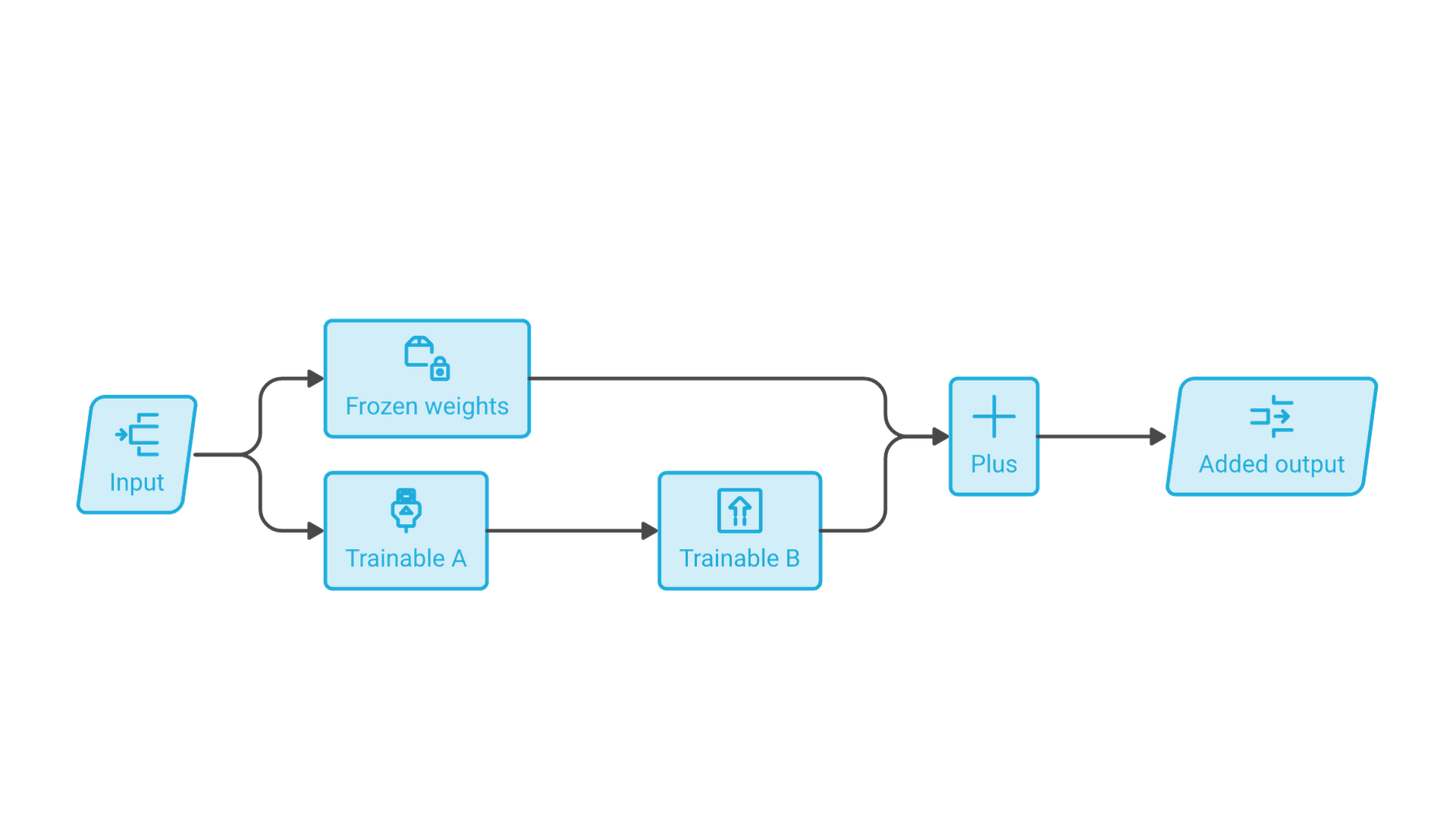
For a frozen pre-trained weight matrix W with shape d × k, LoRA represents the weight update as the product of two small matrices: B with shape d × r and A with shape r × k, where the rank r is much smaller than d and k. The layer's output becomes:
h = W x + (α / r) · B A x
Only A and B are trainable parameters; W stays frozen, preserving the knowledge in the base model. The paper initializes A with random Gaussian values and B with zeros, so BA starts at zero and training begins from exactly the original model. The scaling factor α (lora_alpha in PEFT) divided by r controls how strongly the update is applied, which reduces the need to retune the learning rate when you change the rank.
Why a low-rank update is enough
This low-rank adaptation acts like a compact "delta" to the original weights. The LoRA paper reports that on GPT-3 175B a very small rank already performs competitively, and that a rank as small as one was sufficient when adapting both the query and value projections in their experiments. That does not make r = 1 right for every task, but it explains why so few parameters can work. Because the update is additive, you can also store several LoRA deltas for different domain-specific datasets and choose, swap or combine them at load time.
A worked parameter count
Consider one 4,096 × 4,096 projection, a common size in 7B-class models. Fully fine-tuning it means updating 16,777,216 values. A LoRA adapter with r = 16 trains A and B instead: 16 × (4,096 + 4,096) = 131,072 values, under 1% of the original matrix. Across every targeted layer, this yields the reductions the paper reports: compared with Adam fine-tuning of GPT-3 175B, LoRA reduced trainable parameters by about 10,000 times and GPU memory requirements by about three times.
Fine-Tuning with LoRA
In practice, LoRA adapters are inserted into key linear layers of the transformer. The original paper limited its study to the attention weights and froze the MLP modules; under a fixed parameter budget, adapting both the query (Q) and value (V) projections gave its best results. You might, for example, tune only the query and value projections for a conservative change, or include MLP projections for stronger stylistic or format shifts.
Later work widened that default. The QLoRA paper found that the total number of LoRA adapters was the most critical LoRA hyperparameter and that applying LoRA to all linear transformer block layers was required to match full fine-tuning performance in its experiments. The current PEFT LoRA developer guide reflects this with a target_modules="all-linear" shortcut that applies LoRA to every linear layer, which it describes as the QLoRA-style setup.
What changes in the training process
The optimizer stores state only for adapter weights, freeing memory for larger batches or longer sequences and shortening each experiment. The LoRA paper reports a 25% training speedup on GPT-3 175B compared with full fine-tuning, along with a cut in training VRAM from 1.2 TB to 350 GB.
Key Advantages and Trade-offs
LoRA's headline benefits are lower memory usage, reduced compute and modularity. Training adapters rather than the full model shrinks the GPU memory requirement and the size of what you save: with r = 4 on the query and value projections, the LoRA paper cut the GPT-3 175B checkpoint from 350 GB to about 35 MB. It also simplifies MLOps: you keep one pre-trained model artifact and ship small adapter files per use case.
There are trade-offs. A 2024 study, LoRA Learns Less and Forgets Less, found that in standard low-rank settings LoRA substantially underperformed full fine-tuning on programming and math tasks, while better preserving the base model's performance outside the target domain. The same authors report that full fine-tuning learns weight perturbations with a rank 10 to 100 times higher than typical LoRA configurations, which may explain part of the gap.
In practice this means very large distribution shifts or deep changes to a model's behavior may require a higher rank, wider target modules or even full fine-tuning. LoRA also introduces new hyperparameters, including rank, scaling factor and target modules, that must be tuned. Still, for many business tasks, keeping general abilities intact matters as much as the new skill.
LoRA Adapters and Configuration
Most modern stacks implement LoRA through the Hugging Face PEFT library, which reached version 0.21.2 on October 1, 2026 according to its PyPI page. Microsoft's original loralib reference implementation remains available.
The core LoraConfig parameters
- r: the rank of the update matrices. Lower ranks mean fewer trainable parameters. The PEFT signature defaults to 8.
- lora_alpha: the scaling factor. By default the update is scaled by lora_alpha / r; the PEFT signature also defaults to 8.
- target_modules: which layers receive adapters, such as
["q_proj", "v_proj"], or"all-linear". Module names vary by architecture. - lora_dropout: dropout applied to the adapter path for regularization.
- bias: whether bias terms are trained: "none", "all" or "lora_only".
- modules_to_save: extra modules, such as a new classification head, trained fully and saved with the adapter.
Here is a concise example using PEFT in Python. Replace the model ID with the base model you are licensed to use:
import torch
from transformers import AutoModelForCausalLM, AutoTokenizer
from peft import LoraConfig, get_peft_model

base_model = "your-org/your-base-model"
model = AutoModelForCausalLM.from_pretrained(base_model, dtype=torch.bfloat16)
tok = AutoTokenizer.from_pretrained(base_model)

lora_cfg = LoraConfig(
    r=16,                         # rank of the low-rank matrices
    lora_alpha=32,                # scaling factor (update scaled by alpha / r)
    lora_dropout=0.05,            # regularization on the adapter path
    target_modules=["q_proj", "v_proj"],  # or "all-linear"
    bias="none",
    task_type="CAUSAL_LM",
)
model = get_peft_model(model, lora_cfg)
model.print_trainable_parameters()
This setup yields a small fine-tuned model delta while keeping the pre-trained model weights frozen. print_trainable_parameters() confirms that only the adapter is trainable.
PEFT's default initialization follows the paper: B starts at zero, so the adapter begins as an identity transform. Alternatives such as PiSSA, OLoRA, EVA, CorDA and LoftQ (for quantized bases) are documented in the developer guide and are worth testing only after a baseline works.
Forward Pass and Efficiency
During the forward pass, each adapted linear layer computes the base projection W x and adds the low-rank update B A x scaled by α / r. Because A and B are small, the extra computation is minor.
For inference, you can either keep adapters separate or merge them into the model's parameters. The PEFT conceptual guide notes that loading the base model and LoRA weights separately can add latency, and that merge_and_unload() folds the adapter into the base weights so the merged model runs at the same cost as the original. That is the property the LoRA paper emphasized: unlike earlier adapter layers, a merged LoRA update adds no inference latency.
Merging has one cost. Once BA is folded into W, the paper notes it is not straightforward to batch requests for different tasks with different adapters in a single forward pass. If you need that, keep adapters unmerged or use PEFT's merge_adapter() and unmerge_adapter().
Comparing LoRA, Full Fine-Tuning, and QLoRA
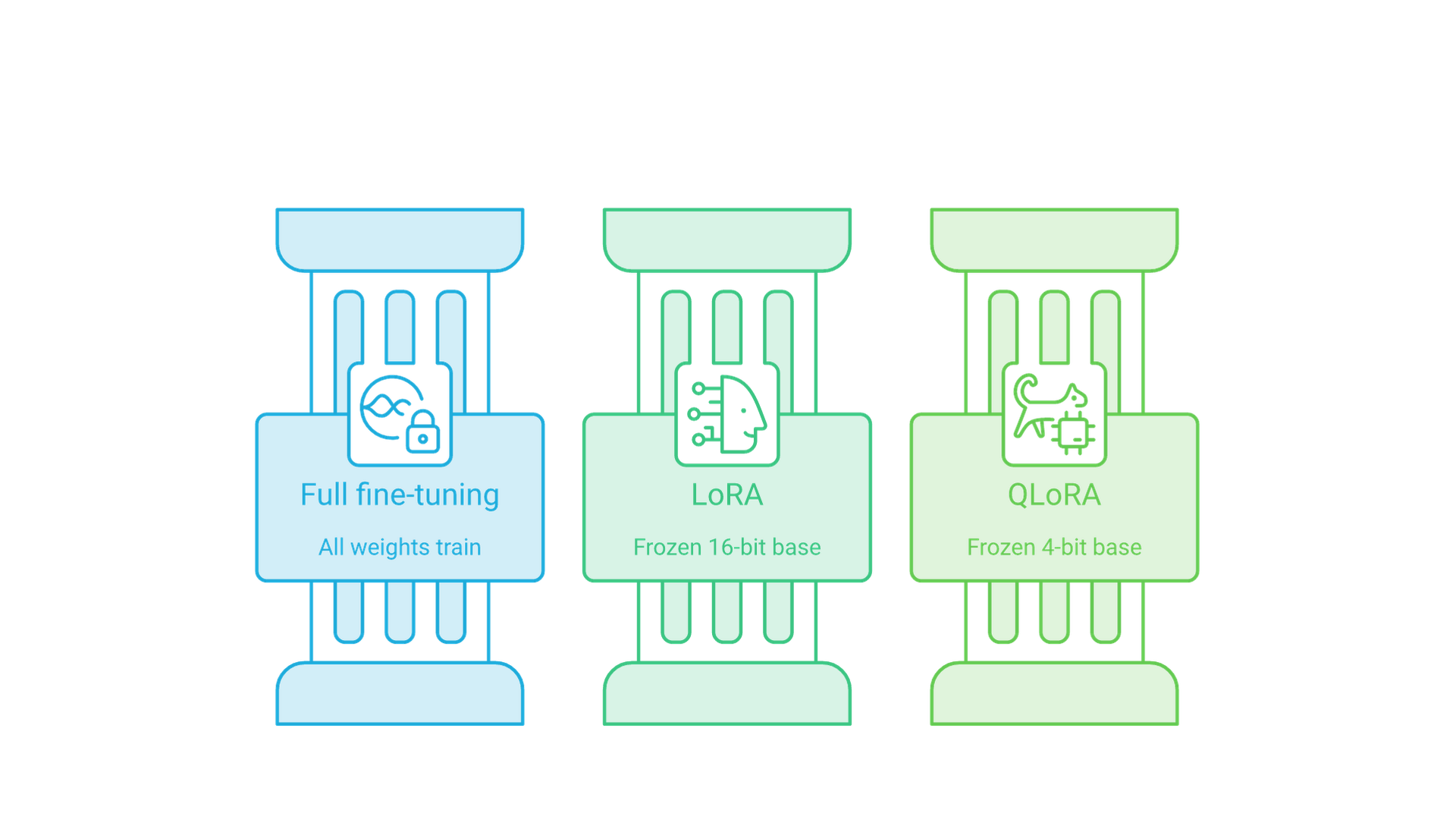
Full fine-tuning updates every parameter. It offers the maximum capacity for change but scales poorly in memory, time and storage, particularly with very large models. LoRA updates only adapter parameters, striking a balance between flexibility and efficiency.
QLoRA, introduced by Tim Dettmers and colleagues in 2023, pushes efficiency further. It backpropagates through a frozen base model quantized to 4 bits into LoRA adapters kept in higher precision. The paper adds the 4-bit NormalFloat (NF4) data type, double quantization and paged optimizers. Together they made it possible to fine-tune a 65B-parameter model on a single 48 GB GPU while aiming to preserve 16-bit fine-tuning performance.
| Aspect | Full fine-tuning | LoRA | QLoRA |
|---|---|---|---|
| Weights updated | All parameters | Small adapter matrices | Small adapter matrices |
| Base model precision | 16-bit or higher | 16-bit, frozen | 4-bit (NF4), frozen |
| GPU memory | Highest | Much lower | Lowest of the three |
| Saved artifact | Full model copy | Adapter file | Adapter file |
| Capacity for change | Highest | Set by rank and targets | Set by rank and targets |
In practice, teams often begin with LoRA or QLoRA, raise the rank or widen target modules if results fall short, and consider full fine-tuning only when the evidence shows adapters cannot close the gap. QLoRA trades some compute for memory, because the 4-bit weights must be dequantized to the compute data type during each pass, so if a 16-bit base model already fits your GPU, plain LoRA is usually simpler.
LoRA Variants Worth Knowing in 2026
Several refinements of the original method are now one flag away in PEFT.
DoRA: weight-decomposed low-rank adaptation
DoRA (ICML 2024) splits each pre-trained weight into a magnitude and a direction, and uses LoRA to update the direction. The authors report that it consistently outperformed LoRA when fine-tuning LLaMA, LLaVA and VL-BART on their benchmarks without extra inference overhead once merged. In PEFT you enable it with use_dora=True; the guide notes that it adds training overhead and recommends merging for inference.
rsLoRA: rank-stabilized scaling
The rsLoRA paper argues that dividing by r slows learning at higher ranks and proposes dividing by the square root of r instead. PEFT exposes this as use_rslora=True, which sets the scaling to lora_alpha / sqrt(r). It is most relevant when you experiment with larger ranks.
PEFT also lists initialization and optimizer variants such as LoRA+ and LoRA-FA. None is a universal upgrade; each must beat your plain LoRA baseline on held-out data.
Practical Recipe: Fine-Tune a Model with PEFT
A minimal supervised fine-tuning loop with the Transformers Trainer looks like this, continuing from the previous snippet:
from transformers import TrainingArguments, Trainer

args = TrainingArguments(
    output_dir="lora-out",
    per_device_train_batch_size=4,
    gradient_accumulation_steps=8,  # larger effective batch without OOM
    learning_rate=2e-4,             # adapters often tolerate higher LR than full FT
    num_train_epochs=3,
    logging_steps=20,
    bf16=True,
)
trainer = Trainer(model=model, args=args,
                  train_dataset=train_ds, eval_dataset=val_ds)
trainer.train()
model.save_pretrained("lora-out")  # saves only the adapter weights and config
Because you train only a subset of parameters, you can often use a higher learning rate and a larger batch size than full fine-tuning under the same memory budget. Treat the values above as a starting point and validate them with small ablations. The final artifact contains the LoRA weights and config, not a duplicated full checkpoint.
The QLoRA variant of the same recipe
The PEFT quantization guide shows the QLoRA pattern: load the base model in 4-bit through a bitsandbytes config with load_in_4bit=True, bnb_4bit_quant_type="nf4" and double quantization, call prepare_model_for_kbit_training(), then attach LoRA with target_modules="all-linear".
The same guide documents LoRA training on top of other quantization backends, including GPTQ, AQLM, EETQ, HQQ and torchao, each with its own merging caveats.
Data and Training Considerations
LoRA is not a substitute for data quality. If your training data is noisy, inconsistent or off-domain, the fine-tuned adapter will faithfully learn those flaws. Curate domain-specific datasets, enforce consistent labels and formats, and check for leakage between training and validation sets.
When the data is sensitive, decide early whether the knowledge should live in weights at all. Our guide to using LLMs with private data compares fine-tuning with retrieval and covers the access-control and compliance questions that apply to adapter training sets too.
Rank r is a capacity knob. Smaller ranks give computational efficiency; larger ranks capture richer changes but increase memory usage and the risk of overfitting small datasets. When adapting to a particular domain with subtle stylistic constraints, a moderate rank and targeting both attention and MLP projections can help. The ratio of lora_alpha to r sets the update's strength, so adjust both together.
Evaluation and Model Performance
Evaluate the model's performance with task-appropriate metrics and robust baselines. Compare against a prompt-only baseline, a full fine-tune when affordable, and smaller models if latency is tight.
Because LoRA tends to forget less than full fine-tuning, also measure what you want to keep: run a small set of general capability checks before and after training so you notice regressions outside the target task. Where human judgment matters, add preference ratings.
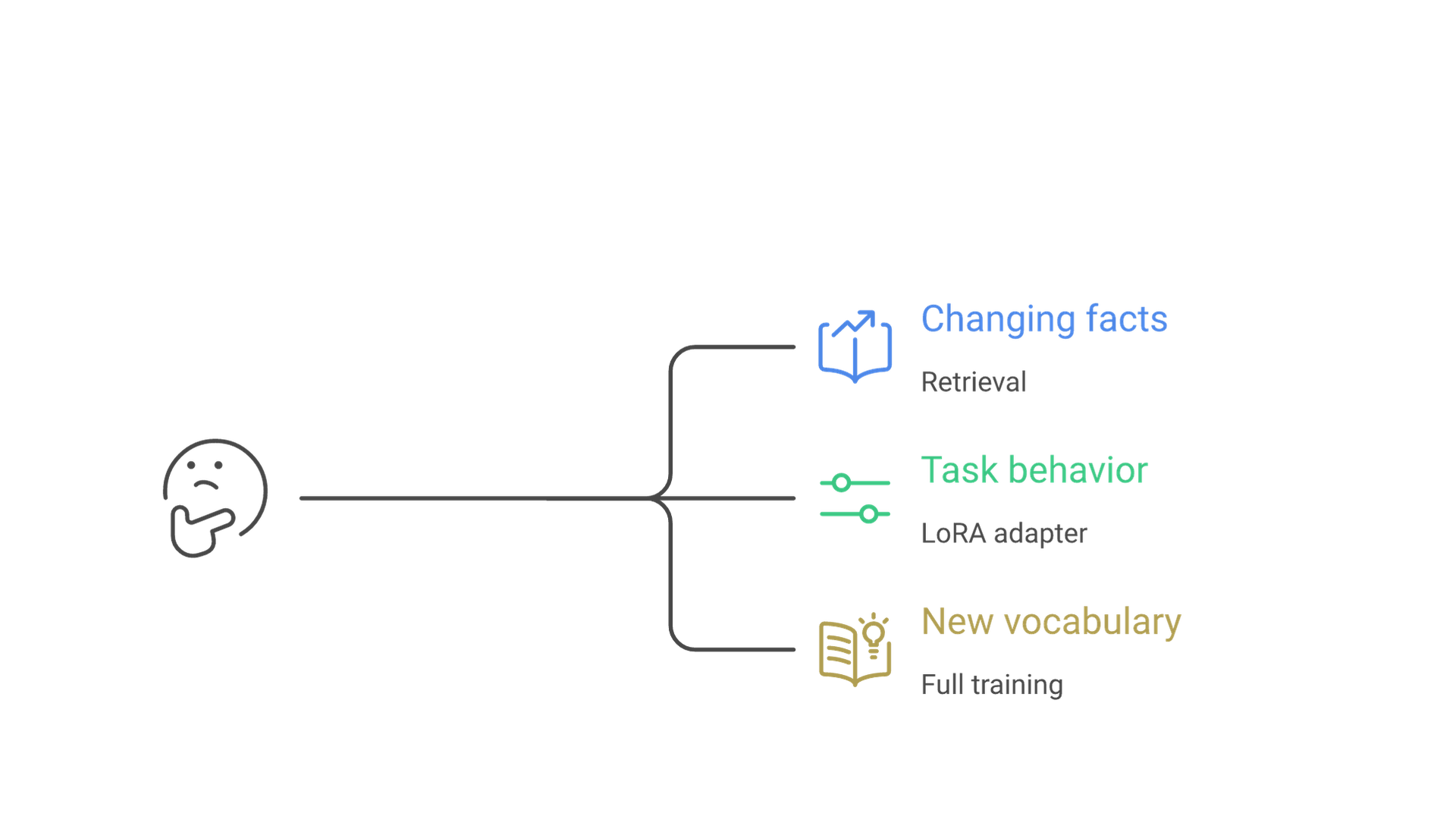
Monitor accuracy, calibration and safety, not only raw scores. If the model must cite sources or work with changing facts, consider combining LoRA with retrieval-augmented generation: the adapter teaches format, tone and task behavior, while retrieval supplies current, auditable knowledge instead of baking proprietary facts into weights.
Deployment Patterns and Memory Usage
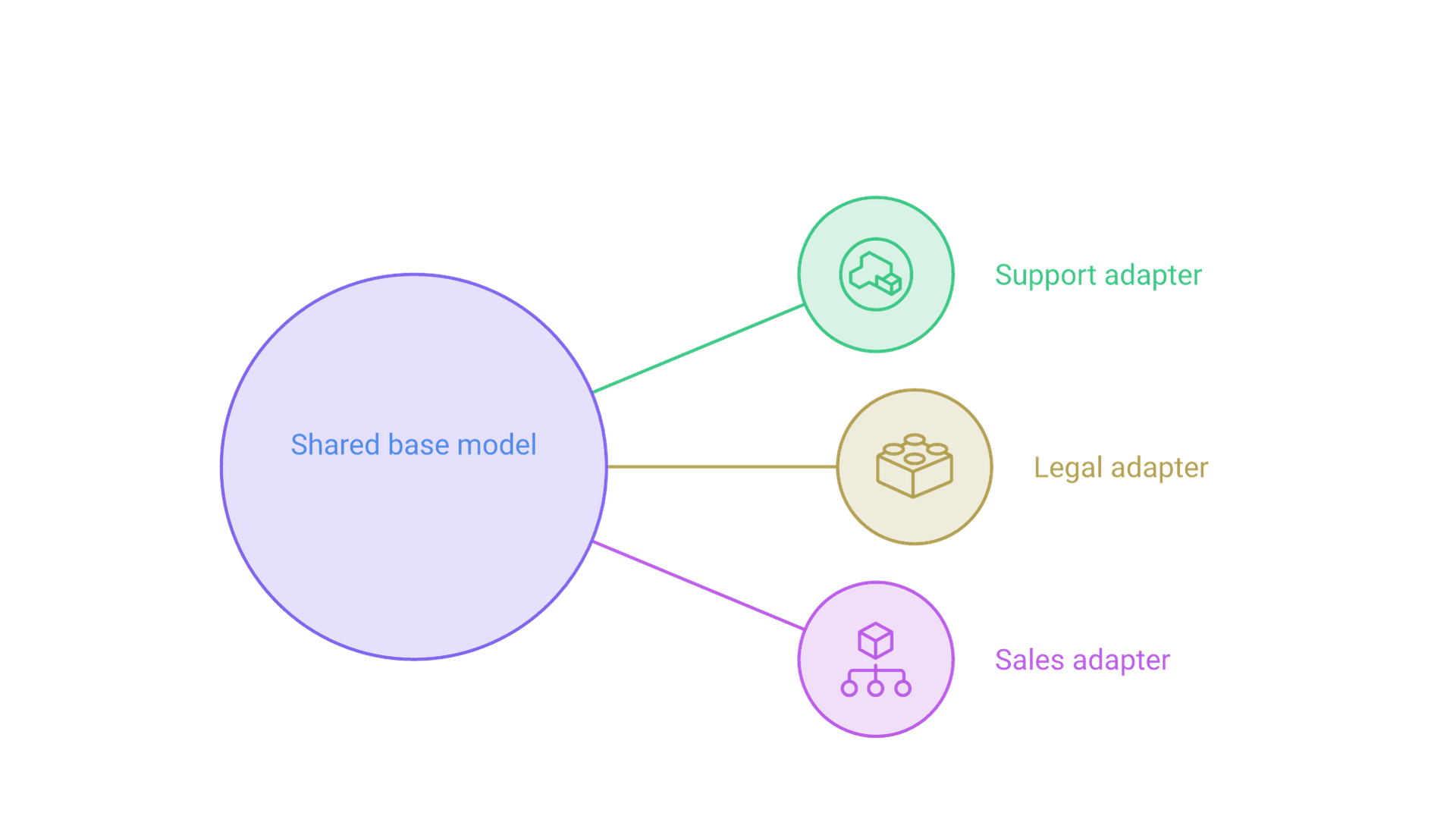
In production, you can load a single pre-trained model and hot-swap LoRA adapters per tenant, locale, task or policy. This "one base, many adapters" pattern maximizes reuse while minimizing disk space and GPU memory. PEFT supports it directly: load_adapter() adds adapters without merging, set_adapter() activates one, and the adapter_names argument to generate() lets a single batch route different rows to different adapters, with "__base__" selecting the unmodified model.
Merging adapters into weights is convenient for simple deployments with one task, but you lose the ability to switch or combine adapters at run time. PEFT's add_weighted_adapter() offers a middle path by building a new adapter from a weighted mix of existing ones.
For large fleets, track inference latency, GPU memory footprint and throughput under concurrent requests. Adapters typically add little overhead; bottlenecks more often stem from sequence length, KV cache size and attention costs. If you plan to serve adapters on your own hardware, our guide to what a local LLM is and how to use one covers the basics. For production serving, our AI infrastructure services cover GPU sizing, model serving and the operational work of running a base model with many adapters.
Common Pitfalls and How to Avoid Them
Setting too low a rank harms capacity; setting it too high erodes the efficiency you wanted and invites overfitting. Start with a rank in the 8 to 32 range and increase it only if the target task underfits on validation data.
If you adapt only the query projections and see limited gains, widen coverage to key, value, output and selected MLP layers, or try "all-linear". Module names differ between architectures, so inspect the model first.
Misaligned tokenizers or preprocessing can quietly degrade outcomes. Keep the base model's tokenizer and chat template, and follow its normalization. If you add new special tokens, you must also train or save the affected embedding layers, for example through modules_to_save.
Two newer pitfalls come from the tooling itself. merge_and_unload() is not in-place, so assign its return value. And on quantized models, PEFT warns that merging and unmerging is not exact and can accumulate rounding error; reload the base model if you need the original weights back. With very small datasets, use dropout, early stopping and evaluation on unseen data.
When Not to Use LoRA?
If you need fundamental changes to a model's architecture, or must retrain embeddings and vocabulary for a new script, LoRA alone is not the right tool. For heavy multilingual expansion, new modalities or large new domain corpora, consider continued pre-training or full fine-tuning; the "LoRA Learns Less and Forgets Less" results suggest the gap with full fine-tuning is largest in demanding domains such as code and math.
If your goal is to give the model access to proprietary facts that change often, weigh that against policy, privacy and freshness. LoRA can encode knowledge, but retrieval keeps facts outside the weights, where they can be updated, permissioned and cited. If a good prompt already meets your quality bar, fine-tuning may be unnecessary cost.
Choosing between prompting, retrieval, LoRA and full fine-tuning is a product and risk decision; our LLM solutions work starts there and picks the lightest adaptation that fits.
Frequently Asked Questions
What does LoRA stand for in LLMs?
LoRA stands for Low-Rank Adaptation. It fine-tunes a model by training two small matrices whose product approximates the needed weight change, while the original weights stay frozen.
Is LoRA only for language models?
No. The same low-rank idea applies to vision, multimodal and diffusion models. The DoRA paper, for example, evaluates LLaVA and VL-BART, and PEFT supports LoRA on convolutional layers as well as linear ones.
Does LoRA hurt inference speed?
Not once merged: merge_and_unload() gives a model with the original cost. Unmerged adapters add a small computation per adapted layer.
How does QLoRA differ from LoRA?
QLoRA freezes the base model in 4-bit NF4 precision and trains LoRA adapters on top, adding double quantization and paged optimizers. It needs less GPU memory than LoRA on a 16-bit base, though dequantization can make training slower.
What rank and alpha should I use?
There is no universal value. PEFT defaults to r = 8 and lora_alpha = 8; many recipes start between 8 and 32. Increase rank only if validation results underfit, and adjust alpha with it.
Can I stack or combine multiple adapters?
Yes. PEFT can load and switch adapters, serve different adapters in one batch, or blend them with add_weighted_adapter(). Re-evaluate quality after combining.
Conclusion: Why LoRA Matters for LLM Fine-Tuning
LoRA trains a low-rank update beside frozen weights. That update cuts parameters, memory and storage, merges away at inference time, and lets one base model serve many tasks. QLoRA extended the same idea to 4-bit base models, and variants such as DoRA and rsLoRA are now a configuration flag away in PEFT.
It is not free capacity. LoRA learns less than full fine-tuning on demanding tasks, depends on good data and evaluation, and is a poor substitute for retrieval when facts change. For adapting format, tone and task behavior efficiently, it remains the usual starting point for customizing open-weight LLMs.
If you are weighing LoRA, QLoRA, retrieval or full fine-tuning for your own models and data, talk to Cognativ about your LLM fine-tuning project.