


Logistics Software with AI Integration: A Complete Guide for Supply Chain Leaders
Connect AI to your TMS, WMS and ERP: the data layer, integration patterns, cloud or hybrid choices and a five-step rollout that takes pilots into production.
Logistics software with AI integration helps enterprises move from reactive supply chain management to predictive, automated and continuously optimized logistics operations. These platforms combine the systems logistics teams already run—transportation management systems (TMS), warehouse management systems (WMS), ERP, inventory tools and visibility platforms—with artificial intelligence that analyzes data, detects anomalies, recommends actions and, increasingly, executes routine decisions on its own.
This guide is for logistics executives, supply chain directors, technology leaders and logistics managers evaluating AI-enabled platforms. It covers warehouse operations, transportation management, demand forecasting, route optimization, predictive maintenance, supply chain visibility, compliance and, above all, integration with existing systems. That last part is where most projects succeed or stall: AI only creates value when it can read reliable operational data and write its decisions back into the systems people use every day.
The direct answer: AI-integrated logistics software uses predictive analytics, automated workflows, AI agents and optimization models on top of your TMS, WMS and ERP data to reduce costs, improve service reliability, raise inventory accuracy and speed up decisions. The technology is mature enough to use today; the hard work is data quality, integration and governance.
In this guide you will learn: what AI-integrated logistics software is and how it differs from traditional systems, which AI capabilities matter most, how to connect AI to ERP, WMS, TMS, IoT and partner data, how to plan a secure rollout, and how to measure return on investment.
What Is Logistics Software with AI Integration?
Traditional logistics software depends on fixed rules, scheduled reports, manual exception handling and historical data. These systems work for stable operations, but they struggle when transport disruptions, supply constraints, demand spikes, weather events or supplier delays change conditions faster than planners can respond. In many organizations, logistics teams still move data between spreadsheets, carrier portals, warehouse platforms and ERP screens, which increases human error and slows response time.
Logistics software with AI integration adds an intelligence layer to that stack. Instead of waiting for a delayed shipment, a late supplier update or an inventory imbalance to appear in a weekly report, AI models continuously analyze live operational data, sensor readings, historical patterns and external feeds, then turn them into prioritized recommendations or automated actions. The integration is two-way: the AI reads from systems of record and writes its outputs—a new route, a reorder, an alert, a dock appointment—back into those same systems.
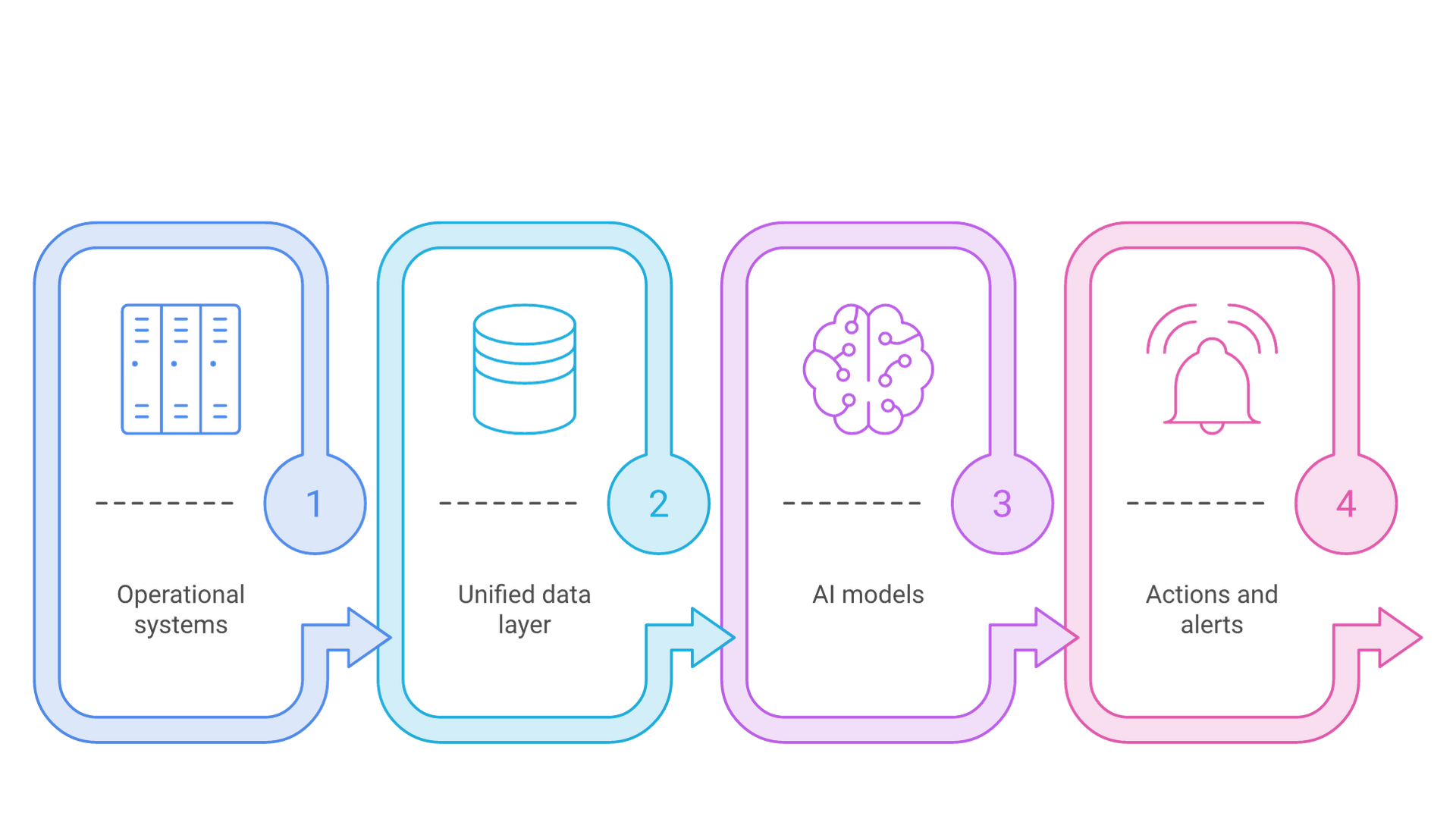
In practice, the architecture has four layers: the operational systems that run the business, a unified data layer that cleans and synchronizes their data, the AI models that forecast and optimize, and the actions that reach planners, dispatchers, warehouse staff and partner systems. If you want a survey of the commercial tools in this space rather than the integration approach, see our overview of AI logistics solutions for supply chains.
Core AI Technologies in Logistics Platforms
Machine learning is the core technology behind most AI capabilities in logistics. Machine learning models use operational data to forecast demand, identify inefficiencies, predict asset failures, recommend efficient route plans and balance inventory across warehouses, loading docks, fleets and distribution hubs. They combine real-time feeds with historical data to account for seasonal patterns, promotions and regional consumption behavior.
Computer vision extends AI into physical logistics environments. In warehouse operations it can verify inventory, monitor packing quality, inspect damage, detect mispicks and support automated inventory tracking from cameras or drones. At gates and yards it can read trailer numbers and detect unauthorized access or tampering with consignments, which supports both security and compliance.
Natural language processing and large language models handle the unstructured side of logistics: emails, bills of lading, delivery notes, customs paperwork, supplier updates and customer inquiries. They turn those documents into structured data that other models can use, draft exception summaries and answer questions about shipment status in plain language.
AI agents are the newest layer. An agent combines models with access to tools—your TMS, WMS or carrier APIs—so it can take a multi-step action such as rebooking a missed pickup or reallocating stock between sites within limits you define. Gartner predicted in May 2025 that by 2030, half of cross-functional supply chain management solutions will use intelligent agents to act on decisions without human direction, and in April 2026 it forecast that spending on supply chain management software with agentic AI will grow to $53 billion by 2030 (Gartner, May 2025; Gartner, April 2026).
AI-Driven vs Traditional Logistics Systems
Traditional systems are rule-based. A conventional TMS may run route planning on a fixed schedule, a WMS may update inventory after batch processing, and a planning team may review forecasts weekly or monthly. Those workflows leave leaders with limited visibility because reports describe what already happened rather than what is changing now.
AI-integrated platforms are adaptive. Models retrain as new data arrives, interpret signals from IoT sensors and external feeds, and monitor warehouses, fleets and suppliers continuously. When conditions change, they can adjust inventory allocation, reroute shipments or flag a supplier risk before it becomes a missed delivery.
For enterprise logistics, the value is not simply "more automation." It is a proactive operating model: AI detects anomalies, raises real-time alerts, recommends the most efficient option and automates the low-risk decisions, while people keep oversight of decisions that affect safety, compliance, cost or customer commitments. The broader business case for this shift is covered in our guide to AI for supply chain efficiency and resilience.
Core AI Features in Modern Logistics Platforms
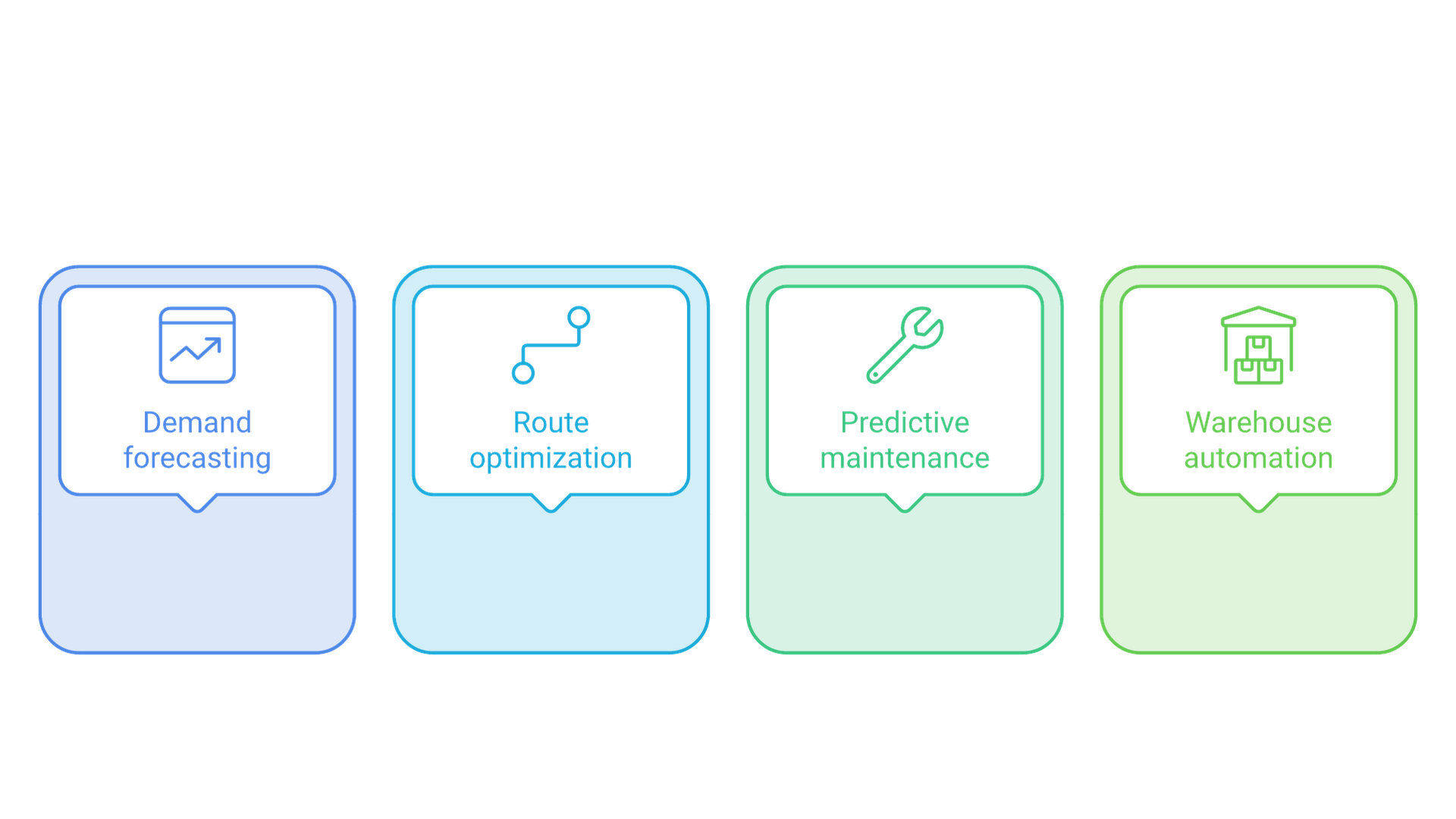
Once the foundation is clear, the practical question is which AI capabilities create measurable value. Most fall into four areas: predictive planning, intelligent transportation, asset reliability and automated warehouse operations. Each uses models that read data from several systems and turn operational complexity into faster, more reliable decisions.
Predictive Analytics and Demand Forecasting
Predictive analytics combines historical orders with seasonality, promotions, regional behavior, market trends, supplier signals and external data such as weather or economic indicators. Forecasts that update continuously, instead of once per planning cycle, let the system adjust reorder points, safety stock levels and production schedules as demand shifts. McKinsey estimates that embedding AI in distribution operations can reduce inventory by 20 to 30 percent and logistics costs by 5 to 20 percent, based on its surveys of distributors (McKinsey). Treat ranges like these as directional; your own baseline determines what is achievable.
Route Optimization and Transportation Management
AI-powered route planning considers traffic, delivery windows, vehicle capacity, driver hours, fuel cost, dock availability and customer priority at the same time. Instead of a static route built the night before, the TMS receives updated plans as conditions change, and dispatchers see why a route changed. Load consolidation, carrier selection and dynamic appointment scheduling use the same optimization engine.
Predictive Maintenance for Fleets and Equipment
Telematics and sensor data from trucks, forklifts, conveyors and sorters feed models that predict failures before they happen. Maintenance teams can schedule repairs during planned downtime rather than reacting to breakdowns that strand freight or stop a pick line. The integration point is the maintenance or asset management system, which receives work orders automatically.
Warehouse Automation and Inventory Accuracy
Inside the warehouse, AI optimizes slotting, pick paths, labor allocation and replenishment, while computer vision verifies counts and catches mispicks. When the WMS, robotics controllers and vision systems share one data model, inventory accuracy improves and cycle counts become continuous instead of disruptive.
Real-Time Supply Chain Visibility
Visibility platforms combine carrier events, GPS, IoT sensor data and supplier updates into a single view of where goods are and when they will arrive. AI adds predicted arrival times, risk scores and automated alerts. Shared event standards help here: GS1's EPCIS 2.0, ratified in 2022, defines a common way to record and exchange supply chain events and added a JSON format, REST interfaces and sensor data such as cold-chain temperature (GS1).
How to Integrate AI with TMS, WMS and ERP Systems
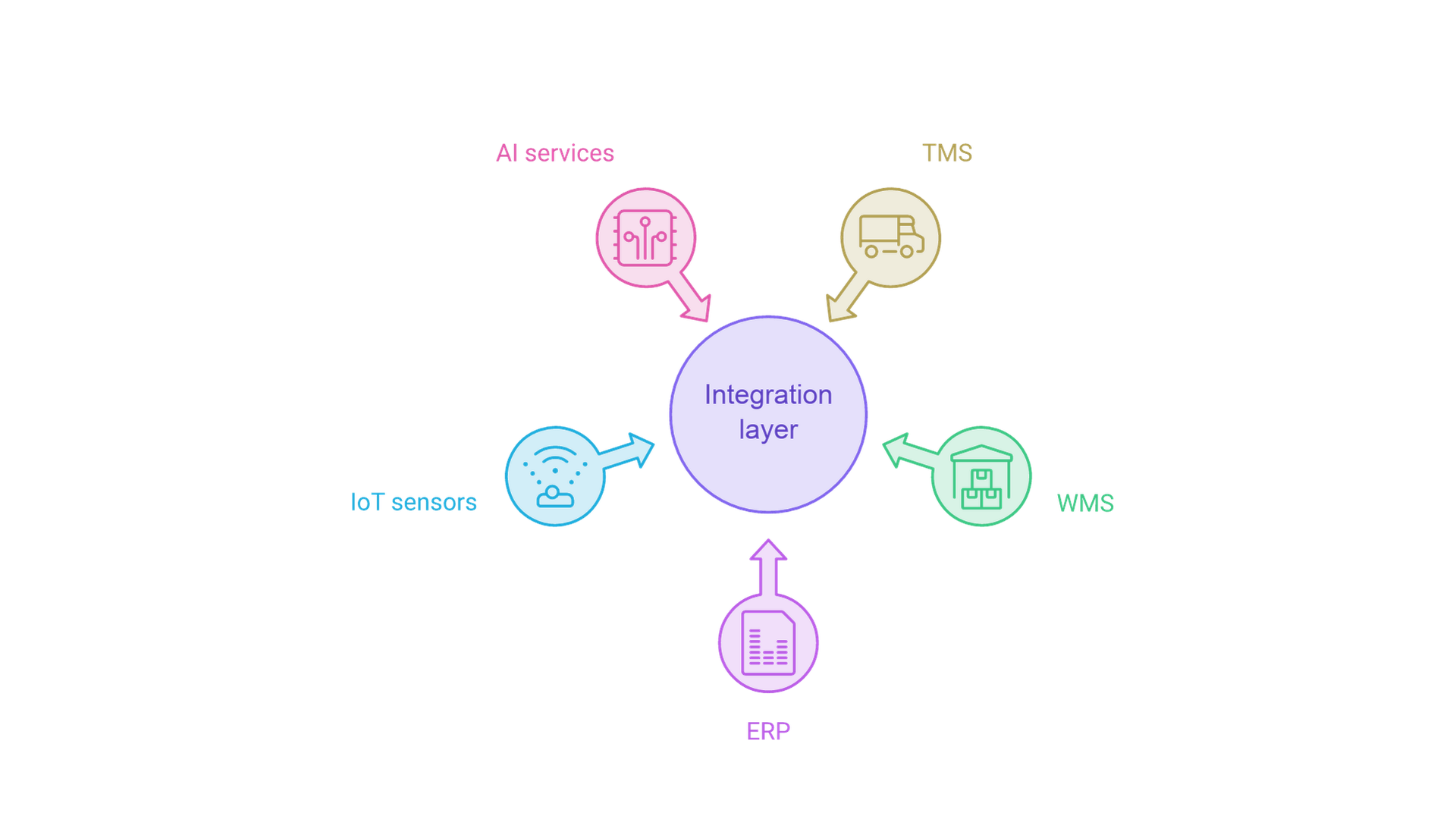
Integration is the part of an AI logistics project that determines whether models ever reach production. AI systems need data synchronization between transportation, warehouse, order, supplier and finance systems, and they need a safe way to write decisions back. A common pattern is an integration layer in the middle: it collects data from the TMS, WMS, ERP and IoT devices, standardizes it, exposes it to AI services and routes approved actions back to each system.
Integration Patterns That Work
APIs are the first requirement. Modern TMS and WMS products expose REST APIs or webhooks; older systems may need middleware, change data capture or scheduled extracts. Event streaming lets models react within seconds to a scan, a geofence entry or a delayed status update. If a legacy WMS updates only in batches, real-time visibility will be limited until an event layer or a reliable data pipeline is added. Plan the write-back path just as carefully as the read path: every automated action should be logged, reversible and attributable.
Cloud, On-Premise or Hybrid Deployment
The right architecture depends on security, scalability, latency, compliance and the condition of your existing systems. Most enterprises compare three options before committing.
| Criterion | Cloud AI logistics platform | On-premise or custom deployment |
|---|---|---|
| Scalability | Scales compute easily across regions, carriers and hubs | More controlled, often slower and costlier to scale |
| Data control and compliance | Requires careful review of data residency, privacy and vendor governance | Greater control over sensitive data, audit trails and compliance |
| Integration with existing systems | Prebuilt connectors, but workflows may be vendor-defined | Tailored to your ERP, WMS, TMS, IoT and partner systems |
| Real-time processing | Strong when connectivity and streaming are mature | Strong for low-latency, sensor-heavy local operations |
| Customization | Faster to deploy, less room for specialized rules | Better for unique dispatch rules, regulated flows and complex constraints |
| Maintenance | Vendor handles updates; lock-in and forced changes are possible | You control the roadmap but own monitoring, security and MLOps |
Hybrid architectures are increasingly common: cloud services for forecasting and analytics, with edge or on-premise components for warehouse automation and anything that must keep working when connectivity drops. Commercial platforms accelerate standard workflows, while custom development fits when you need specialized controls, multimodal orchestration or deep integration with legacy systems—the kind of work covered by our logistics software development services.
Implementation Roadmap for AI Logistics Software
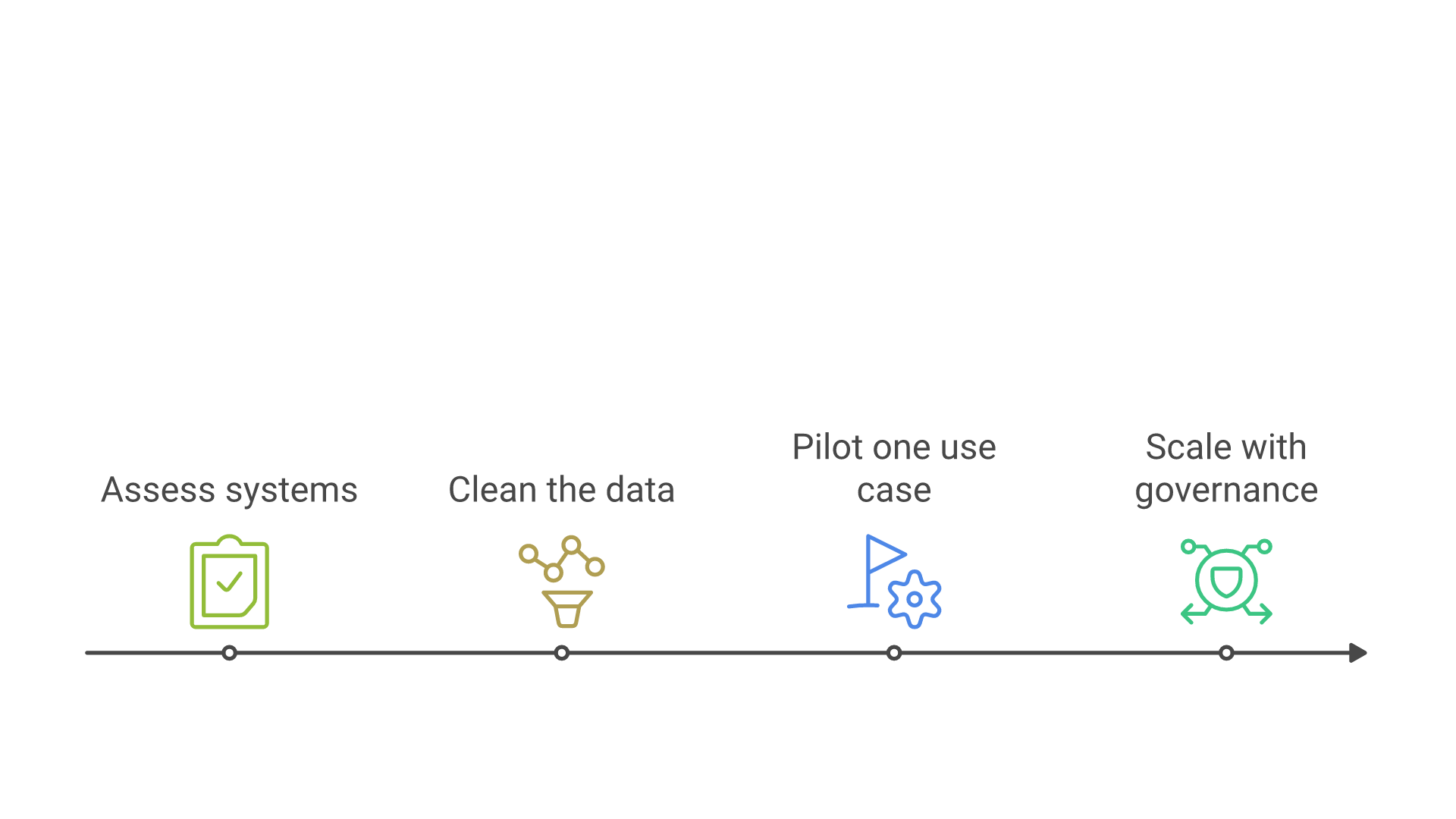
A structured rollout reduces risk and builds the trust that adoption depends on. The sequence below works for most mid-size and enterprise logistics operations.
1. Assess your systems and data. Document the ERP, WMS, TMS, carrier tools, IoT devices and spreadsheets in use, the data each holds, and where manual work fills the gaps. Check whether each system supports APIs, events or only batch exports.
2. Define specific business outcomes. Set baselines and targets for cost per shipment, on-time delivery, inventory accuracy, order accuracy, dwell time, empty miles or response time to disruptions. Outcomes decide which use case comes first.
3. Clean and connect the data. Standardize SKUs, units of measure, locations and carrier codes; build the integration layer; and validate data before it reaches a model.
4. Pilot one high-value use case. Start contained: demand forecasting for one product group, route optimization in one region, predictive maintenance for one fleet segment or computer vision in one warehouse zone. Compare results against the baseline.
5. Scale with governance. Expand to more sites and decisions only when the pilot meets its targets, with monitoring, retraining schedules, clear decision rights and training for the people who work with the system.
Common Integration Challenges and Solutions
AI integration in logistics faces unique challenges because supply chain operations combine physical assets, partner dependencies, regulations, legacy software and time-sensitive execution. The main risks are rarely the models themselves.
Data Quality and System Integration Issues
AI models are only as reliable as the data that feeds them. Outdated SKU data, inconsistent units of measure, delayed sensor readings, missing carrier updates, duplicated customer records and disconnected warehouse systems produce inaccurate forecasts, poor routing recommendations and noisy alerts. The fix is master data management, schema standardization and validation pipelines before large-scale deployment, plus real-time synchronization between the systems that matter most.
Change Management and User Adoption
Logistics teams may distrust AI recommendations, especially after years of relying on their own judgment. Adoption suffers when recommendations appear without explanation. Start with augmentation rather than full autonomy: show why the model chose a route, raised safety stock or escalated a supplier risk, and let experienced dispatchers and planners override it. Their overrides become valuable training data.
Scalability and Performance
A pilot that works in one warehouse or region can fail when expanded across hubs, geographies or business units, and models degrade when demand patterns, suppliers or networks change. Modular design helps: separate forecasting, routing, inventory, visibility and document services so each scales independently, and add drift detection, model versioning and performance benchmarks from the start.
Cost Growth
AI features change the economics of logistics software. Vendors increasingly price advanced AI capabilities into higher subscription tiers or usage-based fees, so budget for licensing, compute, integration and ongoing model operations, not only the initial build.
Security, Compliance and Governance
Connecting AI to operational systems widens the attack surface. Threats include data poisoning, unauthorized access to carrier or customer data, prompt injection against AI assistants that read external documents, and agents acting outside their intended scope. Role-based access, least-privilege API credentials, audit trails, approval thresholds for automated actions and continuous monitoring should be designed in from day one.
Compliance requirements vary by freight type and region: trade and customs documentation, hazardous materials, driver regulations, food and pharmaceutical traceability, and data privacy. A recognized framework keeps governance consistent. The voluntary NIST AI Risk Management Framework organizes the work into four functions—govern, map, measure and manage—and many enterprises use it to structure AI oversight (NIST).
How to Measure the ROI of AI in Logistics
Measure AI against the baseline you set before the pilot, using the same definitions. Useful metrics include transportation cost per unit or per mile, forecast accuracy, inventory levels and stockouts, on-time and in-full delivery, equipment downtime, empty miles, labor hours per order, manual interventions per shipment and time to respond to a disruption.
Count the full cost on the other side: data preparation, integration, licenses, compute, monitoring and training. Many of the largest gains come from decisions that were previously impossible to make in time, so track avoided costs such as expedited freight that was no longer needed, alongside direct savings.
Frequently Asked Questions
What is logistics software with AI integration?
It is logistics software, such as a TMS, WMS or visibility platform, connected to AI models that forecast demand, optimize routes, predict maintenance and automate routine decisions using live operational data.
How is AI used in logistics software?
Common uses are demand forecasting, route optimization, predictive maintenance, warehouse slotting and pick optimization, computer vision for inventory checks, document automation and real-time shipment visibility with predicted arrival times.
Can AI integrate with my existing TMS, WMS and ERP?
Usually, yes. Systems with APIs or webhooks connect directly; older systems may need middleware, change data capture or an event layer. Plan both how AI reads data and how its decisions are written back.
What are AI agents in logistics?
AI agents combine models with access to tools such as carrier or warehouse APIs so they can complete multi-step tasks, like rebooking a missed pickup, within limits and approval rules set by the business.
What are the biggest challenges of AI in logistics?
Poor data quality, disconnected legacy systems, user distrust of unexplained recommendations, scaling beyond a pilot, rising software costs and security risks from connecting AI to operational systems.
How long does it take to implement AI in logistics?
A focused pilot on one use case often takes a few months when data is accessible. Enterprise-wide rollout takes longer and depends mostly on data cleanup and integration work.
Conclusion and Next Steps
AI-integrated logistics software turns supply chain operations into predictive, adaptive and increasingly self-optimizing networks. The strongest results come from combining demand forecasting, route optimization, predictive maintenance, warehouse automation and real-time visibility on top of clean, connected data, with security and human oversight built in.
The practical path is consistent: assess your current systems, define measurable outcomes, fix the data and integration layer, pilot one high-value use case, then scale with governance. Choose between commercial platforms, custom development and hybrid architectures based on your existing systems, compliance needs and operational complexity, and use our AI integration services where connecting models to legacy systems is the main obstacle.
If you are planning to add AI to your TMS, WMS or ERP and want an integration plan grounded in your own data, talk to Cognativ about your logistics AI project.