

Open Source AI Models for Local Deployment: A 2026 Model-Selection Guide
Most downloadable AI models are open-weight, not open source. See which 2026 families fit laptops, single GPUs or servers, and what their licenses really allow.
Open source AI models for local deployment have moved from an experiment to a normal architecture choice. In 2026 almost every major model lab publishes weights that you can download and run on your own laptop, workstation or server: Alibaba's Qwen, Google's Gemma, Mistral AI, OpenAI's gpt-oss, Meta's Llama, DeepSeek, Microsoft's Phi, IBM's Granite and Ai2's OLMo. Running a model on infrastructure you control keeps prompts and documents inside your boundary, replaces per-token fees with capacity you own, and lets you fine-tune and pin a version that will not change under you.
The hard part is no longer whether a capable open model exists. It is choosing the right one. Families now span from phone-sized models under 1 GB of memory to trillion-parameter mixture-of-experts systems that need a full multi-GPU node. Licenses range from genuinely permissive Apache 2.0 and MIT terms to custom "open-weight" licenses with user thresholds, naming rules and service restrictions. A model that looks free on a leaderboard can be the wrong legal or hardware fit for your deployment.
This guide is the model-selection layer. It explains the difference between open source and open-weight licenses, profiles the current model families as of October 30, 2026 using their official model cards and license pages, maps each family to realistic hardware, and gives a selection and governance process you can apply before you commit. Setup tutorials, runtime walkthroughs and server builds are covered in the related guides linked throughout.
Key strategic takeaways:
- "Open" is a license question, not a download button. Apache 2.0 and MIT models (Gemma 4, gpt-oss, Qwen3.6, Qwen3.8-27B, Mistral Small 4, Ministral 3, Phi-4, Granite 4.2, DeepSeek V4) carry few obligations. Llama 4, Qwen3.8-Flash-Next and Mistral Large 4 use custom licenses with conditions you must read.
- Hardware fit decides the shortlist. Weight memory scales with parameter count and precision, and mixture-of-experts models must load every expert even though only a few are active per token.
- Open source in the strict sense is rare. Fully open models that also release training data and code, such as OLMo, are the exception; most "open source LLMs" are open-weight.
- Evaluate on your own tasks. Public benchmarks shortlist candidates; your documents, prompts and latency targets pick the winner.
Understanding Open Source AI Models, Open Source LLMs, and Local Models for Deployment
An open model, in everyday usage, is one whose trained parameters you can download and run yourself. A closed or proprietary model is reachable only through a vendor's API, so the provider controls the version, the pricing, the data path and the availability. With an open model you receive the model files and decide where inference happens: on a developer laptop, an on-premises GPU server, a private cloud tenancy or an edge device with no network at all.
Local deployment means the model runs on infrastructure you own or exclusively control, and prompts, retrieved documents and outputs do not leave that environment unless you send them. That is the property most regulated teams care about. It also changes the cost model from usage-based to capacity-based: you pay for hardware, power and operations instead of per token.
Open Weight vs Open Source: What the Licenses Actually Mean
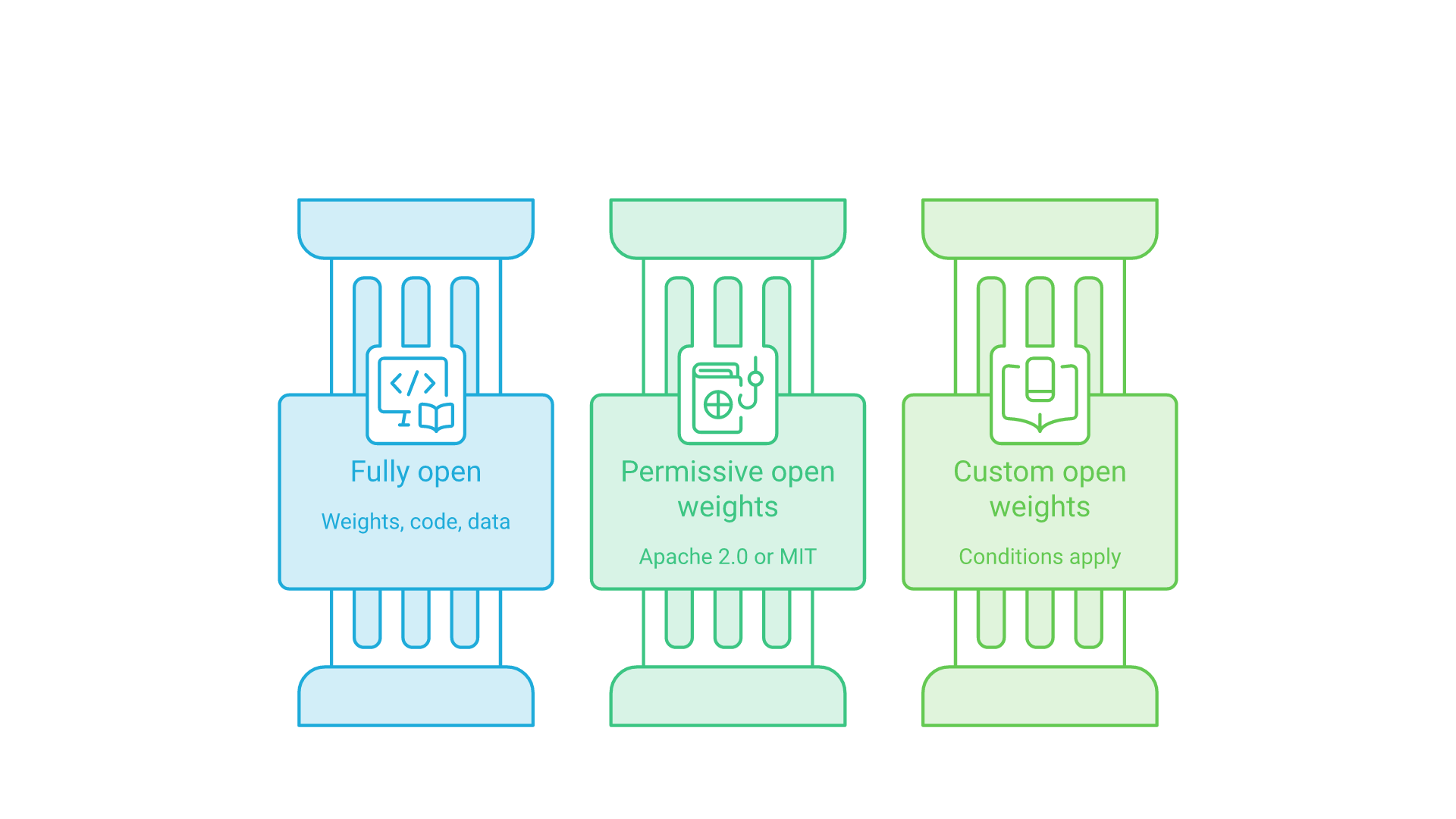
The Open Source Initiative's Open Source AI Definition 1.0 sets the strict bar. An open source AI system must make three things available in the form you would need to modify it: data information detailed enough for a skilled person to build a substantially equivalent system, the complete code used to train and run it, and the parameters. It must also grant four freedoms: use the system for any purpose without asking permission, study how it works, modify it for any purpose and share it, with or without changes.
Most popular models do not meet that bar because they publish weights and inference code but not their training data or full training pipeline. Those models are best described as open-weight. Within open-weight models there are two very different license groups:
- Permissive open-weight licenses. Standard licenses such as Apache 2.0 and MIT grant broad rights to use, modify and redistribute, including commercially, with notice and attribution obligations. Gemma 4, gpt-oss, Mistral Small 4, Phi-4, Granite 4.2 and DeepSeek V4 sit here.
- Custom open-weight licenses. Publisher-written licenses allow free use but attach conditions: a monthly-active-user threshold, naming or "Built with" display rules, acceptable-use policies, or a separate commercial license for model-as-a-service businesses. Llama 4, Qwen3.8-Flash-Next, Qwen3.8-2.4T-A95B and Mistral Large 4 sit here.
A small third group is fully open: weights plus training data, training code and intermediate checkpoints. Ai2's Olmo 3.1 32B Think model card lists its Dolma 3 pre-training data, its Dolci post-training datasets, the OLMo-Core and Open-Instruct training code and step checkpoints, all under Apache 2.0. That level of transparency is what researchers and auditors need when they must explain where a model's behavior came from.
Market Landscape and Enterprise Adoption of Open Source LLMs and Local AI Models
The open-weight landscape changed sharply between late 2025 and October 2026. Google moved Gemma from its own Gemma Terms of Use to Apache 2.0 with Gemma 4; the Gemma terms page now applies the older terms to Gemma 3 and earlier and points Gemma 4 users to a separate license, which Google publishes as the Apache License 2.0. Alibaba's Qwen team split its releases: compact models such as Qwen3.8-27B ship under Apache 2.0, while its largest and newest sparse models use Qwen-specific licenses. Mistral did the same, keeping Mistral Small 4 and Ministral 3 on Apache 2.0 while releasing Mistral Large 4 under a modified MIT license with a model-as-a-service clause.
Meanwhile, Meta's official Hugging Face organization shows Llama 4 as its current family, with no newer Llama generation published there as of this update. Llama is still widely deployed, but it is no longer the default starting point it was in 2024. The practical result for buyers is that license review has become as important as benchmark review, because two models from the same publisher can carry very different terms.
Strategic Business Benefits of Running Open Source LLMs on Local Infrastructure
The benefits of local models are real but conditional: they depend on usage volume, data sensitivity and whether your team can operate inference infrastructure.
Cost structure. API pricing is per token, so cost rises with every user and every long document. Local inference converts that into a fixed investment in GPUs, memory, power and staff time. Whether that is cheaper depends on utilization: a steadily used internal assistant can justify dedicated hardware, while an occasional workload is usually cheaper through an API. Model the break-even with your own token volumes and hardware quotes rather than relying on generic savings claims.
Data sovereignty. When the model runs inside your network, prompts and retrieved documents never reach a third-party processor. That simplifies data-protection reviews for financial services, healthcare, legal and public-sector work, and it makes retrieval-augmented generation over proprietary documents easier to approve.
Latency and availability. Local inference removes the network round-trip and the dependency on a provider's uptime and rate limits. Actual response time still depends on model size, quantization, batch load and hardware, so measure it on your configuration.
Customization. Open weights can be fine-tuned with adapters such as LoRA, distilled into smaller models or constrained with your own system prompts and tools. Closed APIs may offer fine-tuning, but you never control the base model or its update schedule.
Risk Mitigation and Competitive Advantages of Self Hosted LLMs
Self-hosted LLMs reduce several strategic risks at once. You can pin an exact model version and keep it running for as long as it meets your needs, which protects you from deprecations, silent behavior changes and price increases. You keep proprietary data, fine-tuned weights and evaluation sets inside your organization. And you can switch between open models without rewriting your stack if you serve them behind a standard, OpenAI-compatible endpoint, which most local runtimes provide.
The trade-off is that you inherit responsibilities a vendor would otherwise carry: patching, capacity planning, security hardening, monitoring and license compliance. Self-hosting is a competitive advantage only when those operations are planned from the start.
- Vendor lock-in: lower, because weights and serving stack are portable.
- Data exposure: lower, provided the serving environment is secured and logged.
- Cost volatility: lower per token, but hardware and staffing become fixed costs.
- Availability: under your control, which also means it is your responsibility.
- Model quality ceiling: the largest closed frontier models may still lead on some tasks, so test before you commit.
Top Enterprise-Grade Open Source LLMs and Large Language Models for 2026
The families below are the ones most teams shortlist for local deployment in late 2026. Facts come from each publisher's official model card or license page, checked on October 30, 2026. Release dates are given where the card states them; parameter counts are the publisher's figures. No ranking is implied by the order.
Qwen (Alibaba): Qwen3.6 and Qwen3.8
Qwen offers the widest range of sizes and is the family many local users start with. The Qwen3.6-27B model card describes an April 2026, 27B dense model under Apache 2.0 with a native 262,144-token context, extensible to about one million tokens. Its sibling, Qwen3.6-35B-A3B, is a mixture-of-experts model with 35B total and 3B active parameters, also Apache 2.0, accepting text and image input.
The August 2026 Qwen3.8-27B model card describes a compact, deployment-friendly dense model with a vision encoder, a hybrid of Gated DeltaNet and Gated Attention layers, text, image and video input, the same 262,144-token native context and an Apache 2.0 license. It thinks by default and exposes a reasoning-effort setting. The larger Qwen3.8 releases are different. Qwen3.8-Flash-Next is a sparse model with about 6B active parameters out of a 125B language model plus large n-gram embeddings, released under the qwen-community-1.0 license, which allows commercial use but requires a separate license for model-as-a-service and "AI work assistant" businesses and a visible model name for products above 100 million monthly active users or US$20 million in monthly revenue. The flagship Qwen3.8-2.4T-A95B has 2.4 trillion total and 95B active parameters under its own qwen3.8-max license, and it is a data-center model rather than a local one.
Gemma 4 (Google)
Gemma 4 is the strongest choice when you need one license and one family across phones, laptops and single-GPU servers. Google's Gemma 4 overview lists five sizes: E2B and E4B "effective parameter" models for mobile, edge and browser use, a 12B unified multimodal model, a 26B A4B mixture-of-experts model and a 31B dense model. All accept text and images; E2B, E4B and 12B also handle audio natively. The small models have a 128K context window and the larger ones 256K. The Gemma 4 31B model card and 26B A4B model card both state Apache 2.0; the 26B model activates about 3.8B of its 25.2B parameters per token.
Google also publishes the most useful memory table of any family. For weights alone, including 20% overhead, it lists about 2.9 GB for E2B at 4-bit, 6.7 GB for 12B at 4-bit, 14.4 GB for 26B A4B at 4-bit and 17.5 GB for 31B at 4-bit, against 69.9 GB for 31B in BF16. Those figures exclude the KV cache, which grows with context length.
Mistral AI: Ministral 3, Mistral Small 4 and Mistral Large
Mistral covers edge, workstation and data-center tiers. The Ministral 3 14B model card lists Apache 2.0, a 256K context, image input and 3B, 8B and 14B sizes; it states the 14B instruct model fits in 24 GB of VRAM in FP8. Mistral Small 4 is a 119B mixture-of-experts model with 6.5B active parameters, 256K context, image input and an Apache 2.0 license; its example serving command splits it across two GPUs.
At the top end, Mistral Large 3 (about 675B total, 41B active, Apache 2.0) runs in FP8 on a single node of B200 or H200 GPUs, according to its card. The newer Mistral Large 4 has about one trillion total parameters, roughly 52B active including embeddings, and a one-million-token context. Its card's serving examples use an eight-GPU node, and it ships under the Mistral Ecosystem Open-Weight License, a modified MIT license that permits commercial use but requires a separate commercial agreement if you or an affiliate run a model-as-a-service business. Internal use that does not expose the model to third parties is exempt.
gpt-oss (OpenAI)
OpenAI's two open-weight reasoning models remain popular because of their clean license and efficient memory profile. The gpt-oss-20b model card lists 21B total and 3.6B active parameters and says the model runs within 16 GB of memory; the gpt-oss-120b card lists 117B total and 5.1B active parameters, fitting a single 80 GB GPU such as an H100 or MI300X. Both use MXFP4 quantization of the mixture-of-experts weights from post-training and are released under Apache 2.0. Released in August 2025, they are older than most models here but remain a reliable reasoning baseline.
Llama 4 (Meta)
The Llama 4 Scout model card lists an April 5, 2025 release, 109B total and 17B active parameters across 16 experts, multilingual text and image input, and a context length of up to 10 million tokens. Meta states that Scout fits on a single H100 GPU with on-the-fly int4 quantization. Llama 4 is open-weight but not open source: the Llama 4 Community License requires companies with more than 700 million monthly active users to request a separate license, requires a "Built with Llama" display and a notice file when you distribute it, requires derived models to start their names with "Llama," and incorporates an acceptable-use policy.
DeepSeek V4
DeepSeek publishes very large mixture-of-experts models under the MIT license. The DeepSeek-V4.1-Flash model card describes a 552B-parameter backbone with 8B active parameters during prefill and 16B during decode, a context of up to one million tokens and MIT-licensed weights. The DeepSeek-V4-Pro checkpoint is listed at 1.7 trillion parameters. These are permissively licensed, but they are server-class deployments: neither card states minimum hardware, and their examples assume multi-GPU serving engines.
Phi-4 (Microsoft)
Phi remains the compact, MIT-licensed option. The original Phi-4 model card lists about 14B parameters, a 16K context and a December 2024 release. The newer Phi-4-reasoning-vision-15B, released March 4, 2026, adds image input and reasoning with a 16,384-token context under MIT. The short context makes Phi a better fit for focused tasks than for long-document retrieval.
Granite 4.2 (IBM) and OLMo 3.1 (Ai2)
IBM's Granite family targets enterprise use with Apache 2.0 terms. The Granite 4.2 8B model card lists an August 25, 2026 release, a dense decoder with a native 128K context extended to 512K, twelve tested languages, tool calling and selectable thinking modes; 3B and 30B variants are published alongside it. IBM recommends pairing it with its Granite Guardian safety models.
Ai2's Olmo 3.1 32B Think is the reference choice when you need a fully open model, with data, code and checkpoints released under Apache 2.0. Its card positions it for research and educational use under Ai2's responsible-use guidelines, so confirm fit before using it in a commercial product.
Comparison: Licenses, Sizes and Hardware Fit
| Model family | Sizes (total / active) | License | Typical local fit |
|---|---|---|---|
| Gemma 4 | E2B, E4B, 12B, 26B A4B, 31B | Apache 2.0 | Phone to single GPU |
| Qwen3.6 / Qwen3.8-27B | 27B dense; 35B / 3B MoE | Apache 2.0 | Single GPU, quantized |
| Qwen3.8-Flash-Next | 125B LM + embeddings / 6B | qwen-community-1.0 | Multi-GPU server |
| Ministral 3 | 3B, 8B, 14B | Apache 2.0 | Laptop to 24 GB GPU |
| Mistral Small 4 | 119B / 6.5B | Apache 2.0 | Two-GPU server |
| Mistral Large 3 / Large 4 | 675B / 41B; ~1T / ~52B | Apache 2.0; Mistral Ecosystem Open-Weight | Eight-GPU node |
| gpt-oss | 21B / 3.6B; 117B / 5.1B | Apache 2.0 | 16 GB device; one 80 GB GPU |
| Llama 4 Scout | 109B / 17B | Llama 4 Community License | One H100 with int4 |
| DeepSeek V4 | 552B backbone / 8-16B; 1.7T | MIT | Data-center node |
| Phi-4 | 14B; 15B vision | MIT | Single GPU |
| Granite 4.2 | 3B, 8B, 30B | Apache 2.0 | Laptop to single GPU |
| Olmo 3.1 | 32B | Apache 2.0, fully open | Single large GPU |
Model Selection Criteria and Performance Benchmarks for Open Source LLMs
Model selection works best as a funnel. Start with the constraints that cannot move, which are license terms and available hardware, then narrow by capability, and only then compare quality on your own data. Teams that start from a leaderboard often pick a model they cannot legally ship or physically serve.
Selection Criteria That Matter for Local Deployment
- License fit: commercial use, redistribution, user thresholds, naming rules and service restrictions.
- Memory footprint: total parameters at your chosen precision, plus KV cache for your context length.
- Active parameters: drive speed per token for mixture-of-experts models.
- Context window: 16K suits chat and short tasks; 128K to 256K suits long documents and agents.
- Modalities: text only, image, video or audio input.
- Tool calling and reasoning modes: needed for agents and structured output.
- Languages: check the card's tested-language list for multilingual work.
- Runtime support: availability in GGUF, MLX or the serving engine you use.
Matching Models to Hardware Tiers
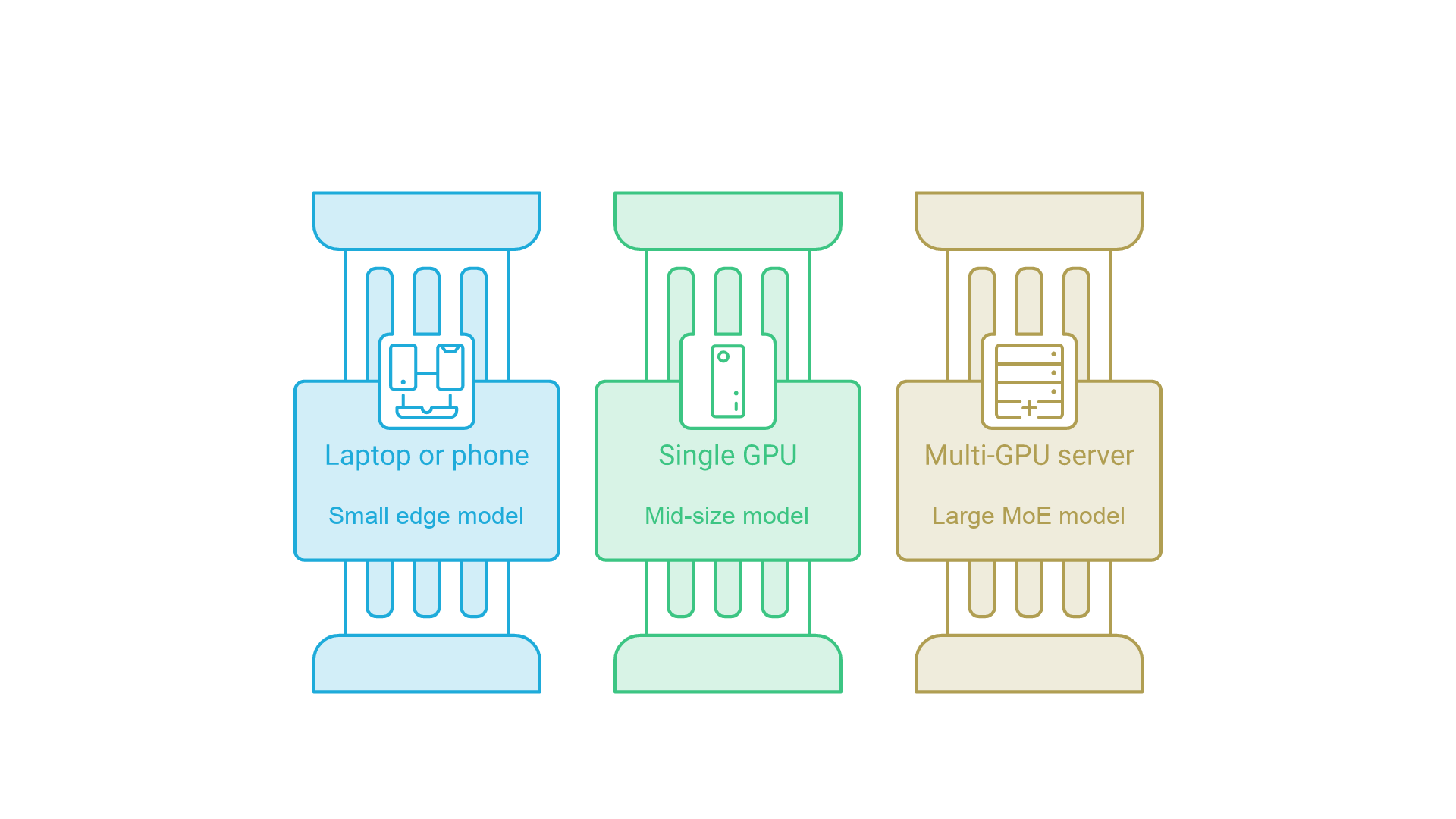
Laptops, phones and edge devices. Gemma 4 E2B and E4B, Ministral 3 3B and 8B, and Granite 4.2 3B are designed for this tier. Google lists Gemma 4 E2B at about 1.1 GB on mobile with its LiteRT-LM runtime. Expect good summarization, classification and short chat, not deep multi-step reasoning. When buying a machine for this tier, prioritize unified or system memory and a supported accelerator over raw CPU speed.
A single 24 GB to 32 GB GPU or a high-memory Mac. This is the sweet spot for local deployment in 2026. Gemma 4 31B at 4-bit (about 17.5 GB of weights by Google's figures), Gemma 4 26B A4B, Ministral 3 14B in FP8 (Mistral says it fits in 24 GB), gpt-oss-20b and quantized Qwen 27B-class dense models all live here, leaving room for a moderate KV cache.
One 80 GB data-center GPU. gpt-oss-120b fits on one H100 or MI300X by OpenAI's model card, and Llama 4 Scout fits on one H100 with int4 quantization by Meta's card. Gemma 4 31B can run here at higher precision.
Multi-GPU servers and nodes. Mistral Small 4, Qwen3.8-Flash-Next, Mistral Large 3 and 4, DeepSeek V4 and the Qwen3.8 flagship need tensor parallelism across several GPUs. These deliver frontier-class open capability but are infrastructure projects, not desktop installs.
How to Read Performance Benchmarks
Every model card publishes benchmark tables, and they are useful for shortlisting. They are less useful for final selection because publishers choose which benchmarks to report, use different prompting and reasoning settings, and often report results at full precision rather than the quantized formats you will actually run. Rankings also change monthly. Treat any single score as a hint, and compare models on a held-out set of your own prompts, documents and expected answers, run at the precision and context length you plan to deploy.
Compact models often handle customer-service and classification tasks well, while multi-step analysis, coding agents and long documents justify the larger tiers. Measure task accuracy, latency at realistic concurrency and failure modes, not just average scores.
Infrastructure Requirements, Deployment Architecture, and Tools to Run LLMs
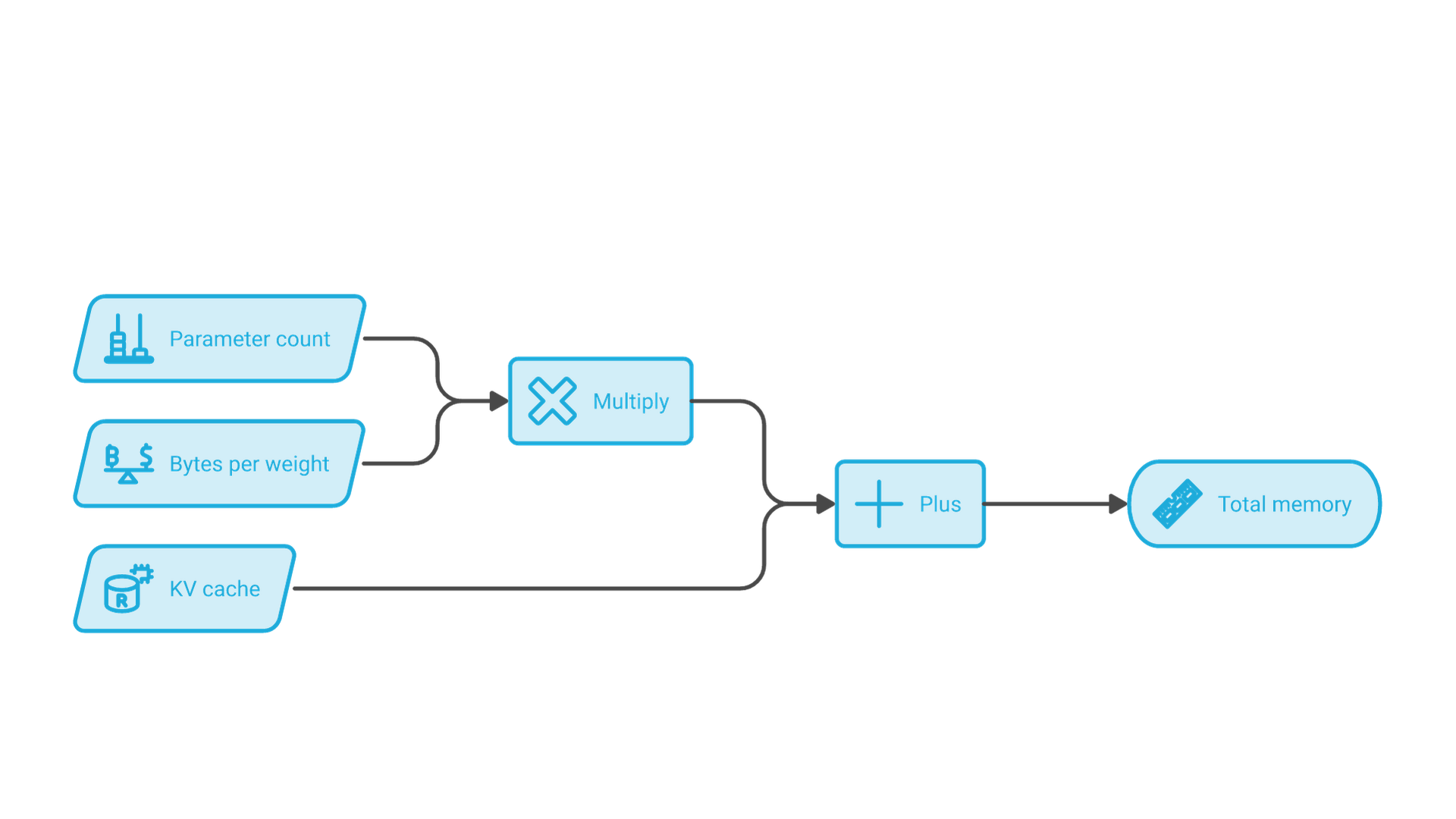
Hardware sizing for local models starts with a simple estimate: weight memory is roughly the number of parameters multiplied by the bytes per parameter. BF16 uses two bytes per weight, 8-bit formats about one byte and 4-bit formats about half a byte, plus some overhead. That is why a 31B model needs around 70 GB in BF16 but under 20 GB at 4-bit in Google's published table. Quantization is the single biggest lever for local deployment, and our explainer on LLM quantization covers the formats and quality trade-offs in depth.
Two details catch teams out. First, mixture-of-experts models must hold all experts in memory. Gemma 4 26B A4B activates about 4B parameters per token, but Google notes that all 26 billion must be loaded, so it needs the memory of a 26B model while running at the speed of a much smaller one. Second, the KV cache, the memory that stores attention state for the conversation, grows with context length and concurrent users. A model that fits with a 4K prompt can run out of memory at 128K, which is why serving examples on model cards often lower the maximum context length to save memory.
Beyond the GPU, plan for system RAM, fast NVMe storage for model files and checkpoints, and enough network bandwidth for multi-GPU nodes. Our local AI server specs guide breaks down CPU, RAM, storage and GPU choices for single-box builds.
Implementation Frameworks, Complementary Tools, and Open Source Community Resources
The runtime you choose depends on whether you are serving one person or many. Desktop tools such as Ollama and LM Studio download quantized models and expose a local API with little setup, which makes them ideal for evaluation and individual use. llama.cpp underpins much of this ecosystem and runs GGUF-quantized models on CPUs, Apple Silicon and consumer GPUs. For multi-user production serving, the official model cards for Qwen3.8, Mistral Large, Mistral Small 4 and DeepSeek V4 point to engines such as vLLM and SGLang, which add continuous batching, tensor parallelism and higher throughput.
Deployment architecture usually converges on the same pattern: a serving engine on GPU hosts, an OpenAI-compatible API in front, an authentication and rate-limiting gateway, a retrieval layer for your documents and centralized logging. Containerizing the stack with Docker and orchestrating it with Kubernetes makes model swaps and rollbacks routine. When the requirement grows from one server to shared, monitored, multi-team capacity, our AI infrastructure services help design and run that platform.
Monitoring is part of the architecture: track tokens per second, time to first token, queue depth, GPU memory, error rates and the model version behind each response.
Compliance, Security, and Governance Considerations in Running Open Source LLMs
Local deployment simplifies data-protection reviews, but it does not remove governance. You now own the controls a vendor would otherwise provide, and you also own the license obligations of every model you run.
License compliance. Record the exact license for each model and version, because terms can differ within one family. Apache 2.0 and MIT require you to keep copyright and license notices. Llama 4 adds a "Built with Llama" display, a notice file, a naming rule for derived models and a 700-million-user threshold. The qwen-community-1.0 and Mistral Ecosystem licenses require separate agreements for model-as-a-service businesses. If you fine-tune and redistribute a model, the obligations travel with your derivative.
Security. Treat model files as software supply chain. Download only from the publisher's official repository, verify checksums, prefer the safetensors format, and scan any third-party quantized or fine-tuned variants before use. Put the inference API behind authentication, encrypt traffic, and segment GPU hosts from the open internet. Prompt-injection and data-exfiltration risks still apply to local models connected to tools or documents.
Data governance. Define what data may be sent to which model, how long prompts and outputs are logged, who can access logs, and how fine-tuning datasets are approved. Regulated teams should map these controls to their obligations, such as HIPAA for health data or GDPR for personal data, with legal review.
Model versioning and change management. Keep a registry with model name, version, license, checksum, quantization, evaluation results and deployment date. That lineage supports audits and lets you roll back quickly when a new version regresses.
Risk Assessment and Mitigation Strategies for Enterprise AI Deployments
- Hallucination and accuracy drift: mitigate with retrieval grounding, evaluation sets and human review for high-stakes outputs.
- Bias and unsafe output: test with adversarial prompts and add a safety classifier where the publisher provides one, such as Llama Guard, Qwen3Guard or Granite Guardian.
- Infrastructure failure: plan redundancy, health checks and a fallback model or endpoint.
- Security breach: enforce access controls, network isolation, encryption and audit logs.
- License violation: maintain a license register and review terms before each new model or business model change.
Legal risk deserves special attention because "open" licenses are easy to misread. A license that allows commercial use may still restrict how you offer the model to customers, how you name a fine-tune or what you can do above a user threshold. Permissive licenses such as Apache 2.0 and MIT give the most flexibility, and fully open models give the most transparency, so they deserve a head start when two candidates perform similarly.
Implementation Strategy, ROI Analysis, and Future-Proofing with Open Source LLMs
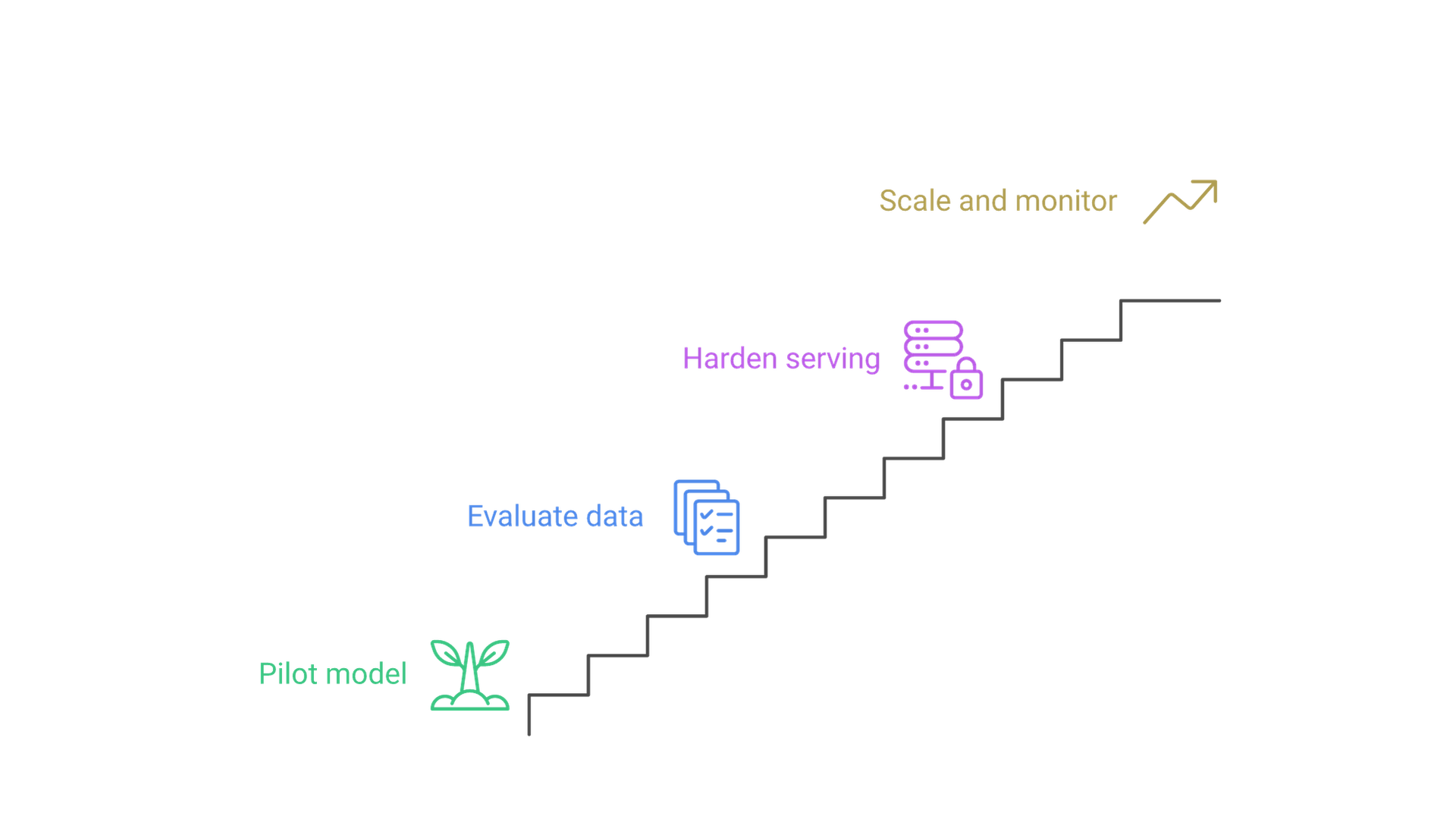
A phased rollout limits risk and builds the skills you need. Start with a pilot on one bounded use case using a compact model on existing hardware, then expand once you have evaluation data, operating procedures and a clear owner. Our walkthrough on setting up and using local LLM models covers the hands-on side of that first pilot.
- Define the task and success metrics: accuracy, latency, cost per request and acceptable failure rate.
- Shortlist by license and hardware: two to four candidates that fit both.
- Evaluate on your data: same prompts, same quantization, same context length.
- Harden the serving stack: authentication, logging, monitoring and rollback.
- Scale and review: add users, re-run evaluations on each model update and revisit the license register.
Return on investment should be calculated from your own numbers: projected tokens per month, the API price you would otherwise pay, hardware amortization, power, and the engineering time to operate the platform. Local deployment tends to pay back when usage is steady and high, data sensitivity is a constraint, or customization creates value an API cannot. It rarely pays back for small, bursty workloads.
Users also need training, clear escalation paths and confidence that their data stays internal. If you want a partner to select, fine-tune and integrate open models into production systems, our LLM solutions team works across model selection, retrieval and deployment.
Future-Proofing and Strategic Roadmap for Large Language and Open Source Models
The architecture trends that the original version of this guide anticipated have arrived. Mixture-of-experts designs now dominate the larger open models, native multimodal input is standard in Gemma 4, Qwen3.8, Mistral and Llama 4, and context windows of 256K to one million tokens are common. Hybrid attention designs such as Qwen's Gated DeltaNet layers aim to make long contexts cheaper to serve.
To future-proof, keep your stack model-agnostic: serve through a standard API, store prompts and evaluation sets separately from any one model, and budget hardware with headroom for memory, which is usually the limiting resource. Expect to swap models at least once a year as families update, and design your license register and evaluation suite so that each swap is a routine review rather than a new project.
Frequently Asked Questions
What is the difference between open-weight and open source AI models?
An open-weight model publishes its trained parameters so you can run and often modify it. An open source AI model, as defined by the Open Source Initiative, must also provide enough training-data information and the full training and inference code to rebuild it, and must grant freedom to use, study, modify and share it for any purpose.
Is Llama 4 open source?
Llama 4 is open-weight, not open source in the OSI sense. Its community license allows broad use but adds conditions, including a separate license for companies above 700 million monthly active users, attribution and naming requirements, and an acceptable-use policy.
Which open models have the most permissive licenses?
As of October 2026, Gemma 4, gpt-oss, Qwen3.6, Qwen3.8-27B, Ministral 3, Mistral Small 4, Mistral Large 3, Granite 4.2 and Olmo 3.1 use Apache 2.0, and Phi-4 and DeepSeek V4 use MIT. Always check the license file for the exact checkpoint you download.
What is the best open model for a single 24 GB GPU?
Strong candidates include Gemma 4 31B or 26B A4B at 4-bit, Ministral 3 14B in FP8, gpt-oss-20b and a quantized Qwen 27B-class dense model. The right choice depends on your task, languages and context length, so test two or three on your own data.
Can I run an open model locally without a GPU?
Yes, for small models. Compact models such as Gemma 4 E2B or E4B and other quantized small models run on CPUs, Apple Silicon and phones, though more slowly than on a GPU. Larger models need GPU memory to be practical.
Do mixture-of-experts models need less memory?
Usually not. They run faster because only a few experts are active per token, but all experts must be loaded, so memory needs follow the total parameter count rather than the active count.
Why Open Source AI Models for Local Deployment Are a Strong Enterprise Strategy
Open source AI models for local deployment give organizations control over data, cost structure, versioning and customization that API-only strategies cannot match. In late 2026 that control no longer requires a compromise on capability: Gemma 4, Qwen, Mistral, gpt-oss, Llama 4, DeepSeek, Phi, Granite and OLMo cover every tier from phones to multi-GPU nodes.
The decision that separates good deployments from risky ones is selection. Read the license before the leaderboard, distinguish permissive open-weight terms from custom ones and from fully open models, size hardware for total parameters and context length, and evaluate shortlisted models on your own tasks at the precision you will run. Then build a serving and governance layer that lets you swap models as the field keeps moving.
If you are choosing open models for a private deployment and want help matching licenses, hardware and use cases, talk to Cognativ about your local AI project.